What Makes Single Axle Utility Trailers Different from Foldable Utility Trailers

Single axle and foldable describe different features of a utility trailer. Single axle identifies the running-gear layout; foldable identifies a design that allows specified parts to change position, often for storage or access. A folding utility trailer can also have one axle, so the two descriptions are not mutually exclusive.

The useful comparison is between exact designs: a fixed deck, a deck that folds for storage, a folding tongue, or folding rails can solve different problems. Check what actually moves, how the trailer is secured for travel, and how much space it needs both in use and while being folded.

By: Review Streets Research Lab
Updated: October 7, 2026
Explainer · 8-12 min read
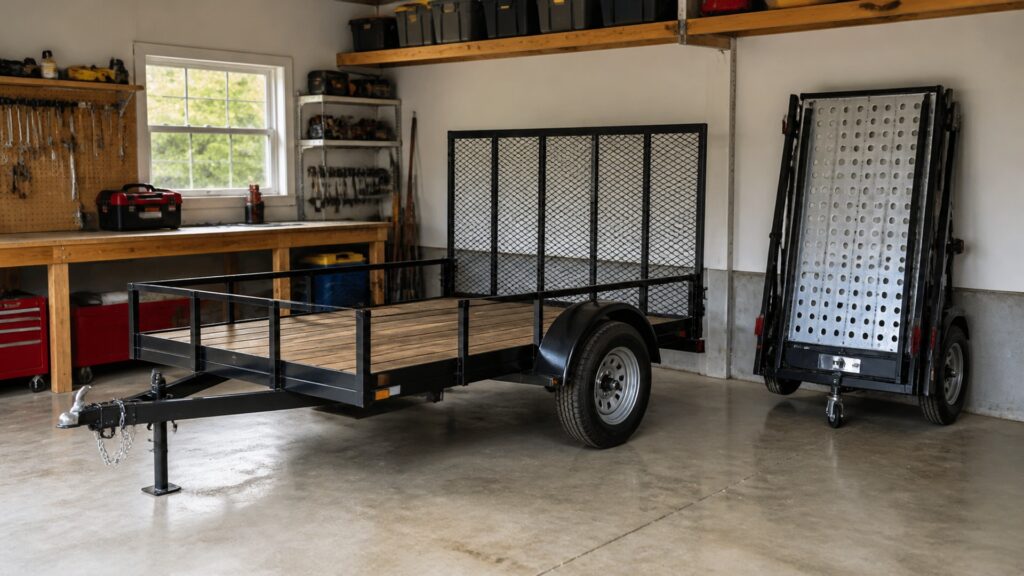
single axle utility trailers explainer hero image for Review Streets
What You'll Learn

Separate Axle Layout from Folding Features

Compare the trailer’s operating form with its storage arrangement.

  • Why single axle and foldable can describe one trailer
  • How folding decks, tongues, and rails differ
  • Why storage dimensions are not enough by themselves
  • What hinges and locking parts add to ownership
  • How to assess the deployed trailer for a real load

Tip: Ask what folds and which dimension it reduces before assuming the trailer will fit your storage space.

Definitions

Six Concepts Behind Folding-Trailer Design

These distinctions help turn a product label into a usable comparison.

Axle layout

Axle layout identifies the number and arrangement of axle assemblies beneath the trailer.

  • Example: one axle supporting a folding utility deck
  • Check: the exact running gear and ratings
  • Limit: axle count does not identify a storage mechanism

Folding feature

A folding feature lets a specified part move into another approved position.

  • Example: a deck section folding for storage
  • Check: which parts move and the approved positions
  • Limit: folding rails do not necessarily shorten the deck

Deployed configuration

The deployed configuration is the assembled position intended for the particular operating task.

  • Example: a deck and tongue secured for towing
  • Check: required locks, fasteners, and clearances
  • Limit: a storage position is not automatically a towing position

Storage envelope

The storage envelope is the space occupied by the trailer in its approved stored position.

  • Example: the footprint and height of an upright-stored trailer
  • Check: all projecting components and required support
  • Limit: a smaller footprint may require more height

Movement clearance

Movement clearance is the space needed as a folding part travels between positions.

  • Example: the sweep of a hinged deck section
  • Check: nearby walls, vehicles, people, and equipment
  • Limit: fitting in the final position does not prove it can be moved there

Locking hardware

Locking hardware holds movable parts in their specified positions.

  • Example: retaining pins securing a folding assembly
  • Check: condition and correct installation under the manual
  • Limit: a hinge alone does not establish that a part is secured

Tip: Measure the deployed trailer, the stored trailer, and the movement between them.

Classification

One Trailer Can Be Both Single-Axle and Foldable

A trailer’s axle arrangement supports its road wheels. Its folding feature changes the position of a deck, tongue, rail, or another designed component. These attributes can coexist. To make a useful comparison, identify a particular fixed configuration and a particular folding configuration rather than treating all single-axle trailers as fixed.

  • Identify the axle arrangement separately.
  • Name the component that folds.
  • Compare the complete trailer specifications.

A single-axle trailer with a folding deck still needs suitable tires, bearings, coupling, and load restraint. The storage feature does not replace those systems.

Mechanism

Different Folding Features Solve Different Problems

A folding deck may reduce the stored footprint; a folding tongue may reduce overall length; folding side rails may improve access without shortening the trailer. Some models support upright storage, while others do not. Use the product instructions to establish the actual benefit and its limits.

  • Check which dimensions change.
  • Distinguish access features from storage features.
  • Use only positions supported by the manufacturer.

Carry-On’s SmartFold supplement concerns moving rails and gate configurations. It is a useful example of why the word folding does not by itself mean the whole deck stands upright or occupies half its original floor area.

Reference: Carry-On SmartFold feature supplement.

Storage

Include Setup Space and the Route to the Storage Position

A trailer might fit against a garage wall once folded but lack room to fold there. Consider the door opening, ceiling height, movement of sections, and the path to the final position. Follow the model’s requirements for surface, supports, handling assistance, and securing the stored trailer. Do not improvise an upright storage arrangement for a design that does not permit it.

  • Measure the complete stored envelope.
  • Allow room for the folding movement.
  • Check the prescribed handling and storage support.

For example, reducing floor space can be useful in a shared garage, but the benefit disappears if the trailer cannot pass through the door or be safely moved into its approved stored position.

Travel

Assess the Trailer in Its Approved Operating Configuration

Folding capability says nothing by itself about allowable cargo mass or load placement. Check the deployed deck, coupling, axle, tires, ramp where fitted, and restraint provisions against the intended load. Confirm the required locks and fasteners are installed before towing. Added boards, boxes, or racks must remain compatible with the folding and operating instructions.

  • Use the exact trailer’s ratings.
  • Check movement and clearance after accessories are added.
  • Verify the required travel configuration.

A toolbox placed across a folding joint can prevent the intended storage movement. Removing or relocating hardware to force it to fold would create a new problem rather than validate the installation.

Reference: Utility-trailer owner instructions.

Ownership

Weigh Storage Savings Against Repeated Setup

Folding may make trailer ownership practical when parking space is limited. A fixed arrangement may be simpler when the trailer is used frequently and already has a suitable parking area. Compare the actual effort, assistance, hardware checks, and frequency of folding. Do not assume all folding designs are weak or all fixed designs are maintenance-free.

  • Try the approved setup process before relying on it.
  • Include hinge and locking-part inspections.
  • Consider how often storage conversion will be needed.

Kendon provides model-specific trailer manuals and instructions. Use the applicable instructions for the exact trailer rather than copying a folding sequence from a visually similar product.

Reference: Kendon trailer manuals and instructions.

Quick Reality Check

Compare Two Configurations, Not Two Opposing Categories

A folding design can have the same axle count as a fixed design.

Fixed arrangement may suit

Frequent use with an adequate permanent parking area.

Equipment that fits the supported deck without a storage conversion.

Folding arrangement may suit

Limited storage where the approved folded envelope fits.

Owners who can carry out the required handling and setup checks.

Common Myths

Misconceptions About Folding Utility Trailers

The exact folding feature matters more than its label.

A single-axle trailer cannot be foldable

Axle layout and folding construction are independent attributes.

Every folding trailer stores upright

Only use the storage positions permitted for that model.

Folding rails mean a folding deck

Rails may improve access while leaving deck dimensions unchanged.

If it fits when folded, storage is solved

Movement clearance, access, surface, support, and handling still need checking.

Tip: A storage feature is useful only when you can safely operate it in the available space.

FAQ

Questions About Single-Axle and Foldable Trailers

Answers for comparing storage and hauling needs.

Which type carries more?

Neither label settles capacity. Compare the exact trailers’ ratings and completed configurations.

Can a folding trailer stay assembled?

Follow its manual for permitted operating and storage positions and required maintenance.

Can accessories interfere with folding?

Yes. Decking, boxes, racks, and wiring must remain compatible with the specified movement and locking arrangements.

Is a folding tongue the same as a folding trailer deck?

No. It changes a different part of the trailer and may solve a different space constraint.

What should be measured before choosing?

The deployed dimensions, folded envelope, access route, and clearances needed throughout the folding movement.

Bottom Line

Single axle identifies running gear; foldable identifies a movable design feature. A trailer can be both.

Choose the exact arrangement that carries the load and can be operated, secured, and stored in your available space.

Next Steps

Go Deeper or Compare Your Options

Use these Review Streets paths to compare related categories and practical next decisions.