
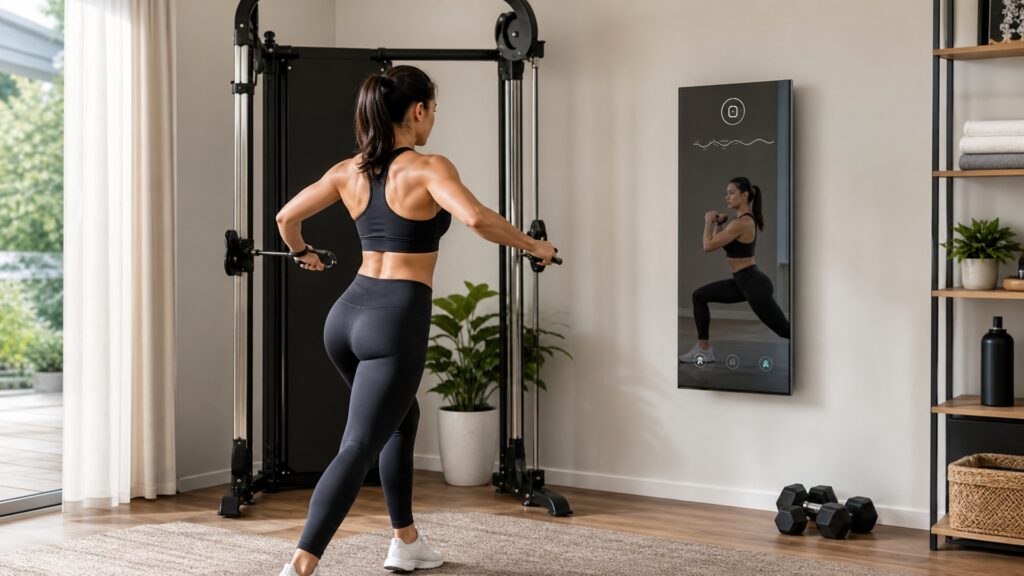
What Makes Smart Home Gyms Different from Smart Workout Mirrors

Smart home gyms and smart workout mirrors can overlap, but they solve different problems. A smart workout mirror is usually a display-centered coaching system that saves space and guides workouts visually. A smart home gym usually adds dedicated training hardware, resistance, attachments, or a broader station for strength and structured sessions.

The difference matters because a mirror can be excellent for instruction and space-saving guidance, while a smart home gym may be better when the workout needs built-in resistance, automatic tracking, or a fixed training station.

By: Review Streets Research Lab
Updated: September 23, 2026
Explainer · 8-12 min read
smart home gyms explainer hero image for Review Streets
What You'll Learn

How Smart Home Gyms And Workout Mirrors Differ

A practical comparison of display-first coaching and hardware-first home training systems.

  • Why smart workout mirrors are usually display-centered
  • How smart home gyms add dedicated hardware or resistance
  • Where space, cost, and exercise variety differ
  • When a mirror is enough for guided training
  • When a smart home gym solves a larger training need

Tip: Judge the system by how it changes real training decisions, not by how advanced the feature sounds.

Definitions

Key Concepts Behind Smart Home Gyms Different from Smart Workout Mirrors

These concepts clarify the practical signals readers should check before choosing home fitness technology.

Display-First Coaching

Display-first coaching uses a screen or mirror surface to show classes, demos, timers, and feedback.

  • Example: following a bodyweight class on a wall mirror
  • Check: see whether the instruction is easy to follow from the workout position
  • Limit: the display does not provide resistance by itself

Hardware-First Training

Hardware-first training uses built-in equipment, resistance, or attachments as part of the workout system.

  • Example: a cable-based strength station with guided sessions
  • Check: identify what physical training need the hardware solves
  • Limit: hardware takes more space and costs more

Resistance Source

Resistance source is where the workout load comes from.

  • Example: dumbbells for a mirror workout or digital resistance in a smart gym
  • Check: confirm whether resistance is included or separate
  • Limit: separate equipment changes the total cost and setup

Space Profile

Space profile is how much room the system needs when installed and during exercise.

  • Example: a wall mirror needing floor space in front of it
  • Check: measure the workout area, not just the device
  • Limit: both options need movement clearance

Training Scope

Training scope is the range of workouts the system can support well.

  • Example: classes and mobility on a mirror versus guided strength on a smart gym
  • Check: review a full week of sessions
  • Limit: marketing categories can blur real limits

Platform Dependence

Platform dependence is how much value depends on the subscription, app, or content library.

  • Example: a mirror losing live classes after cancellation
  • Check: review what works without the subscription
  • Limit: service changes can affect long-term value

Tip: A strong feature should make workouts easier to perform, repeat, or evaluate without hiding important limits.

Core Difference

Mirrors Lead With Instruction

A smart workout mirror is built around seeing the instructor, workout flow, and sometimes the user's reflection. It is strongest when visual guidance and a compact wall-mounted setup are the main needs.

  • Instruction is the central feature.
  • The mirror may pair with separate equipment.
  • Space-saving design can be a major advantage.

A mirror is often a coaching surface first.

Hardware

Smart Home Gyms Add A Training Station

A smart home gym usually tries to provide more of the physical workout system. It may include resistance, cables, accessories, a bench, sensors, or other hardware that shapes the exercises.

  • Built-in resistance can reduce equipment shopping.
  • The station may guide strength sessions more directly.
  • The setup is usually a larger commitment.

The hardware should solve a real training need.

Space

Compact Does Not Mean Identical

Both options can fit at home, but they use space differently. A mirror may have a slimmer footprint, while a smart home gym may need more clearance for cables, benches, handles, and accessories.

  • Measure the device and the workout zone.
  • Think about accessory storage.
  • Check whether the room supports the movements shown.

The usable space matters more than the mounted depth.

Training Fit

Choose Based On The Missing Piece

A mirror makes sense when the user mostly needs instruction, classes, accountability, and a clear display. A smart home gym makes sense when the missing piece is resistance, hardware, or a more complete station.

  • Choose a mirror for visual coaching and space savings.
  • Choose a smart home gym for integrated resistance or hardware.
  • Avoid paying for hardware that does not change the workout.

The better option is the one that removes the real barrier.

Long-Term Value

The Subscription Can Define Both Systems

Both categories can depend heavily on software, classes, programs, and tracking. The purchase price is only part of the decision.

  • Review monthly costs.
  • Check what works without the service.
  • Look for programs you would repeat, not just try once.

The platform has to remain useful after the novelty fades.

Quick Reality Check

Where Each System Fits Best

The categories overlap, but the expected training role is different.

Smart Home Gyms Fit When

Built-in resistance or dedicated hardware would improve the routine.

The user wants a central training station at home.

Smart Workout Mirrors Fit When

Visual coaching and space-saving design are the main needs.

The user already has equipment or prefers bodyweight and light accessory workouts.

Common Myths

Misconceptions About Smart Home Gyms And Mirrors

A mirror and a smart home gym are not always substitutes.

A mirror is just a cheaper smart home gym

It may be a better fit for coaching, but it does not always include training hardware.

Smart home gyms always include a mirror

Some do, but many are built around resistance systems, screens, or compact stations.

The smaller device is always easier to use

A compact device still needs space, accessories, and a routine.

Both systems offer the same workouts

Workout scope depends on resistance, movement space, and the platform.

Tip: Treat strong claims as reasons to inspect the system more closely, not as final proof.

FAQ

Frequently Asked Questions About Smart Home Gyms Versus Workout Mirrors

Short answers for practical buying and training decisions.

What is the main difference?

A smart workout mirror usually leads with visual coaching, while a smart home gym usually adds more dedicated training hardware.

Can a mirror replace a smart home gym?

It can if instruction is the main need and the user already has enough equipment.

When is a smart home gym better?

It is better when built-in resistance, automatic tracking, or a fixed training station would improve consistency.

Which takes less space?

A mirror often has a slimmer device footprint, but both need clear workout space.

What is the practical takeaway?

Choose the mirror for display-centered coaching and the smart home gym for hardware-supported training.

Bottom Line

Smart home gyms usually differ from smart workout mirrors by adding more dedicated hardware, resistance, or training-station structure.

Mirrors are strongest for compact visual coaching, while smart home gyms are strongest when the equipment itself changes the workout.

Next Steps

Go Deeper or Compare Your Options

Use these Review Streets paths to compare related categories and practical next decisions.