
Intrusion Input
A switch, motion, tilt, impact, glass, or other observation evaluated while a protected boundary is armed.
- Physical events vary
- Sensitivity needs context
- Inputs may be supervised
Vehicle security systems and car audio systems may share a dashboard, battery, network, speaker, or phone connection, but they create different outcomes. Security electronics interpret access, movement, credentials, and armed state to decide whether to deter, notify, immobilize, or permit recovery. Their main product is controlled authorization and event response.
Car audio begins with a chosen program source such as radio, storage, streaming, calls, or prompts. It decodes, processes, amplifies, and reproduces sound for occupants. A security warning can pass through the audio chain, yet the receiver and speakers do not become intrusion sensors. Shared interfaces require coordination while the two systems retain separate evidence, failure modes, and acceptance tests.
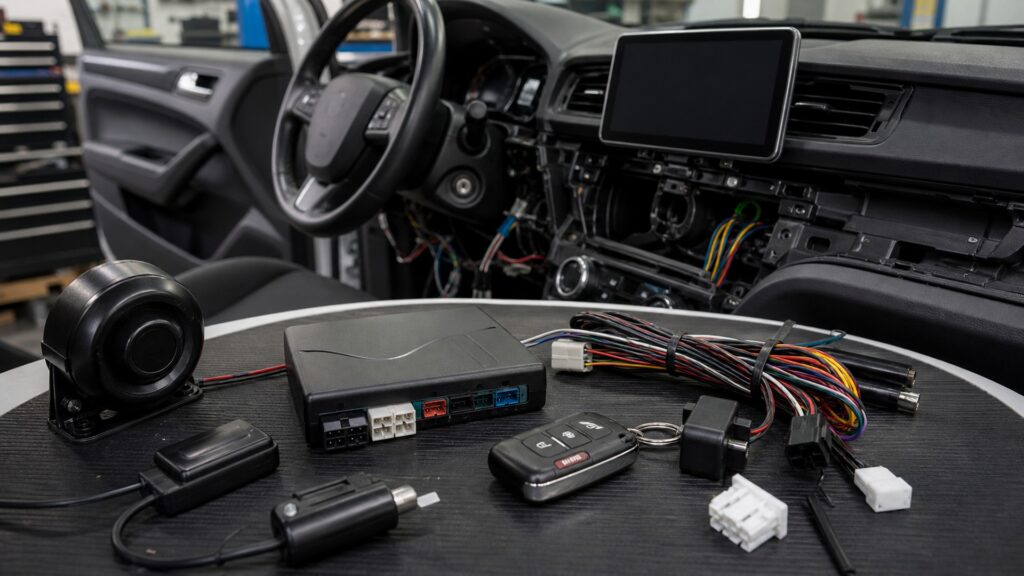
The comparison follows sensing, decisions, response, media processing, shared resources, and proof.
Tip: Trace a sound backward: security meaning originates in an event decision, while program sound originates in a selected source.
These definitions mark the boundary between protected-state information and cabin audio production.
A switch, motion, tilt, impact, glass, or other observation evaluated while a protected boundary is armed.
A recognized key, fob, phone, card, or code allowed to change access or starting state.
The controller result produced after combining armed state, sensor information, timing, exclusions, and configured rules.
Music, speech, calls, broadcasts, or stored content intentionally selected for playback through an audio system.
The audio path from source and decoding through processing, amplification, wiring, and loudspeaker output.
Power, ground, data, or control wiring used by more than one subsystem and capable of carrying interaction or failure effects.
Tip: Assign every input, decision, and output to its owning system.
Door switches, credentials, impact sensors, or tilt observations describe vehicle state. Audio sources deliver intended electrical or digital programs. The similarity of wires or connectors does not make those inputs interchangeable.
The input determines what each system can truthfully report.
A security controller checks armed state, credentials, delays, zones, and exclusions before responding. An audio processor selects sources, adjusts level and frequency balance, mixes prompts, and routes channels without deciding who may enter.
Both systems process information, but their decision questions are unrelated.
Sirens, flashing lamps, remote notices, or start denial respond to security decisions. Music and speech quality depend on clean amplification and speaker behavior. A shared speaker reproduces a message but does not validate its cause.
One audible result cannot prove two upstream systems.
A weak supply may reset both systems; a ground path can add audio noise; an integration module may keep the network awake; and alarm ducking may interrupt calls. Isolation reveals whether the common resource or one controller failed.
Shared symptoms deserve a shared-dependency test before component replacement.
Security testing covers arming, zones, credentials, alarm timing, start authorization, notification, faults, and recovery. Audio testing covers every source, channel, control, call, prompt, noise condition, startup, and shutdown.
Integration passes only after both original purposes work alone and together.
Routing a warning through vehicle speakers changes presentation and priority, not the sensor evidence or controller rule that produced the event.
Managed ducking can make a verified warning intelligible while restoring normal playback afterward.
A supported vehicle interface can coordinate power state without copying authorization decisions into the receiver.
An amplifier cannot detect an open door or authenticate a key.
A security controller cannot correct source quality, speaker distortion, or cabin frequency response.
These myths confuse a shared sound, wire, or screen with shared system ownership.
A siren or spoken warning is only its presentation layer. Security begins with armed state, credentials, sensors, timing, and authorization rules, none of which a receiver, amplifier, or speaker can create from ordinary program audio.
Speakers can change warning clarity and level after a decision, but they cannot improve door-switch coverage, impact discrimination, tilt sensing, credential validation, network supervision, or notification delivery. Detection reliability must be tested before audio reproduction.
Ducking confirms that some trigger reached the audio interface. A test command, nuisance sensor, wiring fault, software error, or real intrusion may invoke identical muting, so event validity requires controller and zone evidence.
Both can share constant power, ground, network wakeups, wireless links, and accessory modules. A failure in either installation may prevent vehicle sleep, while a weak battery can reset both and create misleading paired symptoms.
Tip: Locate the first stage that creates the missing information.
These answers clarify which system owns a complaint and how to test their shared boundaries.
Start with vehicle security because it owns arming, credentials, intrusion inputs, alarm decisions, immobilization, notification, and recovery. Audio equipment may reproduce a warning, but it cannot establish or enforce the protected access state.
Evaluate the car audio chain from source format and decoding through processing, gain structure, amplification, speaker installation, and cabin response. Security electronics neither generate program fidelity nor repair a weak or distorted playback channel.
A supported interface may route tones or speech through the audio system. Verify delay, volume, channel coverage, media ducking, calls, required vehicle warnings, reconnection, and a local fallback if the shared path becomes unavailable.
Battery weakness, voltage drop, poor ground, overloaded wiring, an unstable adapter, network wakeups, or a protection-device problem can affect both. Record supply behavior and isolate shared connections before replacing either security or audio hardware.
Demonstrate every security state and response first, then every audio source and channel. Finally combine alarms, calls, prompts, startup, shutdown, sleep, low voltage, reconnection, and service mode while checking for lost functions or noise.
Vehicle security systems differ from car audio systems because they manage protected state and authorization, while audio systems reproduce selected sound. Speakers, power, or networks create interfaces rather than equivalence.
Diagnose each chain from its own input, then test shared resources under transitions and parked sleep. A complete installation proves security response and listening performance separately before it proves coexistence.
These explainers show how each chain creates its result and where shared interfaces can change behavior.
Follow security state from arming and credentials through sensing, response, and authorized recovery.
Follow media selection, processing, amplification, speakers, and cabin output.
Observe arm, disarm, trigger, alarm, notification, and recovery states during integration.
Choose a retailer
Prices checked regularly. We may earn a commission at no cost to you.