
Disarmed State
The normal access condition in which protected-zone events do not produce the configured intrusion response.
- Starting may be authorized
- Status should be clear
- Some monitoring can remain
A vehicle security system is easiest to trust when its operation can be described as a state machine. Disarmed, pre-armed, armed, entry delay, triggered, alarming, immobilized, service, fault, and recovery states each permit different inputs and outputs. Without that map, identical lights or sounds can be interpreted incorrectly.
Operating function matters most at transitions. A door may remain open during an exit delay, a credential may authorize disarm before an alarm, or a weak battery may interrupt notification while the local siren continues. The controller should expose what state it entered, why it changed, what response it commanded, and how an authorized user returns the vehicle to normal.
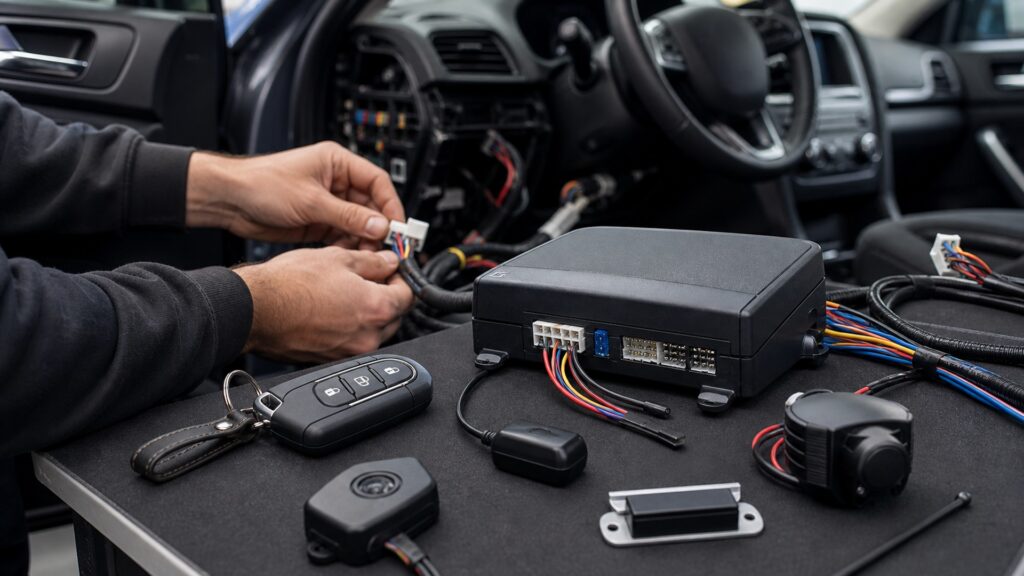
The operating contract covers arming, credentials, zones, timing, response layers, faults, and reset.
Tip: Name the present state before interpreting a sensor, alarm, start denial, or notification.
These definitions make security transitions observable instead of mysterious.
The normal access condition in which protected-zone events do not produce the configured intrusion response.
The protective condition entered after required closures, credentials, delays, and controller checks are satisfied.
A bounded interval allowing an authorized disarm action after a monitored opening before full alarm response begins.
A sensor or authorization observation that satisfies configured rules for changing the controller toward an alarm or denial response.
The controller-managed period for siren, lamps, messages, or other responses, including duration, repetition, and stop conditions.
The authorized sequence restoring access, starting, credentials, settings, and normal monitoring after an alarm, fault, power loss, or service event.
Tip: Record the entry condition, allowed events, visible output, and exit condition for each state.
The controller checks doors, hood, trunk, sensor readiness, selected profile, credential command, and exit timing. An open or failed zone may delay arming, create a bypassed zone, or prevent full coverage.
Arming is a verified transition, not merely a button press.
Keys, fobs, phones, cards, or codes can request unlock, disarm, or start. The controller must distinguish valid, revoked, absent, low-battery, and communication-failed credentials while preserving documented emergency access.
Authorization succeeds only when valid users enter and invalid requests remain denied.
A switch change, impact, tilt, or motion report is contextualized by armed state and configured rules. Warning stages, entry delays, sensor confirmation, or temporary exclusions may prevent immediate full response.
A sensor observation becomes a trigger only through controller policy.
The controller may sound a siren, flash lamps, deny starting, store history, or send a remote message. Cellular coverage, output wiring, server availability, and vehicle voltage create distinct delivery paths.
No single response proves every protective layer completed.
The system should identify unavailable zones or credentials, limit behavior predictably, preserve safety, and provide an authorized reset. After power restoration or service, settings, users, history, and starting must be checked.
Recovery is an operating state because parked vehicles routinely face weak batteries, service, and lost connectivity.
No alarm can reflect no event, a disarmed system, an excluded zone, entry timing, a disabled output, lost connectivity, weak power, or controller failure.
Distinct indicators identify armed status, zone faults, entry timing, alarm history, service mode, and credential problems.
Separate delivery confirmations show whether local and remote responses reached their destinations.
A clear panel cannot guarantee every physical boundary or radio path is intact.
One successful event does not reproduce all temperatures, parking durations, network conditions, or attack methods.
These myths turn a single light, sound, or start result into proof of the whole state machine.
A lamp may confirm a lock command without proving every zone is closed, sensors are ready, the alarm controller entered armed state, immobilization is active, or remote notification is available. Check the dedicated status evidence.
Controllers may apply warning stages, entry delay, confirmation, zone exclusions, sensitivity rules, or event counts. Immediate full response is not always intended, and indiscriminate triggering can increase nuisance alarms without improving protection.
The message and local output travel through different paths. A server can report an event while a siren circuit fails, or the siren can operate where cellular delivery is delayed. Verify both outcomes separately.
Disarm ends the protected response but may leave a failed zone, low-battery warning, tamper record, revoked credential, communication fault, or stored event. Review status and restore normal coverage before relying on the next arm cycle.
Tip: Test transitions and response channels independently.
These answers define practical checks for normal operation, degraded states, and authorized return to service.
Confirm the intended profile, closed or explicitly bypassed zones, sensor readiness, credential command, completed exit delay, armed indicator, notification connection where used, and absence of unresolved battery, network, or output faults.
Use an authorized test plan, arm the system, open only the designated delayed zone, observe the distinct warning and countdown, disarm with a valid credential, and confirm no other zone incorrectly inherits that delay.
Useful history identifies time, armed state, initiating zone or event class, warning or full response, output commands, notification status, power or communication faults, and the credential or procedure that ended the cycle.
Local sensing and configured local responses should follow documented fallback rather than silently pretending remote delivery succeeded. The system should expose connection loss, queue or discard behavior, reconnection, and any gaps in event history.
Verify authorized entry, disarm, valid credentials, starting, sensor readiness, cleared service mode, restored communications, retained configuration, event history, sleep state, and a complete arm-trigger-response-disarm sequence after the original fault is corrected.
Vehicle-security operating function matters because protection depends on controlled state transitions, not on isolated features. Arming, credentials, zones, responses, faults, and recovery stay distinguishable.
Create a state table for the installed vehicle and test one transition at a time. Reliable operation makes both action and silence explainable while retaining a lawful, authorized path back to normal use.
These explainers locate each state in the security chain and preserve the evidence needed to detect drift.
Locate arming, authentication, sensors, decisions, outputs, immobilization, notification, and recovery in the complete mechanism.
Verify vehicle architecture, sensor placement, outputs, parked power, credentials, and service access.
Preserve credentials, sensors, power, software, communications, event records, and recovery procedures over time.
Choose a retailer
Prices checked regularly. We may earn a commission at no cost to you.