
Key Control
Governance of key blanks, cutting, issuance, duplication, return, inventory, and rekeying.
- Blank: limits copying
- Record: assigns custody
- Rekey: removes old authority
Traditional keys and electronic access systems both control openings, but they authorize differently. A key grants whoever possesses the correctly cut object the ability to operate a cylinder. Electronic access associates a credential with an identity and asks a controller to evaluate the door, time, role, schedule, and current system state.
Use electronic control when people change frequently, zones require different permissions, lost credentials must be revoked quickly, doors need monitoring, or event records support investigation. Use controlled keys where openings are few, access rarely changes, connectivity and power add disproportionate complexity, and audit evidence is unnecessary. Many sites need both: electronic control for active business portals and managed mechanical override or isolated low-risk spaces.
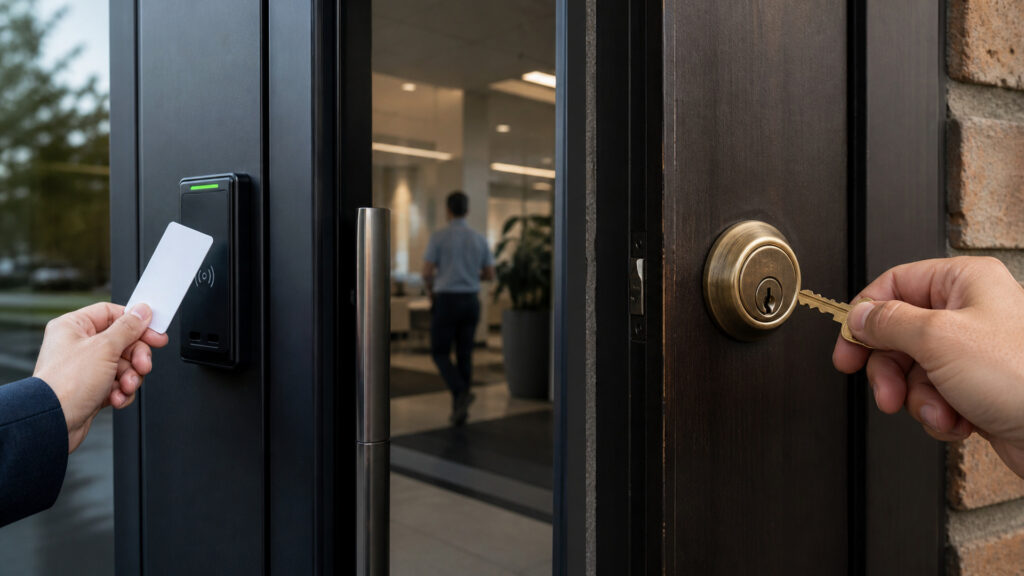
Compare possession, identity, rekeying, schedules, door state, egress, offline behavior, evidence, lifecycle, and cost.
Tip: Inventory every opening, authorized population, turnover rate, lost-key scenario, rekey scope, schedule, monitoring need, egress rule, offline state, override path, and evidence requirement.
These terms describe mechanical authority, electronic identity, revocation, and door-state control.
Governance of key blanks, cutting, issuance, duplication, return, inventory, and rekeying.
The physical profile and pinning system determining which keys operate compatible cylinders.
Issuance, activation, change, suspension, replacement, expiration, and revocation of electronic access evidence.
The component evaluating credential and door policy and commanding lock hardware.
A controller's local authorization behavior while disconnected from central management.
A key-operated method for authorized entry when electronic mechanisms are unavailable.
Tip: Treat master keys and mechanical overrides as broad privileges: restrict creation and custody, record use where possible, and rekey when control is uncertain.
Keys confer capability through possession; electronic credentials request a policy decision associated with an identity. Neither proves the presenter is the intended person without additional verification. A key cylinder and keyway control define mechanical authority, while an access schedule and credential revocation define electronic authority after a lost key or changed role.
Electronic systems fit when authorization must vary by person, place, time, or current risk.
A lost master key can require many cylinders and copies to change, while a credential can be disabled centrally. Electronic revocation still fails if offline controllers retain stale policy or administrators delay action.
Frequent change makes identity-based revocation more valuable than repeated mechanical replacement.
Readers, controllers, request-to-exit devices, and contacts can distinguish grants, denials, openings, held doors, forced doors, and faults. Mechanical keys usually leave no native event record.
Choose electronic control when knowing the physical outcome and responding to exceptions materially reduces risk.
Controllers, readers, locks, batteries, fire interfaces, networks, and software can fail. Door hardware must preserve required egress and defined fail-safe or fail-secure behavior.
Electronic control is appropriate only when its emergency and offline states are intentionally engineered.
Active entrances, sensitive zones, shared facilities, and high turnover favor electronic control. Low-risk closets, remote simple sites, and rarely changing custody may favor controlled keys.
The best design assigns each opening the least complex control that satisfies authorization, revocation, evidence, and safety needs.
Neither option is universally superior across every opening and failure state.
It supports changing identities, schedules, rapid revocation, central visibility, and door alarms.
Permissions can be narrower than a master-key hierarchy.
Simple isolated openings can avoid power, network, controller, software, and credential operations.
Key custody and rekey exposure must remain genuinely manageable.
These assumptions overstate identity proof, reliability, cost, and the disappearance of mechanical controls.
Cards, mobile tokens, PINs, and accounts can be lent, cloned, stolen, relayed, or misissued depending on technology. Stronger factors, secure enrollment, anti-passback, video, guards, and response may be needed. today today today today
Keys avoid electrical dependence, but doors, cylinders, panic hardware, master-key custody, damaged locks, fire conditions, and inaccessible keyholders can still fail. Outage simplicity does not equal complete emergency readiness. either either either either
Mechanical overrides, legacy doors, tenant changes, compromised cylinders, and construction keys can still require rekeying. Electronic credentials reduce many revocation costs but introduce controllers, licenses, batteries, readers, software, and lifecycle replacements.
Installing electronics on low-risk, rarely changed openings can add disproportionate cost and failure complexity. Use risk, population, change frequency, evidence need, emergency behavior, and operating capacity to choose each portal.
Tip: Compare each opening by authority, revocation, evidence, safety, offline behavior, maintenance, and failure consequence rather than applying one technology sitewide.
These questions clarify cost, offline operation, overrides, migration, and fit.
Value rises with many users, frequent turnover, several permission groups, costly rekeying, after-hours schedules, remote administration, door alarms, and investigative needs. Compare installation, licenses, maintenance, staffing, batteries, and lifecycle across years.
Many controllers use cached local policy, but new credentials, revocations, mobile validation, central monitoring, and administration may degrade. Test each door's exact network-loss, power-loss, fire-alarm, battery, and resynchronization behavior. afterward afterward afterward afterward
Some openings need mechanical override for service or emergency access, while others avoid it because it bypasses logging and policy. Qualified life-safety, security, operational, and code review should determine each door's design.
Prioritize high-change and high-consequence portals, preserve safe coexistence, issue governed credentials, control master keys, document overrides, test emergencies, monitor adoption, retire bypasses, and update procedures before expanding to additional doors.
They can fit a small number of low-risk openings with stable authorized users, controlled duplication, affordable rekeying, no scheduling or monitoring need, clear custody, and reliable emergency access under the site's physical design.
Use access control systems when identity-specific permissions, changing schedules, rapid revocation, door-state monitoring, and event evidence materially improve control over active openings.
Use traditional keys where stable custody and simple mechanics meet the actual risk. Hybrid designs succeed only when overrides and mechanical paths remain governed rather than becoming invisible bypasses.
These explainers deepen electronic door control, event records, and the larger detection-response system around each opening.
Trace credentials, readers, controllers, locks, door state, revocation, and egress.
Understand event provenance, time, integrity, access, retention, and investigation.
Place doors inside detection, assessment, monitoring, and response.
Choose a retailer
Prices checked regularly. We may earn a commission at no cost to you.