
Access Credential
Evidence presented to request physical entry, such as a card, mobile token, PIN, or biometric template.
- Association: links to identity
- Factor: proves possession or trait
- Lifecycle: issues and revokes
Access control matters because a mechanical key grants whoever holds it the same fixed capability until the lock changes. Electronic access control can associate entry with a governed identity, credential, door, schedule, role, and current authorization, then revoke that capability without replacing every lock.
The mechanism reaches beyond a badge reader. A controller evaluates credential data and policy; lock hardware changes the physical state; door contacts report whether the opening actually closed; request-to-exit devices preserve safe departure; and logs record grants, denials, forced doors, held doors, tamper, and administrator changes. Its value is narrower access, faster revocation, observable exceptions, and coordinated response. It does not prevent credential sharing, tailgating, weak doors, insider misuse, or unsafe design by itself.
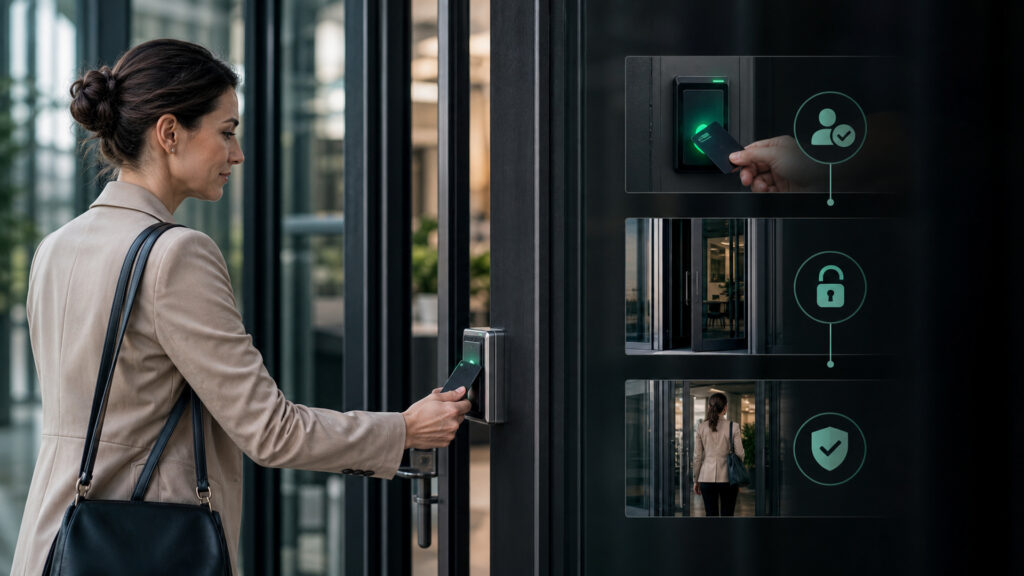
Follow identity proofing, credential issuance, reader presentation, controller policy, lock action, door state, safe egress, events, revocation, review, and response.
Tip: Trace one employee, visitor, contractor, and emergency responder from identity proofing through credential issuance, each permitted door, after-hours use, lost credential, departure, event review, and final revocation.
These terms describe the identity, credential, decision, lock, sensing, and exception mechanisms behind controlled entry.
Evidence presented to request physical entry, such as a card, mobile token, PIN, or biometric template.
A device that captures credential data and sends it to a controller or service.
The decision component evaluating credential, door, schedule, role, and system state.
Electrified hardware controlling whether a compatible latch can pass through the frame.
A sensor reporting whether a door is physically open or closed.
A device or signal permitting safe egress and coordinating door-state monitoring.
Tip: A controller's grant proves policy authorized the request. Door sensors, video, anti-tailgating design, and procedures are needed to learn whether the door opened, closed, or admitted additional people.
HR, contractor, visitor, tenant, and service processes establish identity, sponsor, role, dates, training, and approvals. Credentials represent that authorization and must expire or revoke when circumstances change.
Access control matters because authorization can follow an accountable lifecycle instead of an indefinitely copied physical key.
The reader captures evidence; the controller checks policy locally or through a service; an output powers or releases the lock; and door hardware must still latch, align, resist force, and support code-compliant egress.
Digital authorization becomes security only when reliable mechanical hardware produces the intended physical boundary.
Rules can limit doors, times, holidays, occupancy, escort, two-person access, and anti-passback. Position and latch sensors distinguish a denied attempt, authorized opening, held door, forced entry, or door that never secured.
Door-state evidence exposes failures that a simple list of granted badges would miss.
Fire alarms, emergency releases, power loss, lockdown, first responders, accessibility, deliveries, visitors, lost cards, and after-hours work require explicit behavior. Security and life safety must be coordinated by qualified design.
A secure door that traps occupants or confuses responders is a failed system, regardless of access policy.
Access grants, denials, door alarms, credential changes, administrator actions, and system faults support investigation and recertification. Context from video, visitor records, schedules, and supervisors helps interpret events.
Access matters over time when events lead to timely response and permissions remain aligned with current business need.
Credentials and controllers narrow and record entry while physical, social, and procedural risks remain.
It enables identity-based permission, schedules, rapid revocation, zone-specific control, door alarms, centralized review, and integration with response.
Exceptions become visible and attributable.
Tailgating, credential lending, coercion, weak construction, open exits, insider misuse, and propped doors need physical design, video, staffing, culture, and response.
Identity proofing remains essential.
These claims confuse credentials, grants, electronic locks, and logs with verified identity or complete physical security.
A badge proves possession of a credential unless another factor or human verification is used. Cards can be lent, copied, stolen, or misissued, so critical access may require PINs, biometrics, guards, or contextual review.
A controller decides whether to release a door for one request; it may not know how many people pass. Turnstiles, vestibules, sensors, video, guards, awareness, and response are needed where tailgating risk matters.
Fail-safe hardware unlocks when power is removed, supporting selected egress or fire strategies but potentially reducing security. Fail-secure hardware stays locked from the secured side. Code, door function, risk, and emergency behavior determine selection.
Logs show credential and door events, not necessarily the human present or every person crossing. Tailgating, shared credentials, open doors, mechanical keys, exits, synchronization errors, and offline controllers limit conclusions without supporting context.
Tip: Separate five facts: credential presented, controller granted, lock released, door opened, and a specific person crossed. Each needs different evidence and can fail independently.
These questions explain credentials, offline behavior, revocation, door alarms, biometrics, and reviews.
Options include cards, fobs, mobile credentials, PINs, biometrics, vehicle tags, temporary codes, and combinations. Choose by risk, identity assurance, privacy, accessibility, environmental conditions, lifecycle, interoperability, revocation speed, and user population.
Controllers often make cached local decisions, but enrollment, central changes, monitoring, mobile credentials, identity checks, or cloud administration may degrade. Test each door's exact offline, power-loss, fire-alarm, and reconnection behavior.
Immediately after credible report or detection, with identity verification for replacement. Review recent events, notify security where risk warrants, invalidate related mobile or physical credentials, document the action, and avoid reusing compromised identifiers.
Use them when stronger association justifies privacy, consent, accuracy, accessibility, spoofing, hygiene, retention, breach, and fallback risks. Evaluate false acceptance and rejection in the actual population and environment, not vendor averages alone.
Continuously update joiner, mover, leaver, visitor, and contractor events, plus periodic risk-based recertification by accountable owners. Prioritize critical zones, broad roles, dormant credentials, exceptions, shared access, unusual activity, and expired sponsorship.
Access control matters because it converts physical entry into a governed decision linking identity, credential, door, time, role, and current authorization. It can revoke access quickly, expose door exceptions, and preserve reviewable events.
Its effectiveness depends on reliable mechanical boundaries, safe egress, protected controllers, supervised door state, disciplined identity lifecycle, privacy-aware logs, and response to forced, held, shared, or misused access.
These explainers place credentialed entry inside the full detection-response chain and show how video can verify door events without replacing authorization.
Understand how access, intrusion, video, alarms, monitoring, response, and evidence form one chain.
See how scene design, recording, verification, and evidence reduce ambiguity.
Map power, network, platform, facility, supplier, and recovery dependencies.
Choose a retailer
Prices checked regularly. We may earn a commission at no cost to you.