
Upstream Requirement
A need involving source access, user control, decoding, navigation, calls, or available receiver outputs.
- The dashboard unit often owns it
- It can be tested before speakers
- It may include retained interfaces
Use a head-unit scope when the missing outcome sits upstream: an unsupported source, poor control layout, absent phone projection, unavailable preamp routing, or a receiver-hosted vehicle function. In that case, the amplifiers, wiring, speakers, enclosures, and cabin behavior may already meet the requirement.
Use a broader car-audio-system scope when the measured limit remains after a clean source leaves the receiver. Insufficient amplifier headroom, unsuitable speaker loads, damaged drivers, weak mounting, missing bass extension, or severe acoustic imbalance cannot be corrected by a dashboard interface alone. The decision follows the first failed boundary, not the most visible component.
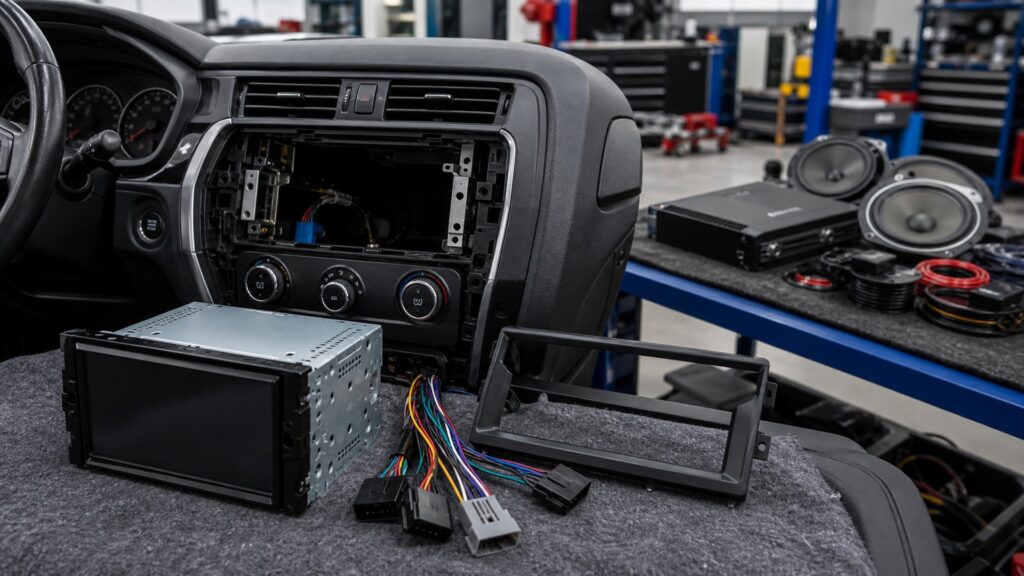
The useful decision separates source and control needs from downstream power, transducer, mounting, and acoustic needs.
Tip: Write one observable requirement, then trace backward from the listener or user until the first stage incapable of meeting it appears.
These concepts turn a vague upgrade idea into a bounded engineering decision.
A need involving source access, user control, decoding, navigation, calls, or available receiver outputs.
The combined ability of processors, amplifiers, wiring, speakers, mounting, and acoustics after the receiver output.
The earliest measured or reproduced stage that prevents the required outcome.
A low-level receiver output that supplies an external processor or amplifier without directly driving a passive speaker.
The set of factory warnings, controls, cameras, amplifiers, settings, antennas, and network functions affected by receiver replacement.
The point at which tests can prove the selected project delivered its stated outcome without creating failures elsewhere.
Tip: Do not start with a component name; start with the unmet behavior and locate its first controlling stage.
A receiver-focused project fits when the decisive gap is radio reception, supported media, phone integration, calls, navigation interaction, camera display, control layout, or an output format. Those are upstream functions the head unit directly acquires or coordinates.
If the desired result ends at a receiver connector or interface, narrow scope may be sufficient.
Before limiting work to the head unit, test the existing amplifier channels, speakers, polarity, mounting, noise floor, and useful output with a known clean source. A failing door speaker or overloaded factory amplifier remains after an interface change.
Receiver scope is defensible only when the rest of the chain passes the relevant baseline.
A suitable preamp channel, remote command, processing path, or digital interface can establish a clean handoff for future amplification. That capability is useful, but it does not supply the downstream power, speaker suitability, enclosure, or tuning by itself.
Preparation is a valid receiver outcome as long as it is not described as finished system performance.
A receiver may share data with a factory amplifier, chimes, steering controls, cameras, climate functions, antennas, or configuration menus. If replacement cannot retain the required set, preserving the original receiver and working downstream may be the narrower system choice.
Physical dash size never settles the integration decision on its own.
When the bottleneck is clean acoustic output, current delivery, thermal shutdown, speaker damage, impedance, crossover coverage, low-frequency extension, mounting leakage, or seat-to-seat response, the solution crosses beyond the receiver boundary.
Escalate only as far as the proven downstream constraint requires.
A head-unit project can solve upstream functions cleanly when the remaining chain is healthy; it cannot substitute for power, speakers, mounting, or acoustics.
The requirement is source, interface, control, decoding, or output availability, and the downstream baseline already passes.
All affected factory functions can be retained and the result has an observable acceptance test.
The complaint begins after the receiver output or depends on amplifier, wiring, transducer, enclosure, power, or cabin behavior.
Factory integration can make receiver replacement broader than retaining it and changing a downstream stage.
These myths confuse component visibility with causal control of the desired outcome.
It may improve sources, controls, processing, or output options, but it cannot repair damaged speakers, increase an external amplifier's clean capability, seal a door cavity, correct polarity, or overcome all cabin noise and acoustic cancellation.
A system view means considering every relevant stage, not automatically changing each one. Tests may identify one downstream bottleneck while existing receiver, wiring, other channels, and speakers remain suitable for their assigned roles.
Some combinations can be integrated through supported analog, digital, or data interfaces. Others impose limits or lost functions. The answer depends on the exact vehicle option, signals, controls, and interface documentation rather than amplifier presence alone.
Preouts only create low-level handoffs. External amplification, power wiring, speaker loads, crossover assignments, enclosures, installation, and calibration determine what happens afterward, so an output count is not an end-to-end result.
Tip: Follow the failed handoff; do not assume the dashboard is responsible because it is easy to see.
These answers locate source, sound, integration, and expansion needs on the correct side of the receiver boundary.
When projection is the primary unmet requirement, the exact phone and receiver combination is supported, required controls and microphones can be retained, and the current downstream audio path already performs acceptably with a known source.
First determine whether the receiver is filtering, clipping, or missing the required output. If its signal is clean, bass limitations more often involve amplification, speaker excursion, enclosure loading, polarity, cancellation, or cabin noise beyond receiver-only scope.
Only if the receiver or its immediate wiring is the source. Noise can enter through grounds, charging systems, signal cables, amplifiers, accessories, or antenna paths, so isolate the first contaminated boundary before selecting a component.
The required source or control works; every intended output is clean; calls, cameras, steering controls, warnings, and retained settings behave; existing channels remain correct; and startup, cranking, delayed shutdown, and sleep create no new fault.
Plan both when separate upstream and downstream requirements are proven, such as new source control plus insufficient amplifier or speaker capability. Define each boundary, sequence the interfaces, and keep acceptance criteria distinct for every stage.
Use a car stereo head unit instead of a full car-audio-system project when the unmet outcome is upstream and the downstream chain is proven healthy.
Choose wider scope when power, loads, transducers, mounting, or cabin behavior controls the result. The smallest honest project reaches the first failed boundary and preserves everything already passing.
These explainers show receiver mechanics, complete-system behavior, and the reciprocal decision for projects whose bottleneck is already downstream.
See which source, command, and output functions the receiver directly owns.
Follow the signal and power chain through amplification, speakers, mounting, and cabin acoustics.
Evaluate the reverse choice when power, transducers, bass, or acoustic output is the proven need.
Choose a retailer
Prices checked regularly. We may earn a commission at no cost to you.