
Seated Pedaling
A bike position where the rider turns pedals from a saddle.
- It reduces the need to stand.
- It makes saddle fit central.
- It keeps movement around the crank.
Use an exercise bike instead of an elliptical when the advantage is seated, repeatable crank cadence. The bike is the better answer when the reader wants the machine to narrow the task to pedaling rather than standing stride, handle timing, and larger whole-body coordination.
That does not make the elliptical inferior. It means the bike fits a different decision: stable seated position, compact pacing, clear cadence control, and less dependence on matching arm and leg motion.
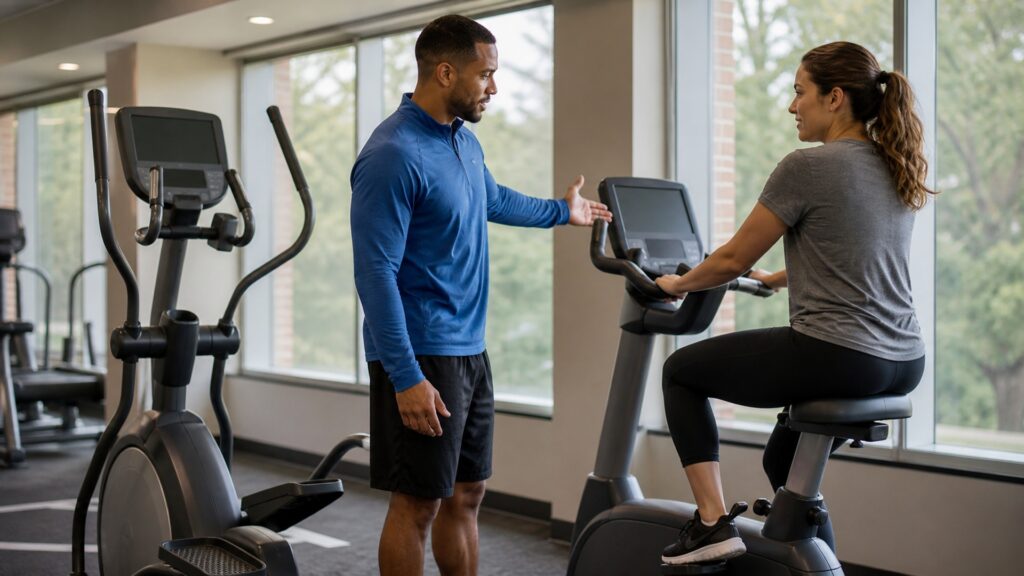
This comparison explains when the bike's narrower movement task is the point of choosing it.
Tip: Choose the bike for the task it simplifies, not because another machine sounds too complex.
These definitions connect the main idea to the variables, limits, and practical signals readers need to compare options.
A bike position where the rider turns pedals from a saddle.
The rate of pedal revolutions on the bike.
The guided standing oval path on an elliptical.
Elliptical arms that move with the stride.
The space and body position needed to get onto the machine.
A session where staying seated and pacing matters most.
Tip: The useful question is whether the reader wants a seated crank task or a standing guided stride.
The strongest reason to choose the bike is that seated cadence is exactly what the session needs. The saddle, crank, and resistance control create a narrower task than an elliptical stride.
The bike wins when reducing the movement task is the intended benefit.
Ellipticals often combine footpath and handle movement. That can be useful, but it can also be extra coordination when the user only wants steady lower-body pacing.
Use the bike when added coordination does not serve the session.
The bike is simpler in motion, but not setup-free. Seat height, fore-aft position, pedal contact, and handlebar reach decide whether the seated crank task is workable.
Choosing the bike means accepting bike-specific fit questions.
Many bikes occupy a different active-use shape than ellipticals. The room decision can favor a bike when length, handle swing, or standing clearance makes an elliptical awkward.
The right machine may be the one that fits the space while doing the intended job.
The decision is not one-way. If the reader wants a guided standing stride, moving handles, or a motion closer to striding than pedaling, the elliptical may answer the intent better.
A fair boundary names when the other machine is the better match.
The bike-over-elliptical choice is strongest when it is about seated cadence, simpler coordination, and room fit.
It identifies situations where the bike's narrower motion is an advantage rather than a compromise.
It separates movement and setup decisions from vague claims about better workouts.
It does not establish medical suitability, calorie burn, or injury prevention.
It also cannot predict comfort without actual fit and context.
Common shortcuts and misunderstandings can make the topic seem simpler than it is.
A bike can support hard or easy sessions. The reason to choose it here is movement structure, not automatic intensity.
More moving parts can help when desired, but they can also add coordination the reader does not need.
Seat and pedal fit are central to whether the crank path works well.
A compact bike helps only if the fit, stability, and controls still suit the user.
Tip: Treat strong claims as starting points for comparison, not final answers.
Concise answers to common questions readers may have after the main explanation.
Use the bike when seated cadence, simpler coordination, compact placement, or repeatable pedaling is the goal.
Keep the elliptical when standing stride and moving handles are important features.
Often it has fewer coordinated parts, but fit and controls still need attention.
Often it uses less fore-aft active space, but model size and mounting clearance still matter.
No. It is an equipment decision boundary, not medical or training advice.
Use an exercise bike instead of an elliptical when the point is seated crank cadence, simpler coordination, and a machine shape that fits the room and role.
Use the elliptical instead when standing guided stride and handle coordination are the features the reader actually wants.
Use these Review Streets paths to connect the explainer to related categories, comparisons, and next decisions.
Use this to understand the seated crank path behind the choice.
Read this for another bike comparison built around posture and foot path.
Browse bike options after confirming the bike is the right category.
Choose a retailer
Prices checked regularly. We may earn a commission at no cost to you.