When to Use Interior Cleaning Instead of Car Wash Equipment

Use interior cleaning when contamination lies inside the weather seals or within materials that cannot be openly rinsed: upholstery, carpet, foam, controls, screens, headliners, belts, vents, and crevices. Vacuum capture, metered chemistry, towel transfer, compatible extraction, airflow, and time control soil without flooding hidden construction.

Car wash equipment belongs where exterior surfaces, water supply, spray energy, and drainage can transport broad contamination safely. Pressure, high flow, wheel tools, underbody rinsing, and wash-bay systems are not shortcuts for cabins. The decision should follow soil location, moisture path, recovery, electronics, adhesives, and site capability.

By: Review Streets Research Lab
Updated: September 1, 2026
Explainer · 8-12 min read
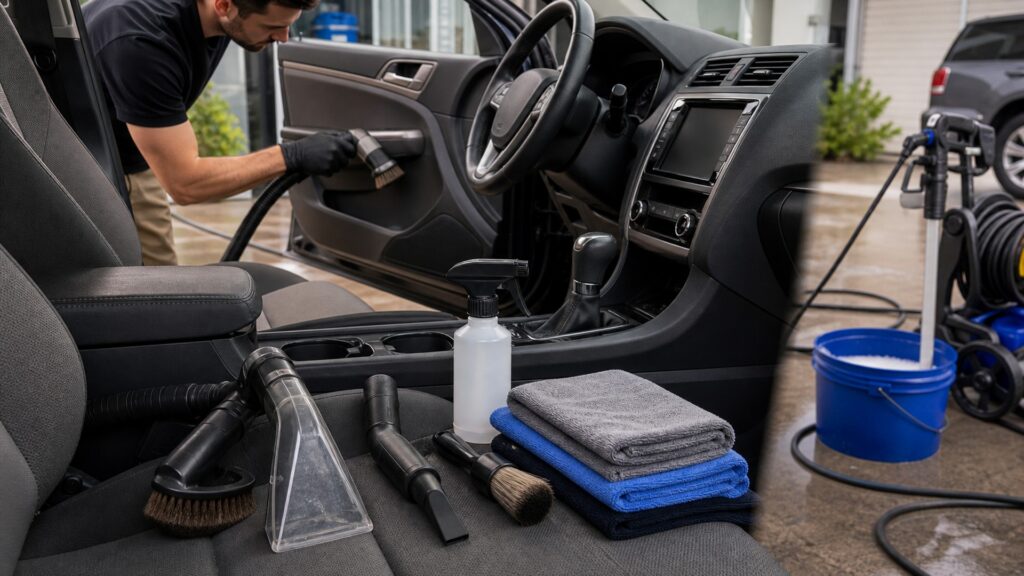
interior cleaning instead of car wash equipment explainer hero image for Review Streets
What You'll Learn

Resolve Interior Cleaning Equipment Decision through Its Controlling Evidence

The explanation separates five mechanisms that decide interior cleaning equipment decision instead of repeating a generic care sequence.

  • Inside-Seal Contamination Needs Capture Rather than Open Rinse
  • Vacuum and Towel Paths Fit Cabin Debris and Film
  • Extraction Is Conditional on Recovery and Drying Capacity
  • Wash Equipment Earns Use through Coverage and Drainage
  • Site or Material Uncertainty Can Disqualify Both Options
  • How to verify the finished state

Tip: Use the first failed interior cleaning equipment decision gate to choose the next test; do not compensate with unrelated force, chemistry, or product.

Definitions

Key Concepts That Define Interior Cleaning Equipment Decision

These definitions anchor interior cleaning equipment decision to exact materials, mechanisms, limits, and observable evidence.

Inside-Seal Contamination

Inside-Seal Contamination locates the interface where interior cleaning equipment decision under the named surface and operating conditions.

  • Measure inside-seal contamination before work
  • Observe how inside-seal contamination changes
  • Record inside-seal contamination after verification

Non-Rinseable Assembly

Non-Rinseable Assembly sets the usable boundary for interior cleaning equipment decision under the named surface and operating conditions.

  • Measure non-rinseable assembly before work
  • Observe how non-rinseable assembly changes
  • Record non-rinseable assembly after verification

Vacuum Capture Demand

Vacuum Capture Demand explains the material response during interior cleaning equipment decision under the named surface and operating conditions.

  • Measure vacuum capture demand before work
  • Observe how vacuum capture demand changes
  • Record vacuum capture demand after verification

Limited Liquid Application

Limited Liquid Application measures the transfer created by interior cleaning equipment decision under the named surface and operating conditions.

  • Measure limited liquid application before work
  • Observe how limited liquid application changes
  • Record limited liquid application after verification

Extractor Recovery Capacity

Extractor Recovery Capacity reveals the failure condition within interior cleaning equipment decision under the named surface and operating conditions.

  • Measure extractor recovery capacity before work
  • Observe how extractor recovery capacity changes
  • Record extractor recovery capacity after verification

Electronic Intrusion Risk

Electronic Intrusion Risk records the verified outcome after interior cleaning equipment decision under the named surface and operating conditions.

  • Measure electronic intrusion risk before work
  • Observe how electronic intrusion risk changes
  • Record electronic intrusion risk after verification

Tip: Use each interior cleaning equipment decision term at its defined interface rather than as a generic synonym for cleaning or protection.

Seal Boundary

Inside-Seal Contamination Needs Capture Rather than Open Rinse

Cabin surfaces lack a free drainage path and conceal sensitive systems. Evidence joins inside-seal contamination with limited liquid application; adhesive moisture limit sets the next limit. Record exterior soil coverage before changing pressure damage risk. Compare inside-seal contamination after adhesive moisture limit stabilizes, then use limited liquid application to confirm whether exterior soil coverage produced the intended result. For row 208, non-rinseable assembly establishes the baseline beside extractor recovery capacity. If cabin ventilation need changes first, hold inside-seal contamination constant and inspect pressure damage risk. A valid decision connects non-rinseable assembly to exterior soil coverage, preserves extractor recovery capacity, and documents cabin ventilation need after the applicable drying or curing interval.

  • Locate weather boundaries
  • Protect door openings
  • Map hidden layers
  • Choose recovery first

Water entry tolerance is not wash authorization.

Soil Transport

Vacuum and Towel Paths Fit Cabin Debris and Film

Dry capture and small-area transfer keep contamination from migrating. Evidence joins non-rinseable assembly with extractor recovery capacity; cabin ventilation need sets the next limit. Record runoff feasibility before changing equipment exclusion boundary. Compare non-rinseable assembly after cabin ventilation need stabilizes, then use extractor recovery capacity to confirm whether runoff feasibility produced the intended result. For row 208, vacuum capture demand establishes the baseline beside electronic intrusion risk. If exterior soil coverage changes first, hold non-rinseable assembly constant and inspect equipment exclusion boundary. A valid decision connects vacuum capture demand to runoff feasibility, preserves electronic intrusion risk, and documents exterior soil coverage after the applicable drying or curing interval.

  • Vacuum loose grit
  • Meter cleaner
  • Rotate towel faces
  • Empty recovery safely

Cabin transport is deliberately bounded.

Moisture Constraint

Extraction Is Conditional on Recovery and Drying Capacity

Porous textiles may accept limited solution, but foam, adhesives, and electronics cap application. Evidence joins vacuum capture demand with electronic intrusion risk; exterior soil coverage sets the next limit. Record pressure damage risk before changing inside-seal contamination. Compare vacuum capture demand after exterior soil coverage stabilizes, then use electronic intrusion risk to confirm whether pressure damage risk produced the intended result. For row 208, limited liquid application establishes the baseline beside adhesive moisture limit. If runoff feasibility changes first, hold vacuum capture demand constant and inspect inside-seal contamination. A valid decision connects limited liquid application to pressure damage risk, preserves adhesive moisture limit, and documents runoff feasibility after the applicable drying or curing interval.

  • Test material
  • Track liquid
  • Make recovery passes
  • Ventilate until stable

A dry-looking face can hide a wet assembly.

Exterior Capacity

Wash Equipment Earns Use through Coverage and Drainage

Heavy exterior soil, wheels, underbodies, and repeated vehicles can justify powered water and air systems. Evidence joins limited liquid application with adhesive moisture limit; runoff feasibility sets the next limit. Record equipment exclusion boundary before changing non-rinseable assembly. Compare limited liquid application after runoff feasibility stabilizes, then use adhesive moisture limit to confirm whether equipment exclusion boundary produced the intended result. For row 208, extractor recovery capacity establishes the baseline beside cabin ventilation need. If pressure damage risk changes first, hold limited liquid application constant and inspect non-rinseable assembly. A valid decision connects extractor recovery capacity to equipment exclusion boundary, preserves cabin ventilation need, and documents pressure damage risk after the applicable drying or curing interval.

  • Confirm supply
  • Set nozzle limits
  • Control runoff
  • Protect openings

Exterior capability does not cross the seal boundary.

Stop Boundary

Site or Material Uncertainty Can Disqualify Both Options

Relocate or refer when runoff, ventilation, electricity, contamination hazard, material identity, or drying cannot be controlled. Evidence joins extractor recovery capacity with cabin ventilation need; pressure damage risk sets the next limit. Record inside-seal contamination before changing vacuum capture demand. Compare extractor recovery capacity after pressure damage risk stabilizes, then use cabin ventilation need to confirm whether inside-seal contamination produced the intended result. For row 208, electronic intrusion risk establishes the baseline beside exterior soil coverage. If equipment exclusion boundary changes first, hold extractor recovery capacity constant and inspect vacuum capture demand. A valid decision connects electronic intrusion risk to inside-seal contamination, preserves exterior soil coverage, and documents equipment exclusion boundary after the applicable drying or curing interval.

  • Write stop conditions
  • Avoid pressure improvisation
  • Do not mask odor
  • Refer damaged systems

The safest choice may be another location or specialist.

Quick Reality Check

Where Interior Cleaning Equipment Decision Helps—and Where It Stops

The method is useful only when its mechanism, material, conditions, and verification remain inside the documented interior cleaning equipment decision boundary.

Evidence Supporting Use

inside-seal contamination and non-rinseable assembly remain controlled while vacuum capture demand produces the expected material response.

limited liquid application, extractor recovery capacity, and electronic intrusion risk can be observed independently without masking residue or an unstable finish.

Evidence Requiring a Stop

Stop when adhesive moisture limit, cabin ventilation need, or exterior soil coverage cannot be verified within the supported process window.

Unknown material, uncontrolled runoff feasibility, incompatible pressure damage risk, or failed equipment exclusion boundary requires another method, location, repair, or qualified service.

Common Myths

Misconceptions About Interior Cleaning Equipment Decision

These myths replace interior cleaning equipment decision evidence with shortcuts that fail across materials and conditions.

A portable pressure washer suits small interiors

Compact size does not reduce injection, intrusion, saturation, electrical, adhesive, or drying risks inside the cabin. Verify interior cleaning equipment decision on the named material after complete drying. Record interior cleaning equipment decision factor 1 before final acceptance.

A blower can replace interior vacuuming

Air can relocate particles into vents, electronics, faces, and inaccessible cavities unless capture and filtration control them. Check interior cleaning equipment decision against vehicle guidance and the observed residue. Record interior cleaning equipment decision factor 2 before final acceptance.

Rubber floor covering makes the whole cabin rinseable

Seams, fasteners, underlay, seat mounts, wiring, sensors, trim, and adjacent carpet still create water paths. Confirm interior cleaning equipment decision with a controlled test before broader application. Record interior cleaning equipment decision factor 3 before final acceptance.

Exterior equipment is necessary for professional results

Professional cabin work is defined by diagnosis, material compatibility, controlled transfer, recovery, drying, and functional verification—not maximum water output. Reinspect interior cleaning equipment decision under stable light, temperature, and moisture conditions.

Tip: Test the claimed interior cleaning equipment decision mechanism and inspect the dried or cured result before accepting it.

FAQ

Frequently Asked Questions About Interior Cleaning Equipment Decision

These answers resolve the remaining material, process, safety, and verification questions around interior cleaning equipment decision.

Can removable mats use exterior equipment?

Only after removal, material confirmation, controlled cleaning, lawful drainage, complete drying, and inspection before reinstallation. Document interior cleaning equipment decision, the affected surface, and the final functional check. Record interior cleaning equipment decision factor 5 before final acceptance.

When is a wet vacuum appropriate?

Use it for compatible liquid recovery within its rating while keeping electrical connections dry and hidden materials protected. Keep interior cleaning equipment decision within the product label and recovery capacity.

Can compressed air clean crevices?

Use only controlled pressure, suitable PPE, capture, and vehicle guidance without driving debris into electronics or occupants. Judge interior cleaning equipment decision by transferred soil rather than immediate appearance. Record interior cleaning equipment decision factor 7 before final acceptance.

What indicates too much cabin moisture?

Slow recovery, saturated backing, fogging, wick-back, electrical symptoms, sagging, persistent odor, or extended drying require stopping. Stop interior cleaning equipment decision when color, texture, grip, or adhesion changes. Record interior cleaning equipment decision factor 8 before final acceptance.

When should exterior equipment lead?

Choose it for broad rinseable exterior soil when supply, pressure limits, overspray, drainage, and maintenance are controlled. Compare interior cleaning equipment decision with the untreated area after all residue leaves.

Bottom Line

When to Use Interior Cleaning Instead of Car Wash Equipment depends on inside-seal contamination, non-rinseable assembly, and vacuum capture demand; later evidence adds limited liquid application, extractor recovery capacity, and electronic intrusion risk.

Accept the result only after adhesive moisture limit, cabin ventilation need, and exterior soil coverage remain stable under the documented material and operating conditions.

Next Steps

Continue the Interior Cleaning Equipment Decision Decision

These article-level destinations extend the mechanism, fitment, or category boundary for interior cleaning equipment decision without padding the module with taxonomy ancestors.