When to Use Interior Cleaning Instead of Detailing Kits

Interior cleaning should lead when the dominant problem is debris, body oil, food, beverage, pet residue, smoke film, staining, moisture, or odor inside the cabin. The job owns dry capture, material testing, controlled chemistry, transfer, extraction where suitable, ventilation, and post-dry inspection.

A detailing kit should lead when the objective is a broader exterior or finish program involving paint decontamination, correction, glass, trim, wheels, or protection. A bundle may contain cabin products, but it cannot erase display, headliner, belt, airbag, sensor, grip, and hidden-foam limits. Each category therefore owns a different completion record.

By: Review Streets Research Lab
Updated: September 1, 2026
Explainer · 8-12 min read
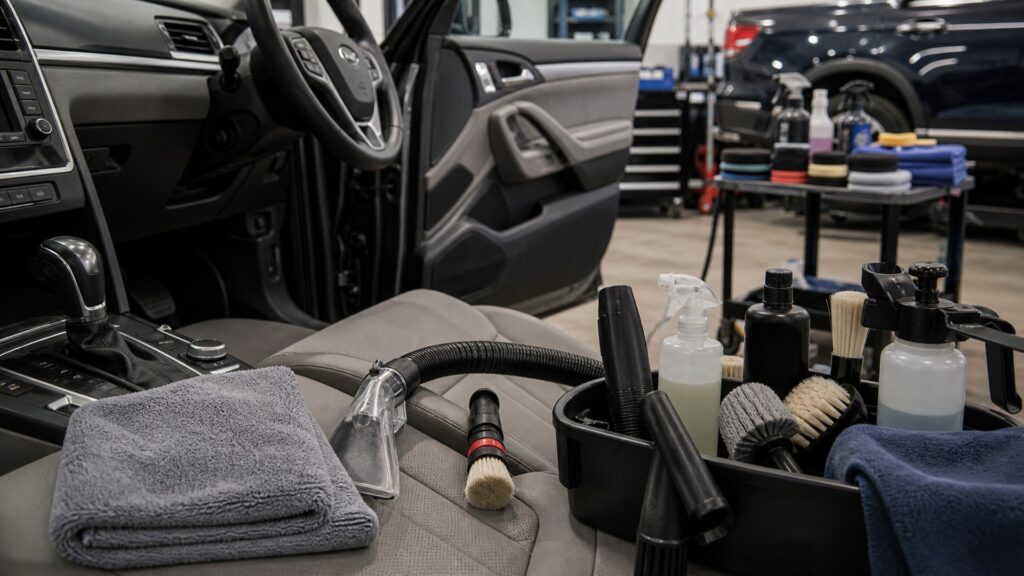
interior cleaning instead of detailing kits explainer hero image for Review Streets
What You'll Learn

Resolve Interior Cleaning Selection through Its Controlling Evidence

The explanation separates five mechanisms that decide interior cleaning selection instead of repeating a generic care sequence.

  • Cabin Soil and Odor Need a Located Reservoir
  • Cabin Construction Narrows the Product Set
  • Interior Work Must Account for Applied Liquid
  • Driving Surfaces and Restraints Need Their Own Checks
  • Exterior Finish Work Remains a Separate Program
  • How to verify the finished state

Tip: Use the first failed interior cleaning selection gate to choose the next test; do not compensate with unrelated force, chemistry, or product.

Definitions

Key Concepts That Define Interior Cleaning Selection

These definitions anchor interior cleaning selection to exact materials, mechanisms, limits, and observable evidence.

Cabin-Only Scope

Cabin-Only Scope locates the interface where interior cleaning selection under the named surface and operating conditions.

  • Measure cabin-only scope before work
  • Observe how cabin-only scope changes
  • Record cabin-only scope after verification

Spill Source

Spill Source sets the usable boundary for interior cleaning selection under the named surface and operating conditions.

  • Measure spill source before work
  • Observe how spill source changes
  • Record spill source after verification

Porous Reservoir

Porous Reservoir explains the material response during interior cleaning selection under the named surface and operating conditions.

  • Measure porous reservoir before work
  • Observe how porous reservoir changes
  • Record porous reservoir after verification

Dry Vacuum Sequence

Dry Vacuum Sequence measures the transfer created by interior cleaning selection under the named surface and operating conditions.

  • Measure dry vacuum sequence before work
  • Observe how dry vacuum sequence changes
  • Record dry vacuum sequence after verification

Minimal-Moisture Method

Minimal-Moisture Method reveals the failure condition within interior cleaning selection under the named surface and operating conditions.

  • Measure minimal-moisture method before work
  • Observe how minimal-moisture method changes
  • Record minimal-moisture method after verification

Extractor Recovery Pass

Extractor Recovery Pass records the verified outcome after interior cleaning selection under the named surface and operating conditions.

  • Measure extractor recovery pass before work
  • Observe how extractor recovery pass changes
  • Record extractor recovery pass after verification

Tip: Use each interior cleaning selection term at its defined interface rather than as a generic synonym for cleaning or protection.

Source Control

Cabin Soil and Odor Need a Located Reservoir

Trace the source before choosing chemistry or fragrance. This section specifically tests cabin-only scope together with spill source. Evidence joins cabin-only scope with dry vacuum sequence; returning odor sets the next limit. Record restraint-zone restriction before changing exterior finish program. Compare cabin-only scope after returning odor stabilizes, then use dry vacuum sequence to confirm whether restraint-zone restriction produced the intended result. For row 203, spill source establishes the baseline beside minimal-moisture method. If control-surface grip changes first, hold cabin-only scope constant and inspect exterior finish program. A valid decision connects spill source to restraint-zone restriction, preserves minimal-moisture method, and documents control-surface grip after the applicable drying or curing interval.

  • Inspect seams and padding
  • Check leak evidence
  • Separate dry and wet soil
  • Document inaccessible zones

A source-free diagnosis cannot guide removal.

Material Boundary

Cabin Construction Narrows the Product Set

Owner guidance and concealed tests govern leather, fabric, screens, trim, and headliners. This section specifically tests porous reservoir together with dry vacuum sequence. Evidence joins spill source with minimal-moisture method; control-surface grip sets the next limit. Record post-dry inspection before changing scope escalation. Compare spill source after control-surface grip stabilizes, then use minimal-moisture method to confirm whether post-dry inspection produced the intended result. For row 203, porous reservoir establishes the baseline beside extractor recovery pass. If restraint-zone restriction changes first, hold spill source constant and inspect scope escalation. A valid decision connects porous reservoir to post-dry inspection, preserves extractor recovery pass, and documents restraint-zone restriction after the applicable drying or curing interval.

  • Map materials
  • Test colorfastness
  • Protect coatings
  • Limit contact force

Broad kit claims do not prove cabin compatibility.

Recovery Ownership

Interior Work Must Account for Applied Liquid

Meter solution, recover repeatedly, ventilate, and inspect for wick-back. This section specifically tests minimal-moisture method together with extractor recovery pass. Evidence joins porous reservoir with extractor recovery pass; restraint-zone restriction sets the next limit. Record exterior finish program before changing cabin-only scope. Compare porous reservoir after restraint-zone restriction stabilizes, then use extractor recovery pass to confirm whether exterior finish program produced the intended result. For row 203, dry vacuum sequence establishes the baseline beside returning odor. If post-dry inspection changes first, hold porous reservoir constant and inspect cabin-only scope. A valid decision connects dry vacuum sequence to exterior finish program, preserves returning odor, and documents post-dry inspection after the applicable drying or curing interval.

  • Vacuum first
  • Track application
  • Make dry passes
  • Delay closure

Moisture without a recovery plan is unfinished work.

Operational Acceptance

Driving Surfaces and Restraints Need Their Own Checks

Preserve dry grip, low glare, clear displays, sound belts, and unobstructed airbags. This section specifically tests returning odor together with control-surface grip. Evidence joins dry vacuum sequence with returning odor; post-dry inspection sets the next limit. Record scope escalation before changing spill source. Compare dry vacuum sequence after post-dry inspection stabilizes, then use returning odor to confirm whether scope escalation produced the intended result. For row 203, minimal-moisture method establishes the baseline beside control-surface grip. If exterior finish program changes first, hold dry vacuum sequence constant and inspect spill source. A valid decision connects minimal-moisture method to scope escalation, preserves control-surface grip, and documents exterior finish program after the applicable drying or curing interval.

  • Avoid pedal dressing
  • Check switches
  • Protect retractors
  • Inspect warnings

A cabin must remain safe to operate.

Scope Split

Exterior Finish Work Remains a Separate Program

Use distinct media, products, timing, and completion records for exterior and cabin work. Evidence joins minimal-moisture method with control-surface grip; exterior finish program sets the next limit. Record cabin-only scope before changing porous reservoir. Compare minimal-moisture method after exterior finish program stabilizes, then use control-surface grip to confirm whether cabin-only scope produced the intended result. For row 203, extractor recovery pass establishes the baseline beside restraint-zone restriction. If scope escalation changes first, hold minimal-moisture method constant and inspect porous reservoir. A valid decision connects extractor recovery pass to cabin-only scope, preserves restraint-zone restriction, and documents scope escalation after the applicable drying or curing interval.

  • Separate tools
  • Reset the workspace
  • Schedule cure and drying
  • Issue separate findings

One invoice does not create one compatible process.

Quick Reality Check

Where Interior Cleaning Selection Helps—and Where It Stops

The method is useful only when its mechanism, material, conditions, and verification remain inside the documented interior cleaning selection boundary.

Evidence Supporting Use

cabin-only scope and spill source remain controlled while porous reservoir produces the expected material response.

dry vacuum sequence, minimal-moisture method, and extractor recovery pass can be observed independently without masking residue or an unstable finish.

Evidence Requiring a Stop

Stop when returning odor, control-surface grip, or restraint-zone restriction cannot be verified within the supported process window.

Unknown material, uncontrolled post-dry inspection, incompatible exterior finish program, or failed scope escalation requires another method, location, repair, or qualified service.

Common Myths

Misconceptions About Interior Cleaning Selection

These myths replace interior cleaning selection evidence with shortcuts that fail across materials and conditions.

A full kit makes cabin specialization unnecessary

General bundles often omit recovery, ventilation, material tests, safety-system restrictions, and enough dedicated media. Verify interior cleaning selection on the named material after complete drying. Record interior cleaning selection factor 1 before final acceptance.

Cabin-only means superficial work

Narrow scope can still require deep source diagnosis, extraction, drying, and functional verification. Check interior cleaning selection against vehicle guidance and the observed residue. Record interior cleaning selection factor 2 before final acceptance.

Fragrance proves odor removal

Perfume can dominate perception while a damp or contaminated reservoir remains active. Confirm interior cleaning selection with a controlled test before broader application. Record interior cleaning selection factor 3 before final acceptance.

Exterior towels are safe after rinsing

Abrasive particles and product residues can survive rinsing and transfer into the cabin. Reinspect interior cleaning selection under stable light, temperature, and moisture conditions. Record interior cleaning selection factor 4 before final acceptance.

Tip: Test the claimed interior cleaning selection mechanism and inspect the dried or cured result before accepting it.

FAQ

Frequently Asked Questions About Interior Cleaning Selection

These answers resolve the remaining material, process, safety, and verification questions around interior cleaning selection.

Can both services happen together?

Yes, but maintain separate zones, tools, chemistry, drying, and acceptance records. Document interior cleaning selection, the affected surface, and the final functional check. Record interior cleaning selection factor 5 before final acceptance.

When is extraction justified?

Use it only on compatible textiles with controlled application, recovery, ventilation, and drying. Keep interior cleaning selection within the product label and recovery capacity. Record interior cleaning selection factor 6 before final acceptance.

When should odor work be referred?

Refer hazardous, flood-related, biological, electrical, inaccessible, or persistent sources. Judge interior cleaning selection by transferred soil rather than immediate appearance. Record interior cleaning selection factor 7 before final acceptance. Recheck result 7 after the surface stabilizes.

Which workflow goes first?

Sequence runoff away from final cabin drying and prevent overspray through open doors. Stop interior cleaning selection when color, texture, grip, or adhesion changes. Record interior cleaning selection factor 8 before final acceptance.

What closes a cabin-only job?

Dryness, stable odor, clear visibility, non-slip controls, functioning electronics, and documented restraints. Compare interior cleaning selection with the untreated area after all residue leaves. Record interior cleaning selection factor 9 before final acceptance.

Bottom Line

When to Use Interior Cleaning Instead of Detailing Kits depends on cabin-only scope, spill source, and porous reservoir; later evidence adds dry vacuum sequence, minimal-moisture method, and extractor recovery pass.

Accept the result only after returning odor, control-surface grip, and restraint-zone restriction remain stable under the documented material and operating conditions.

Next Steps

Continue the Interior Cleaning Selection Decision

These article-level destinations extend the mechanism, fitment, or category boundary for interior cleaning selection without padding the module with taxonomy ancestors.