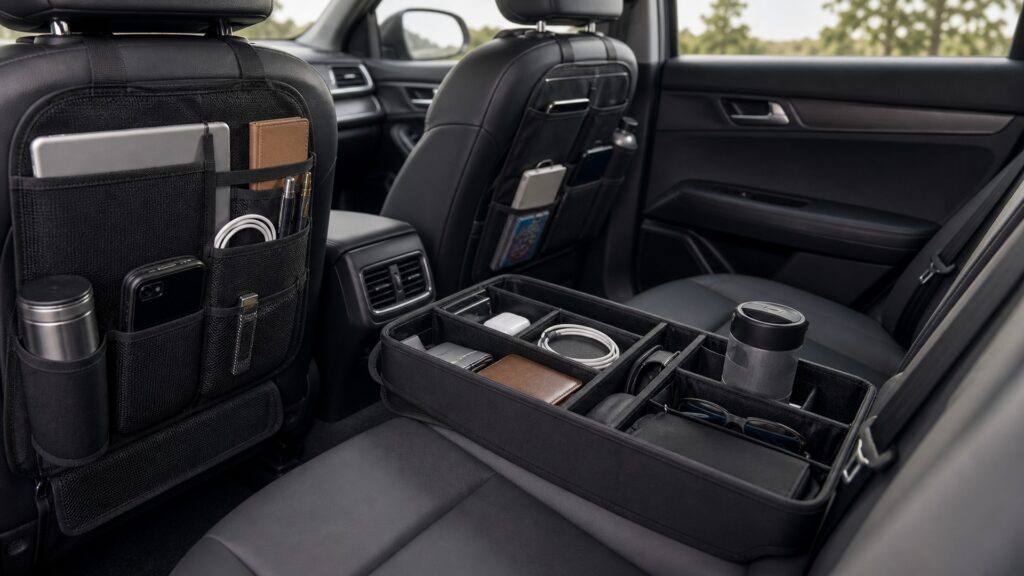
When to Use Interior Organization Instead of Interior Comfort

Use interior organization when objects lack dependable homes, move during braking, mix incompatibly, overflow storage, tangle, or require repeated searching. The needed mechanism is zoning, containment, restraint, and appropriate retrieval—not a change in what the occupant's body feels.

Use interior comfort when the unmet outcome is pressure distribution, posture, thermal balance, airflow, sound, glare, touch, reach, motion tolerance, or fatigue. Convenience can blur the choice: moving clutter may reduce awkward reaching, and a support may create temporary storage space. Classify the primary failure, then test any secondary benefit separately.

By: Review Streets Research Lab
Updated: September 11, 2026
Explainer · 8-12 min read
interior organization instead of interior comfort explainer hero image for Review Streets
What You'll Learn

Choose the Mechanism That Owns the Failure

The decision separates object events from human sensations, then tests attention, shared fit, and mixed-system proof.

  • Observe the failure
  • Name the affected subject
  • Select the direct mechanism
  • Assign safe access states
  • Protect cabin interfaces
  • Run organization evidence
  • Run comfort evidence

Tip: Remove assumptions about product category and write the failure as an object event or occupant response.

Definitions

Key Concepts That Define Interior Organization or Interior Comfort Selection

Key terms establish one owner for each result.

Loose-Object Event

Observed sliding, tipping, opening, spilling, tangling, impact, or migration of an identifiable item during vehicle use.

  • Locate the loose-object event boundary
  • Observe the loose-object event in use
  • Verify the loose-object event result

Search Burden

The time, attention, memory, and physical movement required to locate a needed object in the cabin or cargo area.

  • Locate the search burden boundary
  • Observe the search burden in use
  • Verify the search burden result

Assigned Zone

A consistent location with boundaries and access rules for a defined object class or use state.

  • Locate the assigned zone boundary
  • Observe the assigned zone in use
  • Verify the assigned zone result

Occupant Sensation

A reported pressure, temperature, airflow, sound, glare, touch, vibration, posture, reach, or fatigue response.

  • Locate the occupant sensation boundary
  • Observe the occupant sensation in use
  • Verify the occupant sensation result

Access Frequency

How often and under which parked, stopped, loading, or emergency condition an item legitimately needs retrieval.

  • Locate the access frequency boundary
  • Observe the access frequency in use
  • Verify the access frequency result

Dual-System Proof

Separate evidence that organization and comfort each achieve their intended result in the same final vehicle configuration.

  • Locate the dual-system proof boundary
  • Observe the dual-system proof in use
  • Verify the dual-system proof result

Tip: Use each term to name a measurable boundary.

Observed Failure

Movement, Overflow, and Searching Point to Organization

List what travels, where it starts and ends, how often it is sought, and what happens when it moves. Identifiable object events call for assigned zones, suitable boundaries, closures, and restraint.

  • Name each object
  • Observe motion consequences
  • Measure search burden

Object evidence should precede organizer selection.

Human Alternative

Pressure, Heat, Glare, Noise, and Fatigue Point to Comfort

Record the occupant, body area, onset time, trip condition, and response to factory adjustments. The appropriate intervention changes support, thermal exchange, airflow, visual load, acoustics, touch, or reach.

  • Describe the sensation
  • Restore factory baseline
  • Repeat onset conditions

A human response requires a human-input mechanism.

Reach Boundary

Accessible Storage Does Not Authorize Distracting Use

A well-placed object can reduce searching, yet reaching, viewing, opening, or manipulating it may remain inappropriate while driving. Assign use states and configure needed functions before vehicle movement.

  • Label parked-use items
  • Keep controls unobstructed
  • Minimize visual demand

Organization improves retrieval without redefining safe attention.

Coexistence Test

Organizers and Comfort Products Share Seats, Consoles, Vents, and Footwells

Pockets, supports, straps, cables, bins, and shades can compete for attachment and movement space. Install the final load and actual occupant, then cycle restraints, seats, controls, doors, climate, and exits.

  • Combine final products
  • Load intended contents
  • Test occupant transitions

Mixed accessories need one vehicle-level fit review.

Selection Evidence

Use Motion-Retrieval Proof and Representative-Trip Proof Separately

Organization passes when objects remain controlled and appropriately retrievable. Comfort passes when the original occupant symptom improves over realistic duration without new instability or interface loss. Record both when both categories are installed.

  • Define separate pass criteria
  • Inspect after motion
  • Track symptoms over time

Independent proof prevents convenience from masking discomfort or disorder.

Quick Reality Check

Reducing Search Can Feel Better Without Solving Physical Discomfort

Organization may lower frustration and unnecessary movement, but that secondary improvement does not prove pressure, temperature, posture, glare, vibration, or another body input has been corrected.

Useful Evidence

Items remain located and restrained, and parked retrieval becomes predictable.

The occupant's target symptom is separately measured if comfort is also claimed.

Limits and Escalation

No convenience placement may increase driving distraction or block a safety interface.

Medical, mobility, structural seat, or vehicle-system problems require expertise beyond organization products.

Common Myths

Misconceptions About Interior Organization or Interior Comfort Selection

Misconceptions about interior organization or interior comfort selection confuse adjacent functions or incomplete evidence.

A comfortable cabin has no organization problem

Occupants can feel physically comfortable while bottles roll, cables tangle, tools move, emergency gear disappears, or cargo mixes. Human sensation does not prove that objects are located, contained, restrained, or retrievable.

A tidy cabin cannot be uncomfortable

Visual order may reduce annoyance but does not establish good pressure distribution, posture, temperature, airflow, glare, noise, touch, reach, vibration tolerance, or trip-duration comfort for a particular occupant. a tidy

Putting everything within reach is safest

Reachable objects can obstruct controls, views, airbags, or movement and can encourage interaction while driving. Assign access by legitimate vehicle state, keep distracting items for parked use, and preserve direct driving function.

One multipurpose accessory can be judged as a whole

A seatback organizer may change legroom or seat feel; a console pad may add storage. Test containment, restraint, retrieval, support, pressure, safety interfaces, attachment, and occupant response as distinct claims rather than averaging them.

Tip: Return to the named mechanism and its acceptance test.

FAQ

Frequently Asked Questions About Interior Organization or Interior Comfort Selection

These answers resolve common interior organization or interior comfort selection selection and verification questions.

What is the strongest sign organization is needed?

Repeated object migration, searching, overflow, open closures, mixed incompatible contents, tangled cables, missing emergency items, or loose cargo provides direct evidence that location, containment, restraint, or retrieval is failing. what

What is the strongest sign comfort is needed?

A reproducible occupant sensation or functional limitation tied to body contact, posture, climate, glare, sound, vibration, reach, or trip duration indicates a human-input problem after obvious vehicle faults and factory adjustments are addressed.

Can organization solve awkward reaching?

It can place an appropriately used item in a more predictable parked-access zone and eliminate searching. If normal vehicle controls or safe posture remain difficult to reach, that is a fit, comfort, adaptation, or service concern.

When should both categories be installed?

Use both when separate observations establish object-control and occupant-response failures. Ensure compatible attachments and space, then run a loaded motion-and-retrieval trial plus an occupant-specific trip trial with all products present.

What should be removed before testing?

Remove unneeded loose objects and unapproved stacked layers, restore factory seat and climate settings, inspect for equipment faults, and establish a clean baseline. Reintroduce one controlled mechanism at a time to preserve causal evidence.

Bottom Line

Choose organization when objects are the problem.

Choose comfort when the occupant's physical response is the problem. Separate accessibility from appropriate use, protect the shared cabin envelope, and require independent motion, retrieval, fit, and representative-trip evidence whenever the two systems coexist.

Next Steps

Continue with the Related Mechanisms

The linked guides deepen organization mechanics, the inverse comfort decision, and vehicle-specific fit.