How Interior Organization Works

Vehicle organization starts with the objects already in the car, not with an empty bin. A charging cable used every trip, registration papers, sunglasses, groceries, sports gear, tools, and emergency supplies differ in size, mass, access frequency, spill risk, and consequence if they move.

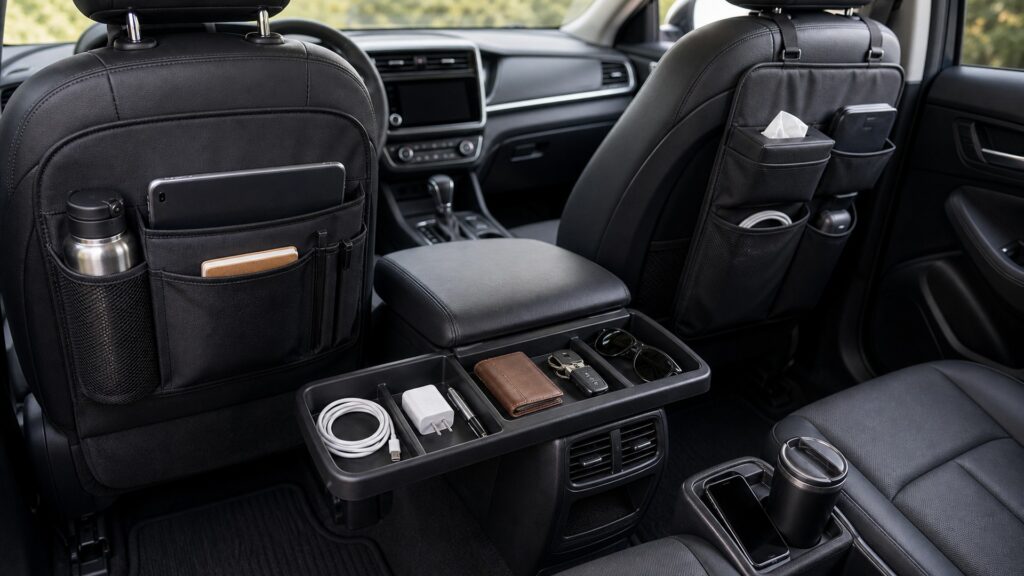
Console trays and door inserts sort small items. Seatback pockets add passenger storage. Trunk bins and dividers separate larger loads. Cargo nets and vehicle anchors limit movement. A useful system assigns each item a location, uses a boundary strong enough for the load, keeps retrieval appropriate to the vehicle state, and returns everything to that state after use.

By: Review Streets Research Lab
Updated: September 14, 2026
Explainer · 8-12 min read
interior organization explainer hero image for Review Streets
What You'll Learn

How Loose Items Become a Usable Storage System

Follow each item from inventory to zone, container, restraint, retrieval, and post-trip reset.

  • Daily-use items and parked-use items
  • Emergency gear and documents
  • Small-item trays and cable routing
  • Seatback pockets and passenger clearance
  • Trunk bins, dividers, and cargo nets
  • Closures and organizer attachment
  • Waste removal, restocking, and overflow

Tip: Empty the cabin and cargo area first. Buying containers before seeing the full inventory usually creates more hiding places, not better organization.

Definitions

Key Concepts That Define Interior Organization Mechanism

The terms below are specific to interior organization mechanism and the products a buyer will compare.

Item Inventory

A current list of objects routinely or occasionally carried, including dimensions, mass, frequency, risk, and required conditions.

  • List every regularly carried object
  • Record size, mass, spill risk, and use frequency
  • Remove obsolete items before buying storage

Access Frequency

How often and under what vehicle state an item legitimately needs to be obtained, used, or returned.

  • Decide whether access belongs before driving, while parked, during loading, or in an emergency
  • Place frequent items consistently
  • Keep distracting objects out of driving reach

Storage Zone

A bounded cabin or cargo location assigned to a class of items based on access, compatibility, and safety constraints.

  • Assign console, door, seatback, under-seat, or cargo areas deliberately
  • Separate clean, dirty, fragile, and hazardous contents
  • Reserve known space for emergency gear

Containment Boundary

The walls, pocket, lid, divider, net, or enclosure that defines where an object may rest.

  • Match tray walls, pocket seams, lids, dividers, and nets to the object
  • Close the final loaded container
  • Do not rely on shallow edges for heavy items

Motion Restraint

The attachment, closure, friction, geometry, or structural feature that limits object travel during vehicle acceleration.

  • Anchor the organizer as well as its contents
  • Inspect movement after braking and turns
  • Move heavy loads to supported cargo areas

Retrieval Path

The sight, reach, opening, hand clearance, and sequence required to identify and obtain an item appropriately.

  • Locate the item while parked without unloading unrelated contents
  • Return it and close the organizer
  • Revise zones that still require searching

Tip: Apply each interior organization mechanism check with the actual occupant, product, load, and vehicle.

Inventory Input

Objects Enter the System with Different Mass, Frequency, and Risk

Measure the real carried set rather than buying containers first. Daily essentials, occasional tools, groceries, cables, waste, documents, and emergency equipment impose different access, contamination, temperature, and restraint requirements. Sort sunglasses, toll transponders, charging leads, tissues, documents, and coins differently from tools, groceries, sports gear, and emergency equipment.

  • Empty and list contents
  • Record size and mass
  • Flag hazardous incompatibilities

Organization begins with evidence about objects, not empty storage volume.

Zoning Logic

Location Follows Use State, Priority, and Consequence

Frequently needed parked-use items may occupy accessible zones; emergency equipment needs known priority; heavy or dirty cargo belongs in robust lower areas; rarely used items can move farther from occupants. Console and door storage suits small items; seatback pockets suit passenger items; secured cargo areas suit higher mass.

  • Rank access frequency
  • Separate incompatible items
  • Reserve emergency locations

A useful zone reflects when and why the item is retrieved.

Containment and Restraint

Walls Define a Home While Closures Resist Vehicle Motion

A tray may organize small stable objects but cannot restrain a heavy tool. Match pockets, lids, dividers, nets, anchors, and load-bearing structure to braking, turning, vibration, impact, and opening forces. A lidded trunk bin, divider, cargo net, and shallow console tray provide very different levels of motion control.

  • Identify the expected load
  • Close every boundary
  • Anchor to supported points

Containment creates order; restraint keeps that order when the vehicle moves.

Access Design

Retrieval Should Minimize Search and Respect Driving Attention

Labels, tactile distinctions, consistent locations, sufficient opening clearance, and simple closures shorten parked retrieval. Items that demand visual or manual attention should not be treated as safely usable merely because they are within reach. Registration documents can live in a labeled wallet, while items requiring screen attention should be configured before driving.

  • Design for parked access
  • Keep views unobstructed
  • Avoid control-adjacent clutter

Reachability and appropriate use are different design questions.

Reset Loop

Return, Review, and Overflow Signals Keep the System Functional

After each trip, remove waste, return items, close restraints, restock essentials, and investigate anything that migrated. Crowded closures, stacked overflow, forgotten contents, and repeated searching signal that inventory or zones need revision. A weekly reset removes receipts and waste, returns cables, checks emergency stock, closes lids, and reveals overloaded zones.

  • Reset after representative trips
  • Inspect migration evidence
  • Reduce or resize inventory

Organization remains reliable only when the assigned state is restored.

Quick Reality Check

A Neat-Looking Bin May Still Be Unsafe

Visual order does not prove that the organizer is anchored, the lid will stay closed, or heavy contents will remain controlled during hard braking.

What a working storage system does

Each object has a known appropriate location and retrieval state.

Final loads stay contained and restrained through representative vehicle motion.

Loads and locations that need stronger control

Cabin convenience never overrides airbags, belts, controls, views, footwells, seats, vents, or exits.

Hazardous materials and heavy cargo require guidance beyond ordinary convenience storage.

Common Myths

Misconceptions About Interior Organization Mechanism

Organization myths that cause loose-object problems

More compartments always improve organization

Extra pockets divide volume but also increase hidden locations, search paths, weak closures, and forgotten contents. Use the fewest zones that clearly separate access frequency, incompatibility, motion risk, and emergency priority.

Anything inside a bin is restrained

Containment can stop small lateral movement while the entire bin slides, tips, opens, or ejects contents. Match the enclosure, closure, base attachment, and supporting vehicle point to item mass and expected motion.

Frequently used items should be reachable while driving

Convenient reach does not make manual or visual interaction appropriate. Configure needed functions before movement, store distracting objects for parked use, and keep primary controls, views, footwells, and steering movement completely clear.

Organization is finished after installation

Inventories change, consumables expire, families switch occupants, seasonal gear appears, and straps loosen. A useful system needs reset, inspection, removal of obsolete items, and reassignment whenever migration, overflow, or repeated searching returns.

Tip: Follow one real item through the complete storage cycle.

FAQ

Frequently Asked Questions About Interior Organization Mechanism

Questions about zones, restraint, and retrieval

What should be inventoried first?

Start with objects found loose, items used every trip, emergency equipment, high-mass tools, spillable or temperature-sensitive contents, documents, charging cables, child-related gear, and anything repeatedly searched for or left in a footwell.

How are storage zones assigned?

Group by legitimate access state, frequency, size, mass, compatibility, contamination, temperature, and consequence of movement. Give emergency items distinct known locations and keep heavy objects low in appropriately supported, restrained cargo areas.

What proves an organizer restrains objects?

Use the final load, close every closure, anchor only to supported points, drive a normal route with braking and turns, then inspect container movement, attachment tension, opened lids, displaced dividers, and item migration.

How should retrieval be evaluated?

While parked, confirm the intended user can identify the zone, see or distinguish the target, open it without unloading unrelated objects, obtain the item, and return it without interfering with seats, restraints, controls, or exits.

What does overflow mean?

Bulging pockets, lids that will not close, stacked loose items, blocked labels, overloaded hooks, migrated contents, or a growing miscellaneous bin show that capacity, inventory, or zoning no longer matches actual vehicle use.

Bottom Line

Give Every Carried Item an Appropriate Home

Inventory first. Put small frequent items in simple consistent locations, keep distracting items for parked use, and place heavier loads in supported restrained cargo areas. Close and anchor the system, inspect it after normal driving, and reset it before clutter erases the plan.

Next Steps

Fit and Category Guides

Use these pages to size the system for the actual vehicle and distinguish object storage from floor protection or comfort.