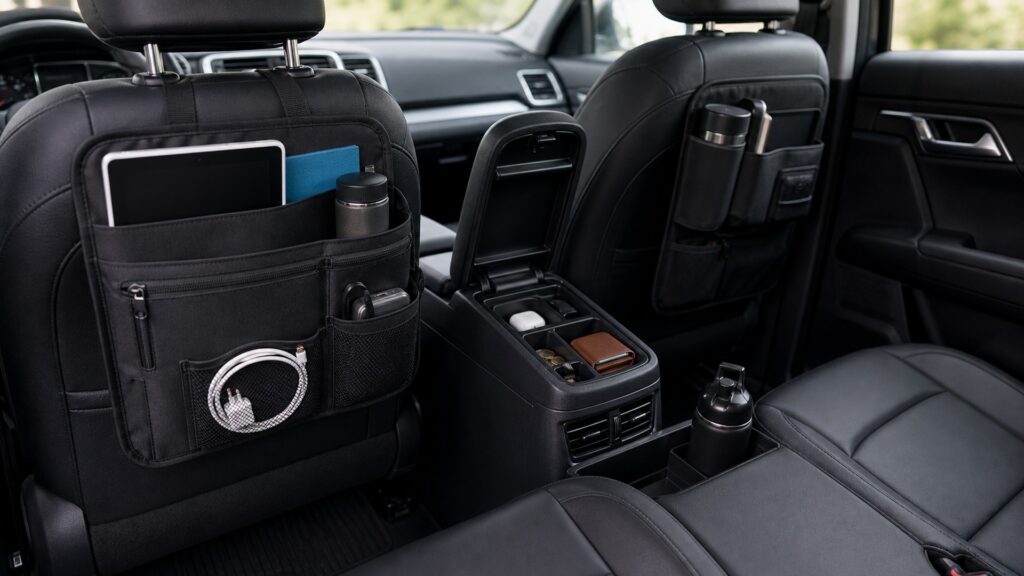
Why Interior Organization Fitment Matters

An organizer fits only when its final loaded shape belongs in the occupied vehicle. Empty dimensions miss bulging pockets, open lids, cable loops, seat travel, belt routing, child-restraint hardware, airbag zones, vents, foot movement, and the hand space needed for retrieval.

Fitment also includes load support. A hook, headrest post, seatback pocket, console gap, or cargo anchor has a specific purpose and consequence; convenient geometry does not imply unlimited strength. Test the exact organizer, contents, occupants, seats, closures, and access sequence across every vehicle configuration that will actually be used.

By: Review Streets Research Lab
Updated: September 11, 2026
Explainer · 8-12 min read
interior organization fitment explainer hero image for Review Streets
What You'll Learn

Fit the Final Loaded System

The evaluation covers occupied geometry, prohibited safety volumes, attachments, services, openings, movement, and user retrieval.

  • Configure real occupants
  • Map full seat travel
  • Exclude safety zones
  • Weigh the final load
  • Verify attachment support
  • Operate adjacent services
  • Test retrieval and motion

Tip: Fit the exact contents and occupants rather than relying on empty organizer dimensions.

Definitions

Key Concepts That Define Interior Organization Fitment

Key terms establish one owner for each result.

Occupied Envelope

The three-dimensional space used by people, clothing, restraints, movement, controls, and belongings in the final vehicle configuration.

  • Locate the occupied envelope boundary
  • Observe the occupied envelope in use
  • Verify the occupied envelope result

Seat Travel

The full fore-aft, height, tilt, fold, rotation, and entry movement available to a seat and its tracks or mechanisms.

  • Locate the seat travel boundary
  • Observe the seat travel in use
  • Verify the seat travel result

Restraint Path

The direct route and accessible hardware used by adult belts, child restraints, buckles, tethers, anchors, and head restraints.

  • Locate the restraint path boundary
  • Observe the restraint path in use
  • Verify the restraint path result

Attachment Rating

The supported load and usage boundary for the organizer connection and the vehicle structure receiving it.

  • Locate the attachment rating boundary
  • Observe the attachment rating in use
  • Verify the attachment rating result

Closure Clearance

The space needed to open, close, latch, and inspect a lid, flap, zipper, drawer, pocket, or divider when loaded.

  • Locate the closure clearance boundary
  • Observe the closure clearance in use
  • Verify the closure clearance result

Retrieval Posture

The body position, reach, view, and hand movement required to obtain an item without instability or inappropriate distraction.

  • Locate the retrieval posture boundary
  • Observe the retrieval posture in use
  • Verify the retrieval posture result

Tip: Use each term to name a measurable boundary.

Vehicle Mapping

Occupied Geometry Defines the Available Storage Volume

Measure with seats positioned for real occupants, belts routed, child restraints installed, doors closed, and controls accessible. Include knees, feet, head movement, clothing, and entry or exit paths rather than treating trim gaps as unused space.

  • Configure every occupant
  • Cycle seat travel
  • Map human movement

Fit belongs to the vehicle state, not an isolated measurement.

Safety Exclusions

Airbags, Restraints, Controls, Views, and Footwells Stay Unoccupied

Identify deployment seams, belt paths, buckles, anchors, pedals, steering movement, shifter access, mirrors, glazing, instruments, emergency controls, and exits before assigning any zone or attachment.

  • Consult vehicle guidance
  • Mark prohibited volumes
  • Test emergency access

Organization volume begins only outside mandatory safety space.

Structural Match

Loaded Mass Must Follow a Supported Attachment Path

Calculate the organizer plus contents, consider acceleration and repeated movement, and use intended anchors or supported surfaces. Seat pockets, trim edges, vents, handles, and headrest posts are not interchangeable load points.

  • Weigh final contents
  • Identify load-bearing structure
  • Inspect attachment after motion

A fit that cannot carry its load is only temporary placement.

Openings and Services

Seats, Doors, Vents, Outlets, and Closures Need Operating Clearance

Bulging organizers can block airflow, pinch wiring, press switches, prevent seat folding, trap a door, or lose access when another component moves. Open every closure and operate adjacent vehicle functions.

  • Load to intended capacity
  • Open lids and doors
  • Check cables and airflow

Usable fit includes the movement needed to operate both product and vehicle.

User Validation

Retrieval and Reset Must Work for Every Intended Occupant

A location that suits one driver may demand twisting, leaning, or searching from another. Test identification, parked reach, opening, replacement, and reset without using restraints or controls as supports.

  • Use each intended user
  • Perform parked retrieval
  • Restore all closures

Human variability is part of organization fitment.

Quick Reality Check

Available Space Is Not Automatically Usable Space

An open-looking gap may belong to an airbag, restraint, seat mechanism, vent, occupant movement, wiring route, control, view, exit, or unsupported trim surface.

Useful Evidence

The loaded organizer stays outside all safety and movement envelopes.

Closures, attachments, retrieval, seats, vents, doors, and exits work through every intended state.

Limits and Escalation

Improvised attachment to safety components is unacceptable.

Heavy, hazardous, or unusual cargo may require vehicle-specific professional guidance.

Common Myths

Misconceptions About Interior Organization Fitment

Misconceptions about interior organization fitment confuse adjacent functions or incomplete evidence.

If an organizer fits while empty, it fits when loaded

Contents can bow walls, sag pockets, open seams, shift the center of mass, obstruct closures, reduce seat clearance, and increase attachment forces. Evaluate the exact load in every occupied and moving configuration.

Headrest posts are universal attachment points

Post spacing, diameter, adjustment, removal method, active head-restraint design, seat structure, airbag integration, and vehicle instructions vary. An attachment must preserve adjustment and safety function rather than merely wrap around the posts.

Under-seat space is always safe storage

Seat tracks, wiring, occupant sensors, vents, mechanisms, feet, and rear-seat movement may occupy that volume. Loose or oversized items can jam adjustment or emerge during braking, so inspect through full travel.

A closed trunk makes cargo fitment irrelevant

Cargo still loads floors, anchors, seatbacks, closures, and emergency access during acceleration. Verify mass, restraint, compatibility, hatch clearance, visibility where applicable, spare-tire access, and movement under the representative final load.

Tip: Return to the named mechanism and its acceptance test.

FAQ

Frequently Asked Questions About Interior Organization Fitment

These answers resolve common interior organization fitment selection and verification questions.

What should be measured before purchase?

Measure final available width, depth, height, openings, attachment geometry, seat travel, occupant movement, restraint paths, vent and outlet locations, closure swing, and retrieval hand space in every intended vehicle configuration.

How is loaded fit tested?

Fill with the exact planned contents, close all boundaries, configure occupants and seats, operate doors and adjacent controls, drive a normal route, then inspect sag, migration, attachment tension, interference, and item displacement.

Can an organizer attach to a child restraint?

Do not add loads or accessories to child-restraint components unless the relevant vehicle and restraint instructions explicitly permit them. Preserve belt, lower-anchor, tether, buckle, seat, and deployment geometry exactly as directed.

How should vent clearance be checked?

Identify cabin and under-seat outlets and returns, operate the climate system at relevant settings, confirm the loaded organizer and clothing do not block airflow, then recheck after seats move and contents settle.

When should a storage location be rejected?

Reject it if the final system contacts safety equipment, controls, feet, seats, wiring, vents, views, doors, or exits; exceeds supported load; cannot close; migrates; or requires unstable or distracting retrieval.

Bottom Line

Fitment is loaded, occupied, and dynamic.

Map real human and vehicle envelopes, exclude every safety zone, support the final mass, preserve operating clearances, and validate retrieval for intended users. Recheck after motion because contents and attachments can change the geometry you originally accepted.

Next Steps

Continue with the Related Mechanisms

Related guides connect fitment to the organization mechanism, floor-space comparisons, and category choice.