
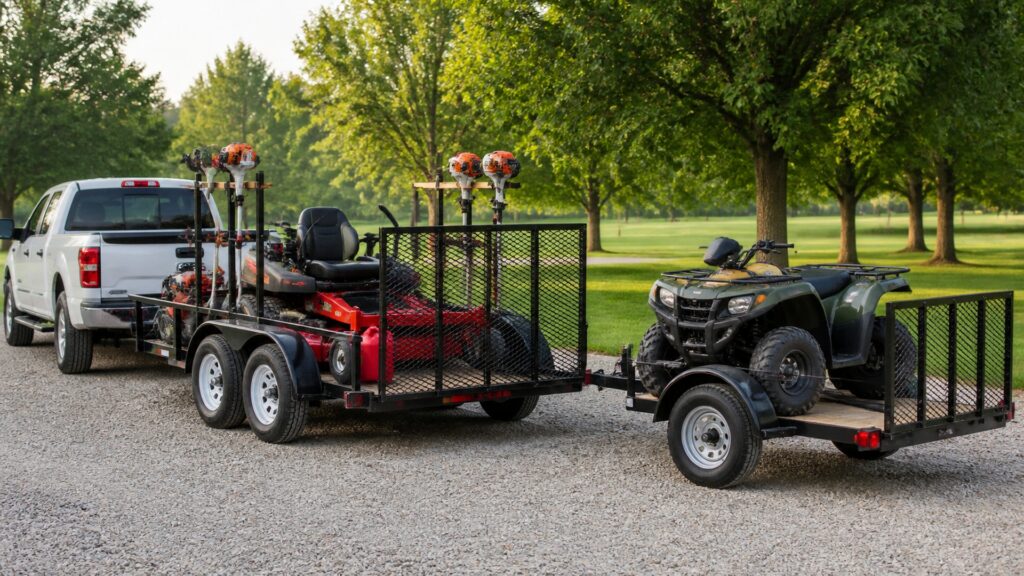
When to Use Landscape Utility Trailers Instead of ATV Utility Trailers

Use a landscape utility trailer when the job calls for transporting landscaping equipment and supplies in a supported arrangement behind a suitable towing vehicle. A mower, tool racks, and repeated stops at separate properties can make deck access and organized equipment storage important. An ATV-towed work trailer may be a better fit for compatible material hauling within a property, under its own operating limits.

First clarify the phrase ATV trailer. It can mean a trailer pulled by an ATV or one carrying an ATV as cargo. The comparison here is with an ATV-towed work trailer. Landscape trailers and ATV transport trailers can overlap in capability, so choose from the exact design and instructions rather than the name.

By: Review Streets Research Lab
Updated: October 7, 2026
Explainer · 8-12 min read
landscape utility trailers explainer hero image for Review Streets
What You'll Learn

Choose Between Equipment Transport and Property Hauling

Match the trailer to the complete task and the vehicle doing the towing.

  • When landscaping equipment favors a deck and ramp arrangement
  • How tool storage affects repeated service stops
  • When an ATV-towed work trailer fits property tasks
  • Why public-road use requires separate verification
  • How mixed transport and property work may need two arrangements

Tip: State the towing vehicle, cargo, loading method, and full route before comparing trailers.

Definitions

Six Concepts for the Landscape-Trailer Decision

These separate the work’s purpose from the trailer’s label.

Landscape equipment transport

Landscape equipment transport moves tools and machines to the places where grounds work is performed.

  • Example: a mower and hand tools carried between service sites
  • Check: equipment mass, dimensions, and transport instructions
  • Limit: landscaping use does not establish a universal trailer capacity

ATV-towed work trailer

An ATV-towed work trailer carries goods behind a compatible ATV under its stated conditions.

  • Example: material moved along a permitted property route
  • Check: ATV and trailer instructions together
  • Limit: it is not automatically a highway trailer

Equipment deck

An equipment deck supports an arranged load of machines or goods.

  • Example: a mower positioned for suitable restraint
  • Check: usable dimensions, load distribution, and support limits
  • Limit: overall length does not prove that several machines fit

Loading arrangement

The loading arrangement is the supported method of moving cargo on and off the trailer.

  • Example: a rated ramp used for a particular mower
  • Check: width, geometry, surface, attachment, and instructions
  • Limit: a ramp that exists may still be unsuitable for the machine

Tool organization

Tool organization gives carried equipment suitable positions and retention for transport and access.

  • Example: a compatible trimmer rack and storage box
  • Check: mounting, equipment compatibility, access, and added mass
  • Limit: a convenient rack does not replace required transport restraint

Complete route

The complete route includes every segment between departure, work locations, and return.

  • Example: roads between properties followed by an on-site access path
  • Check: permitted trailer use and the combination’s suitability throughout
  • Limit: a short connecting section still belongs in the assessment

Tip: An appropriate trailer must suit both the work equipment and the trip that moves it.

Equipment

Use a Landscape Arrangement When Machines Need a Transport Platform

A landscape trailer may provide a deck, loading access, and space for tools that support recurring grounds work. Check the actual machine dimensions, combined mass, and required restraint. A suitable deck arrangement is useful when several pieces of equipment must travel together, but a landscape label does not guarantee room for any mower or enough capacity for every supply load.

  • List every machine and regularly carried item.
  • Check loading and final parking positions.
  • Keep restraint points accessible.

Big Tex’s utility and landscape range includes multiple configurations. The range illustrates why the job should be matched to a particular trailer rather than to one assumed landscape-trailer specification.

Reference: Big Tex utility and landscape configurations.

Repeated stops

Consider Access to Tools Used at Every Property

At a service stop, the mower may come off while handheld tools remain available in their own positions. Suitable racks and boxes can help organize that work. They must be compatible with the trailer and equipment, and their mass counts in the load. Avoid arrangements that require moving a heavy machine merely to reach a frequently used tool.

  • Identify tools needed at most stops.
  • Assess approved rack and box locations.
  • Check access with the main equipment aboard.

A trimmer rack beside the deck can be useful only if the equipment is retained correctly and does not obstruct loading or movement. Carry-On offers separate landscape boxes and trimmer racks, each requiring a suitable installation.

Reference: Carry-On landscape and tool accessories.

Property work

Use an ATV Work Trailer When Its Design Fits Local Hauling

An ATV-towed trailer can serve property tasks when the vehicle, load, terrain, and operating restrictions align. A suitable tub or tipping feature may help with material handling, whereas a transport deck may better suit wheeled equipment. The difference concerns the supported task, not an assumption that one category is always larger or stronger.

  • Check the ATV’s towing and load instructions.
  • Compare body and unloading features with the material.
  • Stay within the exact terrain and use limits.

For example, distributing material along an approved property route is different from transporting a mower between customers. A trailer useful for the former may not support the latter at all.

Route

Verify Road Use Independently of the Cargo Purpose

A landscaping job may include public roads, narrow entrances, or an off-road work area. Confirm the whole combination is suitable for every planned segment and meets applicable requirements. Some ATV work trailers are expressly off-road-only. Adding a different coupler or lights does not establish that a trailer was designed for highway service.

  • Read the exact intended-use statement.
  • Include connecting road sections and the return.
  • Assess access at each work site.

Clam identifies Polar Trailers as off-road hauling products rather than highway trailers. That is a specific product boundary and a reason to verify the trailer in front of you, not a rule about every ATV-related trailer.

Reference: Polar Trailer intended-use FAQ.

Selection

Choose for the Entire Workday

A landscape trailer is a useful choice when it supports equipment transport, loading access, and repeated work stops within the towing limits. An ATV-towed trailer may suit compatible movement on the property itself. Some jobs need separate arrangements for road transport and local distribution. Include the changed return load, such as empty containers or collected material, before deciding.

  • Assess the full outgoing and return loads.
  • Check whether one arrangement truly covers all stages.
  • Use another transport plan when requirements conflict.

If the ATV itself must travel to the site, treat it as cargo on a suitable transport trailer. That reverses its role from tow vehicle to carried equipment and requires a separate deck, ramp, and restraint assessment.

Reference: NHTSA load-security guidance.

Quick Reality Check

Which Task Is the Trailer Serving?

These examples depend on compatible equipment and documented use.

Landscape transport may fit

Moving a mower and tools between service locations.

Repeated access to supported machine and tool-storage positions.

ATV-towed work may fit

Compatible hauling within the trailer and ATV’s property-use limits.

Material handling supported by the particular tub or unloading design.

Common Myths

Misconceptions About Landscape and ATV Trailers

Clarify roles before comparing capabilities.

An ATV trailer always carries an ATV

It may instead be designed for towing behind one.

Any landscape trailer can carry a large mower

Deck, ramp, restraint, and all relevant load limits must fit that machine.

A property trailer is fine for a short road connection

Distance does not override the trailer’s intended-use restrictions.

Tool racks add storage without affecting capacity

The rack and its contents add mass and may change distribution and clearance.

Tip: Choose a supported combination for the work, including the trip home.

FAQ

Questions About Choosing Landscape Utility Trailers

Answers for equipment transport and property hauling.

When does a landscape trailer make sense?

When its exact deck, loading access, storage, and ratings support the landscaping equipment and complete route.

Can it transport an ATV?

Potentially, if that specific trailer and its ramp, restraint, and towing combination support the ATV as cargo.

What favors an ATV-towed work trailer?

A compatible ATV, permitted route, suitable load body, and a task within both products’ operating limits.

Do landscape trailers always have tool racks?

No. Equipment varies, and added racks need compatible mounting and load assessment.

What if the road trip and work-site route need different trailers?

Use separate suitable arrangements rather than extending one trailer beyond its supported use.

Bottom Line

Choose a landscape utility trailer for a complete equipment-transport job; choose an ATV-towed trailer for property hauling it is designed to support.

Verify the towing vehicle, load handling, route, and return arrangement rather than relying on either label.

Next Steps

Go Deeper or Compare Your Options

Use these Review Streets paths to compare related categories and practical next decisions.