Why Landscape Utility Trailers Maintenance Role Matters

Landscape-trailer maintenance keeps the equipment-loading path, tool storage, and towing systems ready for repeated use. A trailer may tow normally while a ramp latch, deck support, or tool-rack attachment is no longer serviceable. For a crew making several stops, those working parts deserve attention alongside tires, bearings, lights, and coupling hardware.

Use the exact trailer and component instructions to set the maintenance plan. Landscaping equipment, loading frequency, dirt, moisture, and reported impacts help identify where condition needs attention, but they do not create one universal service interval. New defects need assessment when found, even if the next scheduled service is weeks away.

By: Review Streets Research Lab
Updated: October 7, 2026
Explainer · 8-12 min read
landscape utility trailers explainer hero image for Review Streets
What You'll Learn

Maintain the Loading Path and the Road Equipment

Connect landscaping use with specific inspection and repair needs.

  • Why gates, ramps, and retention hardware need attention
  • How debris can hide deck and frame defects
  • Why fitted racks have their own requirements
  • How wheel-end and connection care supports every trip
  • What confirms a reported fault has been resolved

Tip: Record the component and the action that exposed a defect, such as a gate failing to latch after loading.

Definitions

Six Maintenance Concepts for Landscape Trailers

Keep each working system visible in the service plan.

Ramp hardware

Ramp hardware includes the attachments, hinges, latches, and other parts supporting the ramp’s intended operation.

  • Example: a gate latch that no longer retains correctly
  • Check: the exact ramp and assist-system instructions
  • Limit: a gate moving freely does not prove its locks or supports are sound

Deck condition

Deck condition concerns the load-carrying surface and its supporting attachments.

  • Example: damage discovered under accumulated soil
  • Check: material condition, fasteners, and supports
  • Limit: a clean upper surface does not establish structural capacity

Rack attachment

Rack attachment is the connection between a tool-storage accessory and the trailer.

  • Example: a trimmer rack with a loosening mount
  • Check: accessory instructions and the supporting structure
  • Limit: retaining the tool does not prove the rack itself is secure

Wheel-end service

Wheel-end service maintains the wheels, hubs, bearings, and associated fitted parts.

  • Example: bearing inspection for the installed axle design
  • Check: correct parts, procedures, and intervals
  • Limit: one grease method does not apply to every hub

Connection condition

Connection condition is the serviceability of coupling, safety, and electrical interfaces with the tow vehicle.

  • Example: an intermittent trailer-light connection
  • Check: wear, damage, engagement, and required functional checks
  • Limit: a connection that worked yesterday may have a new defect

Defect closure

Defect closure confirms that a reported issue has been appropriately assessed and resolved or restricted.

  • Example: verifying a repaired ramp latch under its instructions
  • Check: the original complaint and completed work
  • Limit: a service invoice alone does not show that every complaint was addressed

Tip: Distinguish the condition of the load-handling equipment from the condition of the trailer on the road.

Loading equipment

Inspect the Gate or Ramp That Works at Every Stop

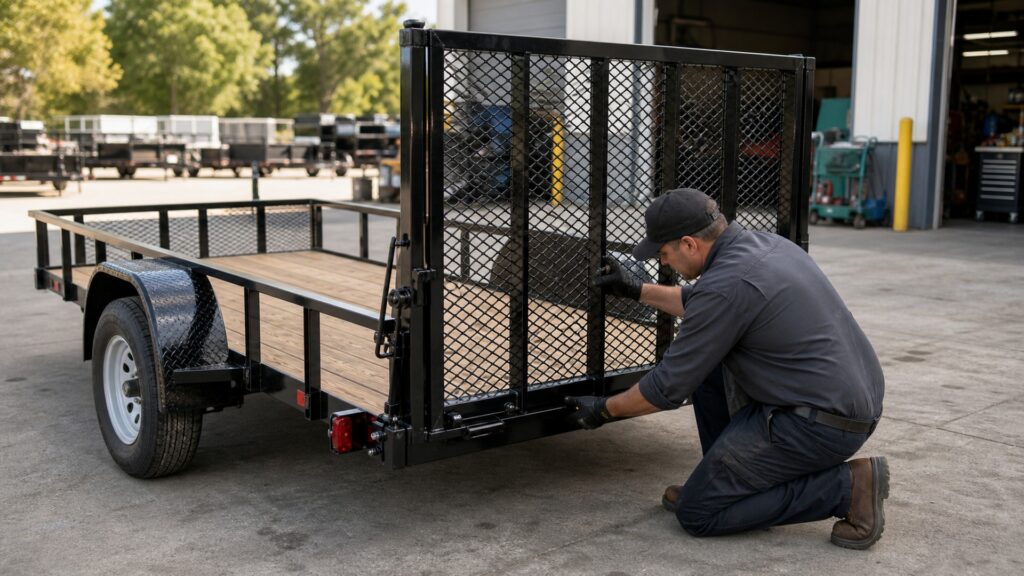
Repeated loading uses the ramp surface, attachment, hinges, and travel-retention hardware. Check them under the applicable instructions, and act on damage or unreliable operation. Where an assist mechanism is fitted, follow its own service requirements; stored-energy components need appropriate expertise. Do not treat a difficult gate as a problem to solve by repeated force.

  • Check the actual ramp and latch arrangement.
  • Report altered movement or visible damage.
  • Use qualified service for uncertain mechanisms.

A gate that lowers normally but will not stay secured for travel is not ready for the next site. The defect affects the transport configuration even if machine loading still seems possible.

Deck and frame

Clear Debris So Condition Can Be Seen

Remove accumulated material using methods suitable for the trailer’s surfaces and components. Inspect accessible deck areas, supports, joints, and attachment points for damage or deterioration. A mower can repeatedly cover the same area, making a problem easy to overlook until equipment is removed. Cleaning helps inspection; it does not repair weakened material.

  • Expose regularly covered load areas.
  • Look for damaged surfaces and attachments.
  • Have suspected structural problems assessed.

Big Tex’s manual requires attention to deck and hold-down condition before loading. A damaged restraint point or supporting surface needs repair or replacement appropriate to the design, not simply another layer of coating.

Reference: Big Tex deck and hold-down inspection guidance.

Accessories

Maintain the Racks and Boxes as Installed Equipment

Tool racks, boxes, carriers, and their retention parts may come from separate suppliers. Include their checks and service instructions in the trailer records. Look at both the tool-retaining mechanism and the attachment to the trailer. An accessory can hold its tool firmly while its mounting has become loose, or remain well mounted while its latch is defective.

  • Identify the fitted accessory and instructions.
  • Check retention and mounting separately.
  • Reassess any relocated or replacement accessory.

Carry-On’s accessory range includes landscape boxes and trimmer racks. These are added working systems, so a routine axle service should not be assumed to cover all their condition and installation needs.

Reference: Carry-On landscape accessories.

Road systems

Keep Running Gear and Connections in the Same Plan

Follow the tire, wheel, axle, bearing, suspension, and coupling requirements for the installed components. Check lighting and any fitted brakes or breakaway equipment using their instructions. Record new noises, unusual heat, leakage, tire damage, or intermittent electrical behavior for assessment. Avoid assigning a generic interval or torque value to an unidentified trailer.

  • Use exact component service guidance.
  • Include the tow-vehicle interface in functional checks.
  • Address new symptoms between scheduled visits.

Dexter’s axle instructions distinguish wheel-end designs and their care. A trailer’s landscaping role does not tell you which bearing arrangement or brake system is fitted.

Reference: Dexter axle and wheel-end service manual, NHTSA tire-care guidance.

Follow-through

Return the Trailer to Work with the Complaint Resolved

Link each condition report to the inspection or repair performed. Confirm what was corrected and what restrictions remain. Before returning to service, verify the repaired function using the appropriate procedure and prepare the complete trailer for travel. Keep records available to the next user, especially when several people share the trailer.

  • Describe defects clearly and consistently.
  • Record parts or equipment changes.
  • Check the original reported function after repair.

For example, replacing a lamp does not close an intermittent-light complaint if the connector still loses contact. The symptom, assessment, and result need to remain connected.

Quick Reality Check

Roadworthy Systems and Ready Working Equipment

A landscape trailer needs both to complete its assigned work.

Road-system care

Serviceable tires, wheel ends, connections, and structure.

Correctly operating lights and fitted braking systems.

Working-equipment care

A usable, secure loading ramp or gate.

Sound deck, restraint points, racks, boxes, and their attachments.

Common Myths

Misconceptions About Landscape-Trailer Maintenance

Frequent use can expose faults outside the usual axle-service checklist.

If it tows quietly, it is ready for work

Loading hardware, deck, and accessory defects can still prevent safe use.

Tool retention proves the rack is secure

The rack’s mounting and the tool’s retention need separate checks.

Cleaning restores damaged structure

Cleaning reveals condition; it does not replace required repair.

All landscape trailers use the same service schedule

The exact trailer, components, and applicable duty instructions determine care.

Tip: Do not postpone a newly found defect simply because scheduled maintenance is not yet due.

FAQ

Questions About Landscape-Trailer Maintenance

Answers for keeping repeated equipment transport dependable.

Which parts deserve attention after repeated loading?

The ramp or gate, its supports and retention parts, deck condition, and the equipment’s restraint points.

Should added racks be included in service records?

Yes. Record their identity, installation, maintenance instructions, and later changes.

Can I use a universal bearing-service interval?

No. Follow the exact axle and hub instructions and applicable operating conditions.

What if the gate-assist system behaves differently?

Stop using an unsafe mechanism and obtain appropriate assessment under its instructions; do not improvise a repair to stored-energy parts.

What confirms a repair is complete?

The original concern has been assessed, the required work documented, and the affected function verified with any restrictions made clear.

Bottom Line

Landscape-trailer maintenance must keep the loading equipment and tool-storage systems serviceable as well as the road-going components.

Use exact instructions, report defects when found, and verify that repairs address the original problem.

Next Steps

Go Deeper or Compare Your Options

Use these Review Streets paths to compare related categories and practical next decisions.