
Light Bar
Linear housing containing multiple emitters and optical cells in one assembly.
- Length does not define pattern
- Rows can mix optics
- Large area increases mounting load
Use a light bar instead of driving lights when the job genuinely needs broad, continuous illumination across a trail, work site, campsite approach, recovery area, or property and the vehicle is operating away from public traffic. A bar can package many emitters into spot, flood, or combination optics across one rigid housing.
Use dedicated driving lights when the primary need is controlled long-range forward illumination that supplements high beams where lawful. Driving lamps are designed and aimed as a paired road-focused system; a general light bar often spreads intense light into roadside, dust, vehicle hood, mirrors, and other drivers. The choice begins with beam task and operating environment—not fixture width or advertised lumens.
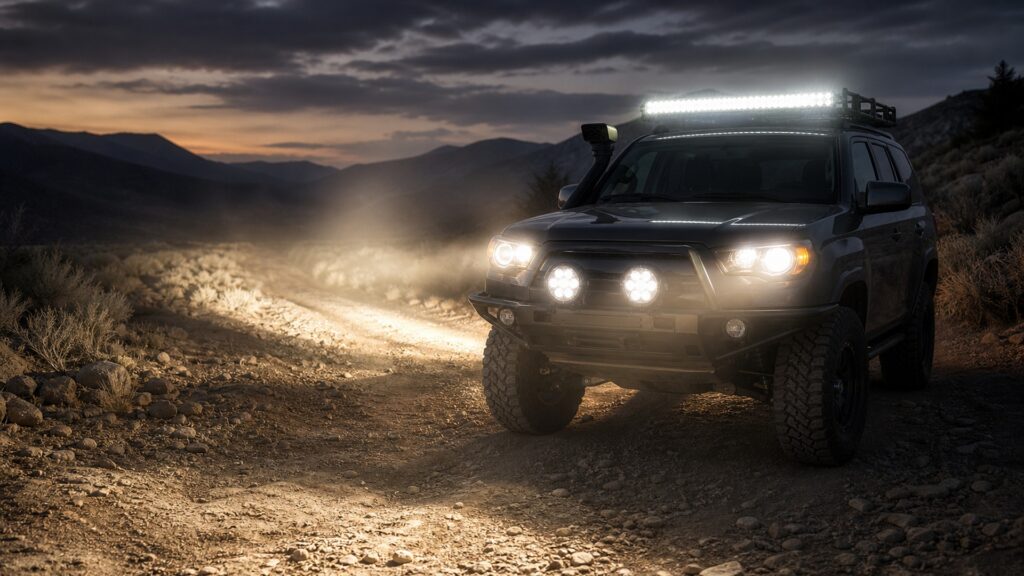
Separate broad low-speed work illumination from long-range forward driving, and design mounting, switching, wiring, aim, and operating rules around that single use.
Tip: Test the installed beam in its intended environment with a spotter outside the vehicle, then label or interlock controls so an off-road bar cannot be activated casually around traffic.
These terms distinguish fixture shape from the beam task it performs.
Linear housing containing multiple emitters and optical cells in one assembly.
Auxiliary forward lamp intended to extend useful distance with high-beam operation.
Narrow distribution concentrating intensity near the forward axis for distance.
Wide distribution emphasizing nearby lateral area rather than distant reach.
Fixture that mixes narrow and wide optical cells to cover more than one zone.
Wiring system using a control signal to switch a protected high-current lamp circuit.
Tip: Auxiliary-light rules vary by jurisdiction and can regulate number, height, color, aim, covers, switching, and use; confirm current local requirements before installation or operation.
Long-range seeing needs concentrated intensity placed far ahead without excessive foreground. Work and trail maneuvering need lateral coverage near obstacles, people, equipment, and turns. A light bar can combine zones, while driving lights usually prioritize controlled distance.
A fixture that appears spectacular against nearby terrain may reduce dark adaptation and reveal less at stopping distance.
Open off-road trails, agricultural work, recovery, and low-speed area inspection can justify a broad bar. Public roads, convoys, dust, snow, fog, rain, hood reflections, windshields, and mirrors make uncontrolled spill hazardous.
Off-road use still requires responsibility toward passengers, workers, animals, neighboring property, and other trail users.
Roof mounting clears some obstacles but increases hood, dust, snow, and fog illumination. Bumper mounting reduces those paths but may be blocked or vulnerable. Bracket flex makes a distant hotspot bounce and weakens seals or body panels.
Placement changes both illumination and mechanical risk, so the brightest mounting point is not necessarily the best one.
Current demand, inrush, conductor length, connector sealing, relay rating, alternator capacity, heat, fusing, grounding, and switch logic determine reliability. Tapping a factory lamp wire directly can overload modules or cause diagnostic faults.
A sound circuit fails safely and prevents the auxiliary lamp from compromising required lighting or vehicle electronics.
Driving lamps are selected, mounted, aimed, and switched to complement high beam with a defined long-range pattern. They should extinguish with low beam where required and cannot compensate for failed or poorly aimed original headlamps.
When the task is lawful forward road reach, purpose-built driving lights provide more controllable information than a general flood or combination bar.
The distinction is the beam task and operating environment, not merely a long housing versus two round lamps.
Low-speed off-road, recovery, agricultural, or work-area operation needs broad lateral coverage from one rugged assembly.
The area is controlled, glare recipients are managed, the vehicle has engineered mounting and wiring, and the bar can remain off around public traffic.
The task is supplemental long-range forward road illumination with controlled optics, paired aim, and lawful high-beam switching.
Neither choice is appropriate when required headlamps are defective, weather scatter dominates, mounting is unstable, or safe stopping distance exceeds the illuminated path.
These myths treat auxiliary lighting as a competition in fixture size and lumen claims.
Length can add emitters and total output, but distance depends on optical concentration and aim. Flood cells may widen nearby coverage while producing less central intensity than smaller purpose-built driving lights.
Workers, passengers, trail users, wildlife, neighboring properties, mirrors, dust, fog, and reflective surfaces can still receive disabling light. Controlled use, aiming, shielding, communication, and immediate dimming remain necessary away from public roads.
A high bar can clear foreground obstacles but also lights the hood, airborne dust, falling snow, fog, branches, and windscreen contamination. It adds wind load, noise, leak risk, cable-routing difficulty, and structural demands.
Reliable systems also need wire sized for load and run length, protected routing, sound grounds, sealed connectors, suitable relays or controllers, strain relief, charging-capacity review, rigid brackets, and compatible vehicle electronics.
Tip: Define the target, beam zone, speed, weather, glare boundary, and legal operating condition before comparing products.
These answers cover pattern choice, public-road use, mounting, wiring, and weather.
Choose spot for narrow distance, flood for broad nearby work, and combination only when both zones must operate together. Compare candela or measured beam plots, not lumens alone, and avoid excessive foreground light.
Only when the exact lamp, placement, switching, aim, color, covers, and operation comply with current jurisdiction rules. Many bars are intended for off-road use and should remain covered or disabled around traffic.
Use a rigid vehicle-approved structure that avoids airbags, cooling airflow, cameras, radar, lamps, license plates, crumple zones, and water paths. Select height after checking hood glare, dust, branches, and cable routing.
Use a fuse or breaker near the supply, wire sized for current and voltage drop, sealed connectors, abrasion protection, strain relief, a correctly rated relay or controller, and a verified ground path.
Usually less, lower, and more tightly controlled light reduces backscatter. A roof bar can illuminate airborne particles directly. Slow down, increase spacing, use appropriate low beams or fog lamps, and preserve dark adaptation.
Choose a light bar for broad low-speed illumination in a controlled off-road or work environment; choose driving lights for controlled supplemental long-range forward illumination where their installation and use are lawful.
Match optics to the task, contain glare, engineer mounting and wiring, repair original lighting first, account for weather and reflections, and never use advertised lumens as the sole decision.
These explainers show how weather scatter and the complete optical system constrain any additional lamp.
Place auxiliary lighting inside the full system of required lamps, aim, glazing, electrical supply, signaling, weather, and human vision.
See why a low, wide, controlled fog pattern serves a different adverse-weather task than a roof bar or long-range driving lamp.
Decide whether reversible bolt-on lighting solves the need without creating structural, wiring, sensor, or calibration problems.
Choose a retailer
Prices checked regularly. We may earn a commission at no cost to you.