
Fog Lamp
Auxiliary lamp producing a wide beam with controlled vertical spread for nearby adverse-weather visibility.
- It is not a driving lamp
- Low mounting can reduce scatter path
- Aim defines usefulness
Fog lights matter because dense fog, snow, and spray scatter forward light back toward the driver and reduce contrast. A properly designed front fog lamp places a broad, low, vertically controlled beam near lane edges and nearby road boundaries while limiting light aimed into the suspended particles above the road.
That geometry can make close-range orientation easier, but it does not cut a tunnel through fog or restore normal sight distance. Excess foreground light can narrow the driver's useful adaptation and distract from dimmer distant targets. Fog lamps work only as part of a slower-speed response that includes low beams, clear glazing, greater following distance, restrained lane changes, and stopping within the distance actually visible.
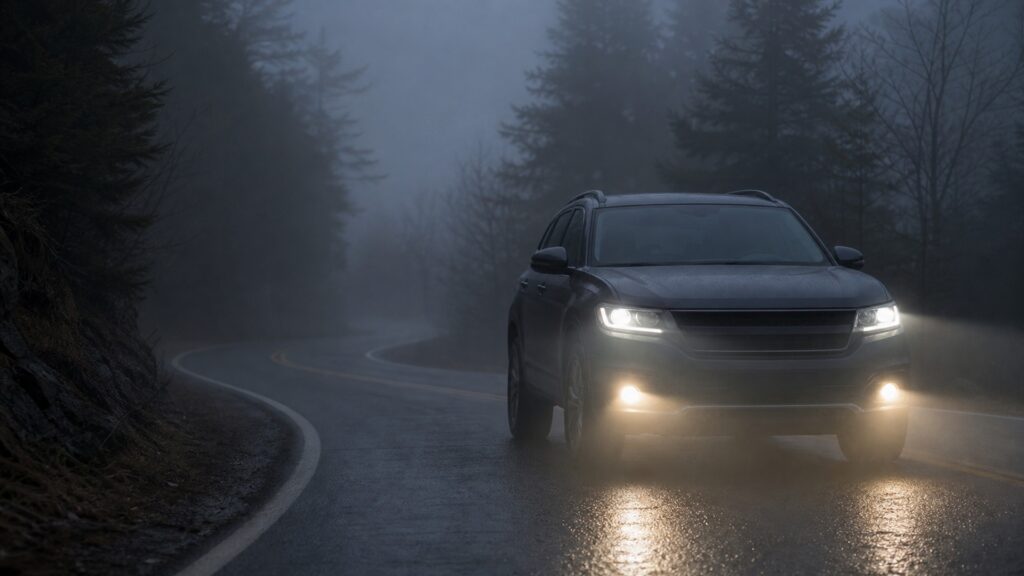
Fog lamps should improve nearby lane-edge contrast without adding a bright veil, dazzling others, or persuading the driver to travel faster than the visible stopping distance permits.
Tip: In actual fog, compare lane-edge visibility and backscatter at a safe stationary or very low-speed location, then choose a speed that leaves a substantial stopping margin inside the visible road.
These terms explain what a fog lamp can change and what weather still controls.
Auxiliary lamp producing a wide beam with controlled vertical spread for nearby adverse-weather visibility.
Light redirected by droplets, snow, dust, or spray toward the observer.
Upper boundary limiting light that would otherwise enter airborne moisture or other drivers' eyes.
Light concentrated on the road immediately ahead of the vehicle.
Filtered yellowish light historically used for some fog lamps.
Road length in which the driver can detect a hazard and bring the vehicle to a stop.
Tip: Fog-lamp use, color, height, number, switching, and interaction with high beams vary by jurisdiction; verify the vehicle instructions and current local rules.
Fog droplets and snowflakes redirect part of a headlamp beam back toward the driver. Light aimed farther upward intersects more suspended material in the line of sight, raising veiling luminance and reducing the contrast of darker road targets.
The problem is not that light stops; it is that returned light competes with the faint scene the driver needs to interpret.
A fog pattern emphasizes nearby lane edges and road boundaries with limited upward intensity. Low mounting can reduce direct illumination of the droplet field near eye level, while horizontal spread helps reveal markings and shoulders during slow travel.
Fog-lamp value comes from controlled placement, not from maximum brightness or a fashionable color.
A very bright patch near the bumper causes the eye to adapt to that luminance and draws attention downward. Dim pedestrians, stopped vehicles, curves, and reflective clues near the edge of visibility can then become harder to perceive.
Close-range clarity is helpful only when it does not purchase confidence at the expense of longer-range detection.
Selective-yellow light may feel less glaring to some drivers and can change contrast or scatter perception, but color filtering also removes energy. Droplet size, intensity, spectrum, beam angle, road surface, and individual vision all influence the outcome.
No color makes dense fog transparent; controlled geometry and reduced speed remain the dominant protections.
Use low beams and fog lamps where lawful, maintain wipers, washers, defogging, mirrors, and rear lighting, increase following distance, avoid abrupt maneuvers, and pull off safely if the road cannot be seen far enough ahead.
Fog lamps matter most when they support conservative decisions rather than justify maintaining normal-weather speed.
Their low, wide, controlled pattern addresses scatter and orientation while speed management addresses the shortened visible road.
A sound, correctly aimed pattern can reveal lane edges, pavement markings, and nearby boundaries with less upward spill than high beams.
Clean optics, compatible low beams, clear glazing, and restrained speed allow that local information to support safer positioning.
Dense fog, blowing snow, heavy rain, spray, dirty glass, worn markings, curves, and glare can reduce sight distance below what any lamp can repair.
Poor aim, excessive output, decorative colors, high mounting, or routine clear-weather use can add glare without meaningful information.
These myths confuse near-field brightness with the ability to see safely through suspended moisture.
Fog lamps may improve nearby orientation but cannot restore normal stopping sight distance. Speed must fall enough to detect, interpret, react to, and stop before a hazard inside the unstable visible boundary.
High beams send more light upward and farther into suspended droplets, often increasing the bright veil returned to the driver. Low beams and controlled fog lamps usually preserve more useful contrast in dense fog.
Yellow light does not bypass droplets. Spectrum can affect comfort and contrast, but beam geometry, intensity, aim, mounting, weather, road surface, and driver vision matter more. An unapproved tint may simply reduce output.
Clear-weather use can add foreground brightness and glare without extending useful seeing distance. Use fog lamps only for the conditions and combinations allowed by the vehicle instructions and local law, then switch them off.
Tip: Judge fog lights by controlled contrast and the speed they safely support, not by how dramatic the road appears beside the bumper.
These answers address use, aim, color, rear lamps, and what to do when visibility collapses.
Use them in fog, falling snow, heavy spray, or similar reduced-visibility conditions when their controlled near-field pattern genuinely helps and local rules permit. Turn them off when the condition clears.
Follow the vehicle or lamp manufacturer's prescribed level-surface method and mounting-height references. The pattern should remain low, symmetrical, and below other drivers' direct view without wasting most output immediately under the bumper.
No. A rear fog lamp is a high-intensity red conspicuity signal, not a road-illumination lamp. It can resemble a brake light in clear conditions, so use it only when visibility is severely reduced.
A controlled low pattern can support lane-edge visibility in spray, but wet-road reflections and falling rain may still create glare. Slow down, increase following distance, maintain wipers and tires, and avoid deep standing water.
Reduce speed smoothly, use low beams, maintain a large gap, avoid abrupt lane changes, and leave the roadway completely at a safe location if visible stopping distance becomes inadequate. Do not stop in a travel lane.
Fog lights matter because a low, wide, vertically controlled beam can improve nearby lane-edge contrast while limiting light scattered back from fog, snow, dust, or spray.
Their benefit remains local: use them with clean glazing, appropriate low beams, greater following distance, lower speed, lawful switching, and a willingness to stop safely when the visible road becomes too short.
These explainers distinguish adverse-weather orientation from general visibility and broad or long-range auxiliary lighting.
See how fog lamps interact with low beams, glazing, wiping, signaling, aim, electrical supply, and driver adaptation.
Review how drivers receive visual information and how a vehicle remains recognizable to others when weather reduces contrast.
Compare a fog lamp's low controlled pattern with broad light bars and long-range driving lights built for different tasks.
Choose a retailer
Prices checked regularly. We may earn a commission at no cost to you.