When to Use Passenger Vans Instead of Commercial Electric Vehicles

Choose a passenger van over a particular commercial electric vehicle when the electric candidate cannot accommodate the required passengers, luggage, access needs, or operating schedule. An electric cargo van is not a substitute for group seating simply because its exterior is van-shaped.

The categories overlap: a passenger van can itself be electric. Passenger van describes a vehicle's accommodation, while commercial electric vehicle describes a broad business-use and powertrain category. First compare vehicles capable of the same passenger task. Then decide whether their range, charging, refueling, and service arrangements fit the route. For battery-electric vehicles, charging must support the complete assignment; plug-in hybrids also have an engine and need a separate operating assessment.

By: Review Streets Research Lab
Updated: October 6, 2026
Explainer · 8-12 min read
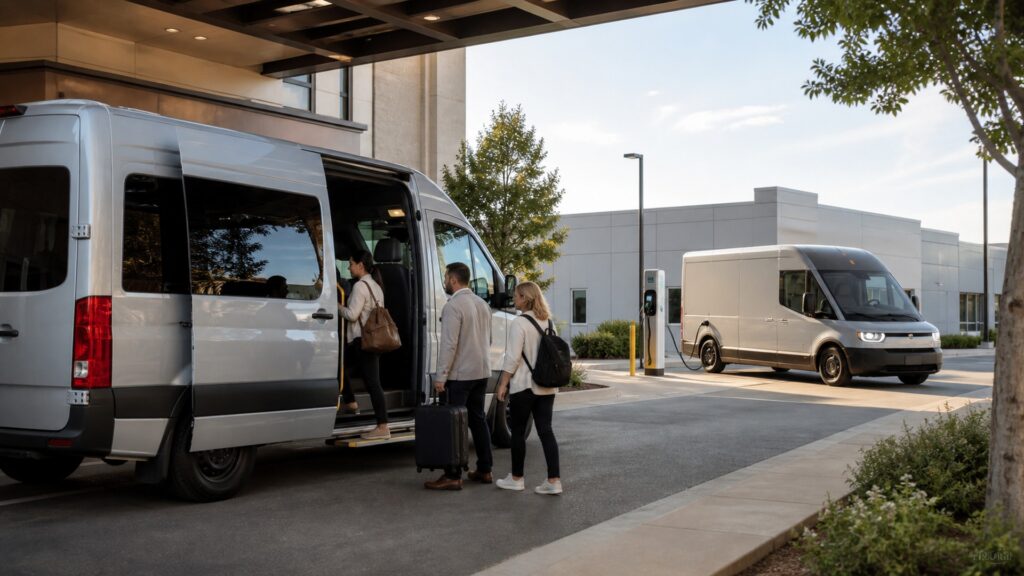
passenger vans explainer hero image for Review Streets
What You'll Learn

Match the Passenger Job Before Comparing Powertrains

Separate the cabin requirements from the energy plan needed to operate it.

  • Why passenger and electric are not opposite categories
  • When an electric commercial candidate fails the seating requirement
  • How the complete day differs from one advertised range figure
  • Why available charging time matters as much as charger location
  • When a conventional or an electric passenger configuration may make sense

Tip: Compare actual vehicles carrying the same group and luggage on the same assignment.

Definitions

Terms for Comparing Passenger Transport Options

These terms keep vehicle purpose and energy requirements distinct.

Passenger configuration

A passenger configuration provides designated seating and cabin arrangements for the intended occupants.

  • Example: a van fitted for a group shuttle
  • Check: seats, access, restraints, luggage, and load limits
  • Limit: the powertrain does not create missing passenger accommodation

Commercial electric vehicle

A commercial electric vehicle uses electric propulsion for a business or organizational transport task.

  • Example: an electric delivery van or an electric passenger shuttle
  • Check: what that particular vehicle is designed to carry
  • Limit: the category contains vehicles with different purposes

Daily duty cycle

A daily duty cycle is the complete pattern of trips, loads, stops, waiting, and energy use across the working day.

  • Example: morning transfers, a midday wait, and evening pickups
  • Check: the whole assignment rather than one short leg
  • Limit: a favorable single trip can hide a demanding day

Charging window

A charging window is the period when a vehicle can actually be connected and unavailable for other work.

  • Example: the overnight interval after the last return
  • Check: access to a compatible charger for enough time
  • Limit: a scheduled stop does not guarantee charging is possible

Operating reserve

An operating reserve is allowance beyond the expected trip requirement for uncertainty or disruption.

  • Example: planning for a detour or a later return
  • Check: a margin supported by the vehicle and route assessment
  • Limit: there is no universal reserve percentage for every route

Charging compatibility

Charging compatibility is the ability of the vehicle and charging equipment to connect and operate together as supported.

  • Example: using a charger with the required connector and capabilities
  • Check: the vehicle and charger specifications
  • Limit: the presence of a charging site does not establish suitability

Tip: Select candidates by passenger suitability before calculating whether their energy arrangements work.

Purpose

An Electric Cargo Van Does Not Solve a Missing-Seats Problem

Suppose an operator needs to move a group between a hotel and a station. An electric delivery van may serve parcels well but lack the rear seating and passenger facilities required for that group. A suitable passenger vehicle is the relevant starting point, whatever powers it. If a conversion is proposed, assess the completed configuration and its documentation rather than treating empty floor space as future seating.

  • Specify the occupants and luggage first.
  • Confirm designated seating and access in each candidate.
  • Exclude vehicles that do not meet the passenger assignment.

A battery-powered passenger van remains a passenger van; the comparison should not rule it out because it also belongs to the commercial electric category.

Daily work

Compare the Entire Day, Including the Unplanned Parts

List all trips, return journeys, waiting periods, and realistic detours. Compare that demand with information appropriate to the loaded vehicle and operating conditions. A published range figure is a useful reference, but it does not describe every combination of weather, speed, load, and cabin use. Gather route data or conduct an appropriate trial before committing a time-critical service to a new energy plan.

  • Include return legs and non-passenger travel.
  • Account for seasonal conditions and cabin energy use.
  • Plan how the service responds to a longer-than-expected day.

The Department of Energy explains that cold weather and cabin heating affect electric-vehicle energy use. Avoid assuming that a mild-weather result applies unchanged through winter.

Reference: DOE winter electric-vehicle guidance.

Charging

A Charger on the Map Is Only the Beginning

Charging must fit the actual stops. Check compatibility, site access, parking space, expected availability, and the time the vehicle can remain connected. A midday break elsewhere on the route is not a charging window at the depot. If public charging forms part of the plan, consider how a queue, unavailable unit, or detour would affect the next pickup.

  • Verify access at the times the service needs it.
  • Match vehicle and charging capabilities.
  • Identify an alternative when the planned charger is unavailable.

AFDC's public-charging guidance highlights vehicle choice, duty cycles, garaging locations, and off-site charging access as fleet-planning considerations.

Reference: AFDC public charging for vehicles and fleets.

Choosing

Use a Conventional Passenger Van When Its Operating Plan Fits Better

A suitable fuel-powered passenger van may be the practical choice when daily routes vary substantially and the operator has no workable charging arrangement for a comparable electric option. That is a conclusion about the current vehicles and service plan, not a rule that passenger transport must use combustion engines. Availability of suitable seating, support, and replacement transport also belongs in the decision.

  • Compare equally suitable passenger configurations.
  • Identify the specific charging or schedule constraint.
  • Reassess if routes, infrastructure, or vehicle options change.

For an irregular long-distance transfer service, predictable refueling access may currently fit better than a charging plan with unresolved stops.

Alternative

An Electric Passenger Vehicle Can Suit a Predictable Return-to-Base Service

A repeated route with a known daily demand and a dependable overnight charging opportunity gives an operator concrete information to evaluate. If the passenger configuration, energy allowance, charging installation, and service support all work together, electric propulsion can be a viable choice. Compare total operating arrangements rather than selecting on fuel or electricity price alone.

  • Check that the loaded route fits the vehicle's assessed capability.
  • Plan responsibility for connecting and monitoring charging.
  • Include maintenance, infrastructure, and substitute transport in the comparison.

AFDC's fleet guidance treats vehicle selection, charging provision, and staff preparation as connected parts of adopting electric vehicles.

Reference: AFDC electric vehicles for fleets.

Quick Reality Check

Two Useful Comparisons, Kept Separate

First test the passenger task, then test the energy plan.

Passenger suitability

Can the exact vehicle carry the group and bags with suitable seating, access, and load allowance?

A cargo-only candidate may fail here regardless of its powertrain.

Operating feasibility

Can the vehicle complete the service with workable charging or refueling and appropriate reserve?

Either an electric or conventional passenger vehicle may fit, depending on the actual assignment.

Common Myths

Misconceptions About Passenger Vans and Electric Vehicles

The labels do not define two mutually exclusive choices.

Passenger vans are always fuel-powered

Passenger accommodation and propulsion are different characteristics. A passenger vehicle can use electric propulsion.

Any commercial electric van can carry a group

The exact vehicle still needs suitable designated seats, restraints, access, and luggage space.

Advertised range proves a route will work

Assess the complete duty cycle and operating conditions, including charging and reserve.

An electric option is unsuitable whenever trips are long

Suitability depends on the actual vehicle, trip, stops, and charging plan. Distance alone does not settle the decision.

Tip: Write down the constraint that decides the comparison instead of treating a category label as the answer.

FAQ

Questions About Passenger Vans and Commercial Electric Options

Answers about overlapping categories and route planning.

Can a passenger van also be a commercial electric vehicle?

Yes. It can have passenger seating, electric propulsion, and a commercial role at the same time.

When is a conventional passenger van a reasonable choice?

When it meets the passenger task and a comparable electric candidate does not currently have a workable range, charging, availability, or support arrangement.

Is overnight parking enough to support charging?

Only if a suitable charging connection is available, accessible, and capable of meeting the vehicle's needs during that period.

Does a predictable shuttle route favor an electric assessment?

It can make assessment easier because the operator can measure the repeated duty and charging opportunity. The actual vehicle and load must still fit.

Should I compare only energy costs?

No. Include vehicle suitability, charging provision, service support, operating time, and replacement arrangements.

Bottom Line

Choose a passenger configuration that serves the group, then choose a powertrain whose energy and support arrangements fit the complete working day.

A conventional passenger van can be appropriate when a comparable electric option has unresolved operating constraints. An electric passenger van may be equally appropriate when those needs are met.

Next Steps

Go Deeper or Compare Your Options

Use these Review Streets paths to compare related categories and practical next decisions.