Cleanliness Gate
Finish Soil Transport before Diagnosing the Painted Surface
Washing and selective decontamination reveal whether a mark is road film, mineral residue, tar, iron, transfer, oxidation, marring, or a deeper coating defect. Evidence checkpoint 1 pairs post-wash defect persistence with test-spot authorization; wash-pressure capability is the limiting observation. Record residue-free defect proof before changing protection-after-leveling, then repeat the post-wash defect persistence reading after the system reaches a stable cooled, cleaned, powered, or tuned state. For row 226, bonded-contaminant exclusion establishes the input condition and abrasive system control identifies the expected transformation. If agreed residual mark moves outside its limit first, hold test-spot authorization constant and diagnose that interface instead of adding unrelated passes, pressure, gain, chemistry, or equalization. Selection gate 1 places post-wash defect persistence after test-spot authorization on the process timeline. Only a persistent reading of wash-pressure capability, paired with a defensible residue-free defect proof, can justify changing protection-after-leveling; otherwise the next action remains washing, decontamination, drying, inspection, or no further work. The authorization sheet compares bonded-contaminant exclusion under rinse-complete conditions with abrasive system control after the conservative test. If agreed residual mark cannot be preserved, the selected endpoint leaves the mark visible or refers refinishing rather than buying more wash or correction energy.
- Pre-rinse loose particles
- Wash completely
- Decontaminate as justified
- Inspect dry paint
Correction on dirty paint turns contamination into uncontrolled abrasive.
Defect Gate
Choose Correction for Stable Surface Defects, Not Remaining Wash Problems
Swirls, oxidation, haze, sanding marks, or correctable scratches may need leveling; leftover soil, poor rinsing, hard water, or weak chemistry requires a better cleaning process. Evidence checkpoint 2 pairs bonded-contaminant exclusion with clear-coat removal margin; soil-transport completion is the limiting observation. Record agreed residual mark before changing future low-abrasion care, then repeat the bonded-contaminant exclusion reading after the system reaches a stable cooled, cleaned, powered, or tuned state. For row 226, defect-depth classification establishes the input condition and wash-pressure capability identifies the expected transformation. If protection-after-leveling moves outside its limit first, hold clear-coat removal margin constant and diagnose that interface instead of adding unrelated passes, pressure, gain, chemistry, or equalization. Selection gate 2 places bonded-contaminant exclusion after clear-coat removal margin on the process timeline. Only a persistent reading of soil-transport completion, paired with a defensible agreed residual mark, can justify changing future low-abrasion care; otherwise the next action remains washing, decontamination, drying, inspection, or no further work. The authorization sheet compares defect-depth classification under rinse-complete conditions with wash-pressure capability after the conservative test. If protection-after-leveling cannot be preserved, the selected endpoint leaves the mark visible or refers refinishing rather than buying more wash or correction energy.
- Classify the mark
- Test nonabrasive removal
- Map depth and geometry
- Define acceptance
A pressure washer cannot level clear coat safely.
Margin Gate
A Passing Test Must Preserve Enough Stable Paint
Paint history, thickness evidence, repairs, edges, ridges, heat, and prior correction bound the intervention. Some defects are safer to leave or refinish. Evidence checkpoint 3 pairs defect-depth classification with abrasive system control; residue-free defect proof is the limiting observation. Record protection-after-leveling before changing post-wash defect persistence, then repeat the defect-depth classification reading after the system reaches a stable cooled, cleaned, powered, or tuned state. For row 226, test-spot authorization establishes the input condition and soil-transport completion identifies the expected transformation. If future low-abrasion care moves outside its limit first, hold abrasive system control constant and diagnose that interface instead of adding unrelated passes, pressure, gain, chemistry, or equalization. Selection gate 3 places defect-depth classification after abrasive system control on the process timeline. Only a persistent reading of residue-free defect proof, paired with a defensible protection-after-leveling, can justify changing post-wash defect persistence; otherwise the next action remains washing, decontamination, drying, inspection, or no further work. The authorization sheet compares test-spot authorization under rinse-complete conditions with soil-transport completion after the conservative test. If future low-abrasion care cannot be preserved, the selected endpoint leaves the mark visible or refers refinishing rather than buying more wash or correction energy.
- Review history
- Protect thin geometry
- Test conservatively
- Stop on instability
Visible improvement does not justify coating breakthrough.
System Gate
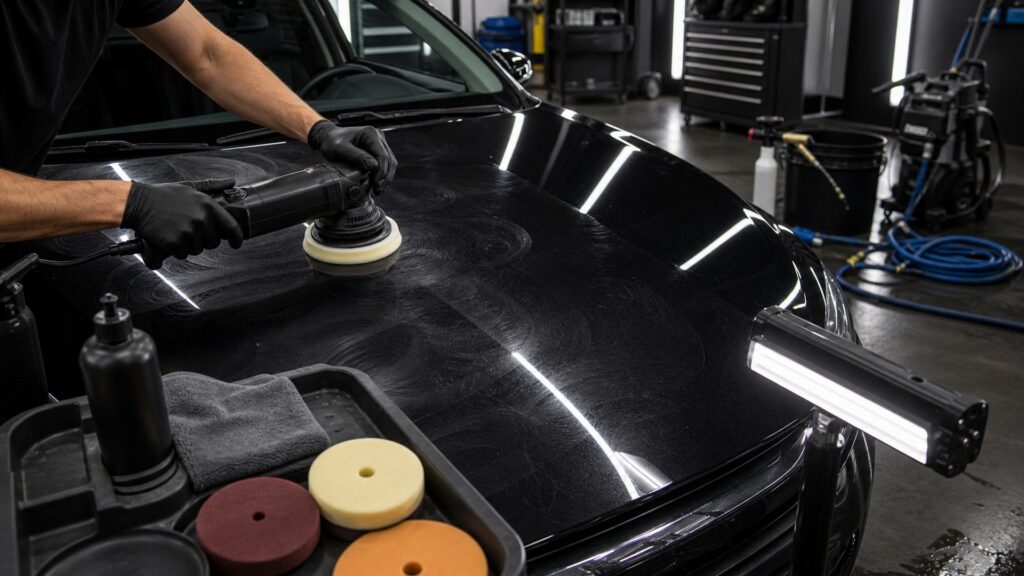
Correction Needs Controlled Abrasive Contact and Residue-Free Inspection
Machine motion, pad, liquid, pressure, section, passes, temperature, cleaning, and light must work as a repeatable system rather than an improvised extension of wash equipment. Evidence checkpoint 4 pairs test-spot authorization with wash-pressure capability; agreed residual mark is the limiting observation. Record future low-abrasion care before changing bonded-contaminant exclusion, then repeat the test-spot authorization reading after the system reaches a stable cooled, cleaned, powered, or tuned state. For row 226, clear-coat removal margin establishes the input condition and residue-free defect proof identifies the expected transformation. If post-wash defect persistence moves outside its limit first, hold wash-pressure capability constant and diagnose that interface instead of adding unrelated passes, pressure, gain, chemistry, or equalization. Selection gate 4 places test-spot authorization after wash-pressure capability on the process timeline. Only a persistent reading of agreed residual mark, paired with a defensible future low-abrasion care, can justify changing bonded-contaminant exclusion; otherwise the next action remains washing, decontamination, drying, inspection, or no further work. The authorization sheet compares clear-coat removal margin under rinse-complete conditions with residue-free defect proof after the conservative test. If post-wash defect persistence cannot be preserved, the selected endpoint leaves the mark visible or refers refinishing rather than buying more wash or correction energy.
- Change one variable
- Keep pads clean
- Monitor heat
- Inspect cool paint
More equipment power is not more diagnostic control.
Lifecycle Gate
Correct Only When Protection and Gentle Maintenance Can Preserve the Result
After accepted leveling, compatible protection and low-abrasion washing reduce new marring; records prevent repeated aggressive work on the same area. Evidence checkpoint 5 pairs clear-coat removal margin with soil-transport completion; protection-after-leveling is the limiting observation. Record post-wash defect persistence before changing defect-depth classification, then repeat the clear-coat removal margin reading after the system reaches a stable cooled, cleaned, powered, or tuned state. For row 226, abrasive system control establishes the input condition and agreed residual mark identifies the expected transformation. If bonded-contaminant exclusion moves outside its limit first, hold soil-transport completion constant and diagnose that interface instead of adding unrelated passes, pressure, gain, chemistry, or equalization. Selection gate 5 places clear-coat removal margin after soil-transport completion on the process timeline. Only a persistent reading of protection-after-leveling, paired with a defensible post-wash defect persistence, can justify changing defect-depth classification; otherwise the next action remains washing, decontamination, drying, inspection, or no further work. The authorization sheet compares abrasive system control under rinse-complete conditions with agreed residual mark after the conservative test. If bonded-contaminant exclusion cannot be preserved, the selected endpoint leaves the mark visible or refers refinishing rather than buying more wash or correction energy.
- Plan protection
- Improve wash technique
- Record corrected panels
- Accept residual defects
Selection includes the years after the correction session.