When to Use Single Axle Utility Trailers Instead of Dual Axle Utility Trailers

Use a single-axle utility trailer instead of a dual-axle trailer when the exact single-axle model meets the load, deck, towing, and route requirements, and its size or simpler running gear suits your use. A second axle is valuable when the chosen trailer needs the capacity or configuration it provides; it is not automatically necessary for every hauling task.

In this comparison, dual axle means two trailer axles, commonly arranged as a tandem pair. It does not mean two tires fitted side by side at one wheel position. Compare actual trailer specifications and complete loaded combinations, because axle count alone does not state payload, braking equipment, or towing suitability.

By: Review Streets Research Lab
Updated: October 7, 2026
Explainer · 8-12 min read
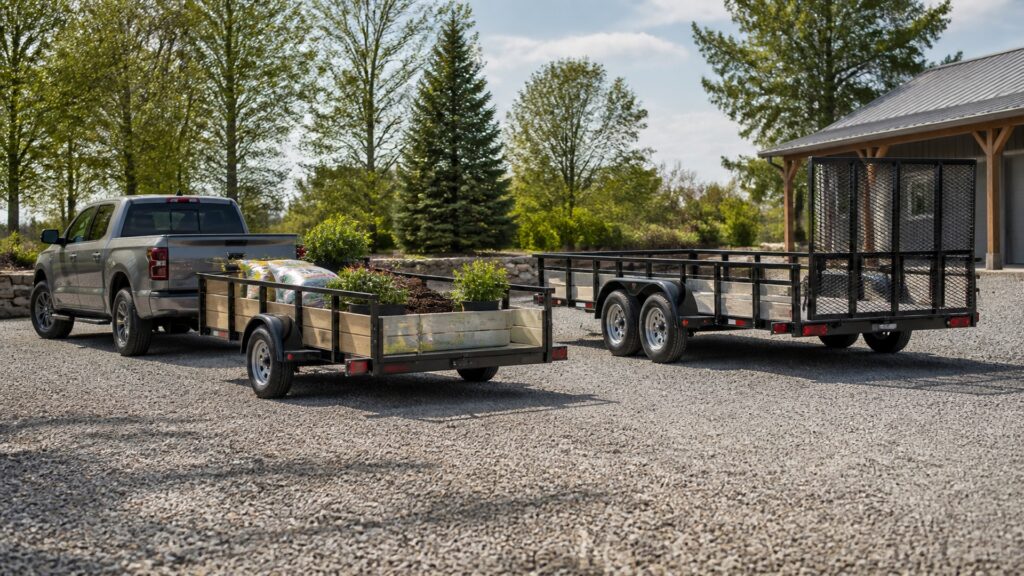
single axle utility trailers explainer hero image for Review Streets
What You'll Learn

Choose the Axle Arrangement from the Job

Start with the load and tow vehicle, then compare useful capacity and ownership needs.

  • What single and tandem axle describe
  • Why rated total weight differs from cargo allowance
  • When a suitable single-axle trailer is enough
  • What changes with tandem running gear
  • When to choose a different trailer or transport plan

Tip: List the largest regular load, including tools and accessories, before deciding how many axles you need.

Definitions

Six Terms for Choosing an Axle Arrangement

Separate the trailer’s specification from broad assumptions.

Single axle

A single-axle trailer has one axle assembly beneath its load-carrying structure.

  • Example: a utility trailer with one axle beneath the deck
  • Check: the particular trailer’s ratings and configuration
  • Limit: one axle does not supply a universal capacity

Tandem axle

A tandem arrangement has two axles positioned one behind the other.

  • Example: two axle assemblies under a utility deck
  • Check: the exact axle, suspension, tire, and brake setup
  • Limit: two axles do not eliminate loading limits

Empty trailer mass

Empty trailer mass is the weight of the trailer before the intended cargo is loaded.

  • Example: the trailer with its fitted gate and permanently installed accessories
  • Check: the actual equipped condition
  • Limit: a published base weight may exclude later additions

Payload allowance

Payload allowance is the cargo weight available within the applicable loaded-trailer limit after its own mass is accounted for.

  • Example: remaining capacity after a toolbox is installed
  • Check: all relevant component and towing limits
  • Limit: GVWR is not cargo capacity

Towing compatibility

Towing compatibility means the loaded trailer can be used with the selected vehicle and connection equipment.

  • Example: a vehicle and hitch suitable for the intended loaded trailer
  • Check: total towing, tongue load, and vehicle loading requirements
  • Limit: a higher-rated trailer does not raise the vehicle’s limits

Ownership burden

Ownership burden is the practical cost and effort of storing, inspecting, and maintaining the trailer.

  • Example: maintaining the fitted tires, bearings, and brakes
  • Check: actual equipment, service needs, and storage access
  • Limit: axle count does not establish the entire purchase or maintenance cost

Tip: Use the numbers and equipment on the exact candidates, not a generic single-versus-tandem rule.

Need

Define a Representative Load Before Choosing Axles

Identify the heaviest regular assignment, its dimensions, and its handling requirements. Include tools, spare equipment, and other items that travel with it. A suitable single-axle trailer may be enough for that defined job; an occasional load beyond its limits requires another arrangement. Do not justify an overloaded trip because most previous loads were lighter.

  • List complete operating cargo.
  • Check deck and loading-equipment suitability.
  • Consider recurring changes in the work.

A mower plus hand tools may fit one candidate, while adding another machine can change both the required deck and allowable mass. The decision should follow that real change in work.

Capacity

Calculate Cargo Allowance from the Actual Trailer

The trailer’s gross vehicle weight rating is a loaded-total limit, not the amount of cargo it can accept. Subtract the actual equipped empty mass as an initial cargo-allowance check, then respect the other relevant limits and required distribution. A tandem candidate may offer greater rated capacity, but compare its own mass and configuration as well.

  • Use the actual equipped empty mass.
  • Check the loaded total and other applicable limits.
  • Do not treat an axle rating as the whole trailer rating.

Illustrative arithmetic: a hypothetical trailer with a 3,000-pound loaded limit and a 900-pound equipped empty weight has 2,100 pounds remaining against that limit. These invented figures explain subtraction; they are not a specification or a complete towing approval.

Reference: Max Built axle and capacity comparison.

Tow vehicle

Keep the Vehicle and Hitch in the Comparison

A trailer with more capacity may also impose more empty weight and different equipment demands. Confirm that the tow vehicle can support the actual loaded trailer and tongue load alongside its occupants and other cargo. Check hitch compatibility and any brake-controller requirements. Buying a larger trailer does not increase the towing vehicle’s capabilities.

  • Assess the vehicle in its loaded travel condition.
  • Check the hitch and coupling requirements.
  • Confirm support for the trailer’s fitted systems.

Carry-On’s utility-trailer instructions require attention to the towing vehicle and connection equipment. If the single-axle candidate meets the task while a larger candidate exceeds the vehicle’s limits, extra trailer capacity is not useful to that combination.

Reference: Utility-trailer towing instructions.

Use and upkeep

Compare Maneuvering Space and Actual Running Gear

A compact single-axle candidate may be easier to store or position, but length, width, load, surface, and the handling method still matter. Typical tandem arrangements add wheel-end components to inspect and maintain. During tight turns, tandem tires can scrub because the two axles follow different paths. Assess the exact trailer rather than assuming any empty trailer is safe to move by hand.

  • Measure storage and access constraints.
  • Compare actual tires, hubs, suspension, and brakes.
  • Use an appropriate parking and maneuvering method.

Max Built’s comparison explains these running-gear tradeoffs. Their practical importance depends on the particular trailer and site; they do not prove that every single-axle model costs less or fits a smaller space.

Reference: Max Built running-gear tradeoffs.

Decision

Choose the Single Axle When It Fully Meets the Assignment

Select the single-axle trailer when its verified capacity, deck, equipment, and towing compatibility satisfy the work and its ownership needs are acceptable. Consider a suitable tandem or another transport arrangement when those requirements exceed the candidate’s capabilities. Greater axle count does not excuse poor load placement, defective equipment, or inadequate restraint.

  • Check every requirement before accepting the simpler option.
  • Allow for realistic recurring loads.
  • Reconsider the choice when the job changes.

A second axle should solve an identified requirement. Conversely, keeping one axle should never depend on omitting equipment from the load calculation or relying on unused deck space as proof of capacity.

Quick Reality Check

When Each Candidate Deserves Consideration

The final decision belongs to the exact trailer and towing combination.

Single axle may be enough

The complete regular load fits the deck and all relevant limits.

Storage and upkeep favor the suitable smaller or simpler candidate.

Tandem or another option may be needed

The single-axle candidate lacks required capacity or load-handling space.

The work requires capabilities offered by a suitable alternative configuration.

Common Myths

Misconceptions About Choosing Trailer Axles

Avoid replacing specifications with a category rule.

Two axles always mean twice the payload

Empty mass, component ratings, and the complete design affect cargo allowance.

A bigger trailer increases vehicle towing capacity

The tow vehicle and hitch retain their own limits.

Every single-axle trailer is easy to move by hand

Mass, load, slope, surface, and the approved handling method matter.

A tandem makes load placement unimportant

Correct distribution and restraint remain necessary.

Tip: A well-matched single-axle trailer is useful because it meets the task, not because an overloaded one is cheaper.

FAQ

Questions About Single Versus Dual Axle Utility Trailers

Answers for selecting a capable combination.

Does dual axle mean dual wheels?

Not here. Dual axle means two axle assemblies; dual wheels refers to paired tires at a wheel position.

Is GVWR the cargo capacity?

No. It includes the trailer’s own mass, and other relevant limits still apply.

When is a single axle a reasonable choice?

When the exact trailer safely supports the complete load and route with a suitable tow vehicle and handling arrangement.

Should I buy extra capacity for future work?

Consider realistic recurring needs, but include the larger trailer’s empty mass, storage, equipment, and towing requirements.

Does a second axle allow continued travel after a tire fails?

Do not treat it as permission to continue. Stop safely and follow the appropriate vehicle and trailer guidance for the failure.

Bottom Line

Use a single-axle utility trailer when its actual capacity and configuration fully support the job and the towing vehicle.

Choose a tandem or another option to meet a real requirement, while preserving the same loading, restraint, and condition checks.

Next Steps

Go Deeper or Compare Your Options

Use these Review Streets paths to compare related categories and practical next decisions.