Why Single Axle Utility Trailers Safety Factors Matters

A single-axle utility trailer depends on several safety conditions at once: a suitable towing vehicle, loading within the relevant limits, a secure connection, controlled cargo, and serviceable running gear. Passing one check does not compensate for failing another. A light trailer can still be unsafe if the coupler is mismatched or the load can shift.

Axle count is only part of the design. Judge the actual trailer, hitch, tow vehicle, and load as a combination. The useful question is not simply whether the trailer can hold the objects, but whether that combination can carry them under the planned operating conditions.

By: Review Streets Research Lab
Updated: October 7, 2026
Explainer · 8-12 min read
single axle utility trailers explainer hero image for Review Streets
What You'll Learn

Understand the Safety Checks That Work Together

Connect the load to the towing vehicle and the road.

  • Why total mass and load position are separate checks
  • How coupling compatibility differs from appearance
  • Why cargo needs restraint even on a short trip
  • What tires and fitted braking systems contribute
  • When a new symptom should interrupt the journey

Tip: Use the exact trailer and towing-vehicle instructions; a general category cannot supply their limits.

Definitions

Six Safety Concepts for Single-Axle Hauling

Each addresses a different way the combination can become unsuitable.

Loaded mass

Loaded mass is the trailer’s own weight plus all cargo and added equipment.

  • Example: a utility trailer carrying tools and bagged material
  • Check: the trailer and towing combination’s applicable limits
  • Limit: empty space does not establish remaining capacity

Tongue load

Tongue load is the downward load the trailer applies through the hitch connection.

  • Example: load placement changing the force at the coupler
  • Check: the specified loading range and hitch or vehicle limits
  • Limit: acceptable total mass does not prove correct distribution

Coupling compatibility

Coupling compatibility means the connection parts match their intended type, size, and ratings.

  • Example: a ball and coupler with matching size markings
  • Check: component condition and the prescribed connection procedure
  • Limit: a latch that appears closed can still be incorrectly connected

Cargo restraint

Cargo restraint controls load movement and prevents material from escaping.

  • Example: equipment secured to suitable trailer attachment points
  • Check: restraint capacity, condition, placement, and instructions
  • Limit: side rails or a tarp alone may not restrain the load

Running-gear condition

Running-gear condition concerns the tires, wheels, hubs, axle, and associated suspension.

  • Example: a tire defect discovered before departure
  • Check: the exact components and required inspection
  • Limit: low mileage does not guarantee sound condition

Combination readiness

Combination readiness means the vehicle, trailer, load, and installed systems are prepared for the planned trip.

  • Example: confirming lights, fitted brakes, load security, and route suitability
  • Check: the complete setup before travel and after changes
  • Limit: one successful past trip does not validate today’s load

Tip: Treat each requirement as a separate check, then assess the complete combination.

Mass and placement

Keep the Load Within Every Relevant Limit

Include the empty trailer, accessories, and all goods when assessing loaded mass. Check the towing vehicle and connection limits as well as trailer ratings. Load placement also matters: moving a heavy object changes tongue load even when total mass stays the same. Follow the trailer’s distribution instructions and verify weights when estimates are uncertain.

  • Account for everything carried.
  • Check specified tongue load and distribution.
  • Do not use deck area as a weight estimate.

For example, a stack of dense pavers may occupy very little deck space while consuming much of the allowable load. A larger but lighter object can create a different restraint and wind-exposure problem.

Connection

Verify the Hitch Connection as a System

The receiver or towing attachment, ball or other coupling, trailer coupler, and their fasteners must be appropriate for the combination. Follow the correct coupling and locking procedure. Attach safety connections and any fitted breakaway system as specified. A damaged or unreliable latch needs assessment, not extra force or an improvised substitute pin.

  • Match component type, size, and rating.
  • Inspect for wear and damage.
  • Complete the prescribed coupling checks.

Carry-On’s utility-trailer manual emphasizes that connection compatibility and condition are essential. Physical proximity between a ball and coupler does not establish correct engagement.

Reference: Carry-On coupling and towing instructions.

Cargo

Prevent Movement and Escaping Material

Restrain the actual load using appropriate equipment and attachment points. Consider braking, bumps, turns, and airflow over an open trailer. Cover loose material where needed without assuming the cover replaces restraint. Recheck the arrangement when cargo is removed, added, or repositioned; the first delivery can change both security and distribution.

  • Secure large objects to suitable points.
  • Contain material that can blow or fall out.
  • Check remaining cargo after a delivery.

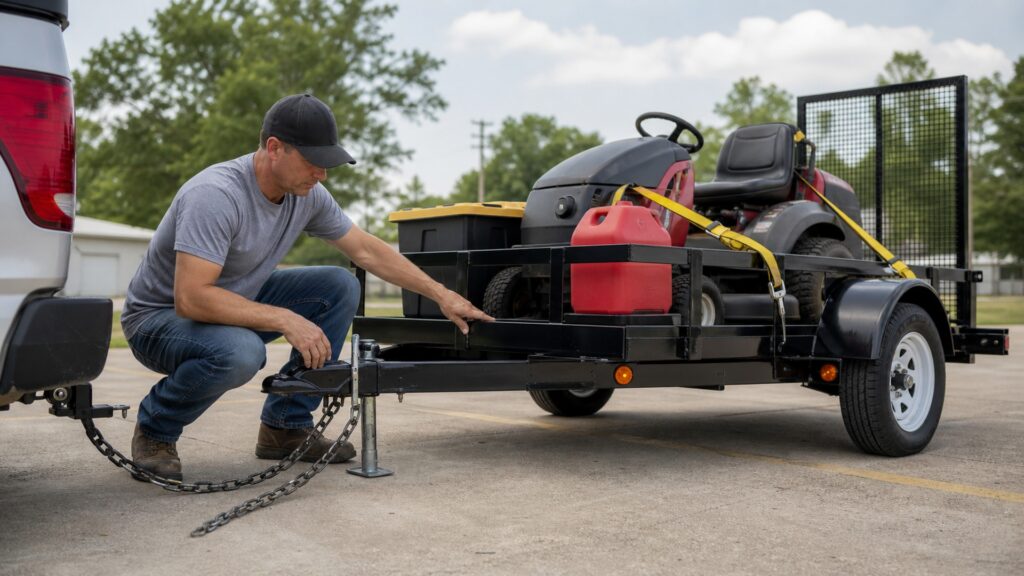
NHTSA’s load-security guidance asks drivers to consider sudden braking and bumps. A mower resting behind a raised gate still needs its prescribed transport restraint; the gate is not a complete securing system.

Reference: NHTSA load-security guidance.

Condition

Check Tires, Wheels, and Fitted Safety Systems

Tires must be appropriate, correctly inflated for the specified setup, and free of disqualifying damage. Wheel attachment, bearings, and suspension need their prescribed care. Check lighting and any fitted brakes, controller, or breakaway equipment using their instructions. Do not assume every single-axle trailer has the same systems or requirements.

  • Inspect tires and wheel condition.
  • Follow the relevant service and fastener checks.
  • Test installed lighting and braking equipment.

NHTSA tire guidance and axle-specific manuals serve different purposes. General tire care does not supply the correct wheel torque, bearing procedure, or brake adjustment for an unidentified trailer.

Reference: NHTSA tire guidance, Dexter axle service instructions.

Travel

Reassess When Conditions or Behavior Change

Allow for the loaded combination’s dimensions, stopping needs, and operating restrictions. Plan maneuvering and unloading space before committing to a narrow site. If the trailer develops abnormal movement, noise, a lighting fault, or another concerning symptom, reach a safe stopping place and have the cause addressed. Continuing because the destination is close does not resolve the defect.

  • Follow the vehicle and trailer operating guidance.
  • Consider weather, surface, and route restrictions.
  • Respond to changes in load or behavior.

A trailer that seemed satisfactory on departure may no longer be ready after cargo shifts or a component is damaged. Safety checks apply to the current condition, not just the start of the day.

Quick Reality Check

Capacity and Readiness Are Different Questions

Both must be satisfied before a loaded trip.

Capacity assessment

The load stays within trailer and towing-combination limits.

Distribution meets the specified tongue-load requirements.

Readiness assessment

Connections, restraint, and installed systems are correctly prepared.

No unresolved defect undermines the planned use.

Common Myths

Unsafe Assumptions About Small Utility Trailers

A compact trailer still needs a complete assessment.

A light load cannot cause trouble

Poor restraint, an incorrect connection, or a tire defect can matter at low load as well.

A closed coupler latch proves correct attachment

Compatibility and the full coupling check remain necessary.

A raised gate secures every load

Cargo requires suitable restraint for its own shape and movement risks.

One axle means brakes are never needed

Equipment and applicable requirements depend on the actual trailer, load, combination, and location.

Tip: Do not use a successful previous trip as evidence that a changed load or new defect is acceptable.

FAQ

Questions About Single-Axle Trailer Safety

Answers for checking the whole towing combination.

Which rating should I use?

Check all applicable trailer, tow-vehicle, hitch, coupling, tire, and axle limits using the exact documentation.

Can a load be under the weight limit but poorly placed?

Yes. Total mass and tongue-load distribution are separate considerations.

Does a tarp replace tie-downs?

No. Containment and restraint must suit the cargo; a cover alone may not stop a heavy object moving.

What should change after unloading part of the cargo?

Reassess remaining load placement and restraint before traveling again.

What if a warning sign appears during the trip?

Stop safely and resolve or obtain appropriate assessment of the cause before continuing with an unsafe condition.

Bottom Line

Single-axle trailer safety depends on the complete combination: suitable limits, correct loading, secure connections, restrained cargo, and sound equipment.

Check each requirement and reassess after load changes or new symptoms.

Next Steps

Go Deeper or Compare Your Options

Use these Review Streets paths to compare related categories and practical next decisions.