
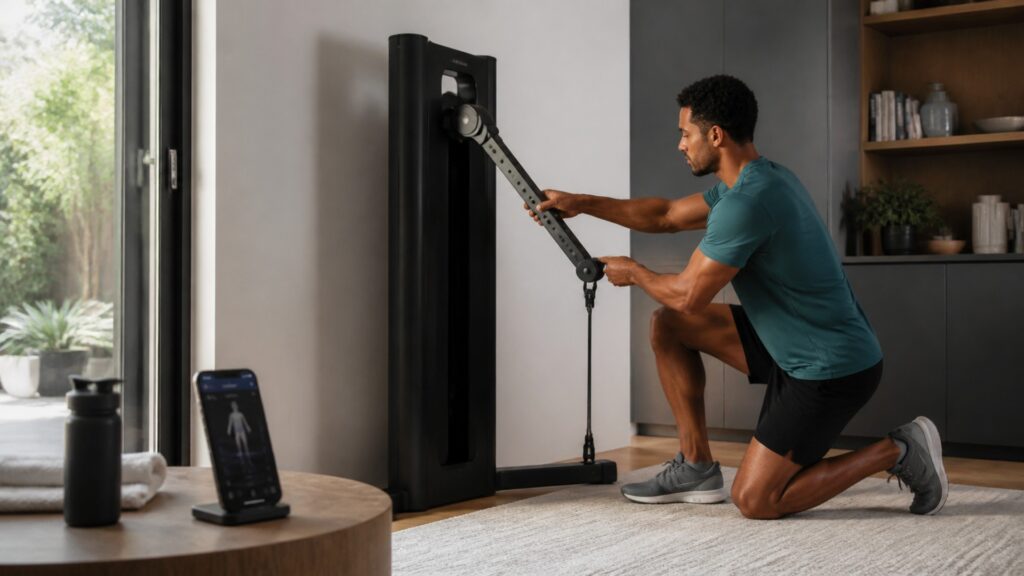
When to Use Smart Home Gyms Instead of Fitness Training Apps

Use a smart home gym instead of a fitness training app when the workout needs dedicated hardware, a ready-to-use home setup, and more structure than a phone can provide. Apps can guide workouts well, but they do not supply resistance, a training station, or machine-level feedback on their own.

A smart home gym makes the most sense when the equipment itself removes friction: fewer setup decisions, built-in resistance, a larger display, automatic tracking, and a clear place to train.

By: Review Streets Research Lab
Updated: September 21, 2026
Explainer · 8-12 min read
smart home gyms explainer hero image for Review Streets
What You'll Learn

When A Smart Home Gym Is The Better Fit

A practical decision path for choosing dedicated home hardware over app-only coaching.

  • Why dedicated hardware can improve workout consistency
  • How built-in resistance and tracking change the session
  • Where a fixed home station beats phone-based flexibility
  • When an app is still the smarter choice
  • What to check before committing to the larger system

Tip: Judge the system by what it makes easier during real workouts, not by how advanced it sounds.

Definitions

Key Concepts Behind Smart Home Gyms Instead of Fitness Training Apps

These concepts clarify the practical signals readers should check before choosing a smart home gym.

Dedicated Training Station

A dedicated training station is a fixed home setup that is ready when the user wants to train.

  • Example: a wall-mounted strength system in a spare room
  • Check: confirm the space can stay available
  • Limit: fixed setups do not travel

Built-In Resistance

Built-in resistance means the system supplies load through digital resistance, cables, weight stacks, or similar hardware.

  • Example: selecting resistance from a screen before a set
  • Check: review resistance range and feel
  • Limit: hardware may not match free-weight preferences

Large-Screen Guidance

Large-screen guidance makes demos, timers, and workout flow easier to see without handling a phone.

  • Example: following a strength session on a mounted display
  • Check: see whether the screen improves focus
  • Limit: a larger screen does not guarantee better programming

Automatic Tracking

Automatic tracking saves workout metrics with less manual entry.

  • Example: recording resistance, reps, and session completion
  • Check: confirm what is captured automatically
  • Limit: data still needs to be useful

App-Only Coaching

App-only coaching gives plans, demos, and logging without dedicated hardware.

  • Example: following a dumbbell plan on a phone
  • Check: decide whether existing equipment is enough
  • Limit: the app cannot create hardware feedback by itself

Commitment Fit

Commitment fit is whether the cost, space, and subscription make sense for expected use.

  • Example: buying a system after proving home workouts are consistent
  • Check: compare expected weekly use to total cost
  • Limit: good intentions do not guarantee repeated use

Tip: The best smart home gym features are the ones that reduce friction without hiding important limits.

Hardware Need

Choose Hardware When The App Cannot Supply The Workout

A fitness app can guide, but it cannot create resistance or a dedicated training station by itself. Smart home gyms make sense when the physical system solves the missing piece.

  • Use hardware when resistance is central.
  • Choose a system that supports the exercises you want.
  • Avoid buying hardware if existing equipment already solves the need.

The equipment should change the workout, not just display it.

Convenience

A Ready Station Can Reduce Setup Friction

Some users train more often when the workout space is always ready. A smart home gym can make training feel like stepping into a small private studio.

  • The system should be easy to start.
  • Accessories should be close at hand.
  • The setup should not require moving furniture every time.

Convenience is a real feature when it leads to repeated use.

Feedback

Built-In Tracking Can Make Progress Easier To See

Apps often depend on manual logging. Smart home gyms can capture resistance, reps, duration, or completion automatically, depending on the system.

  • Automatic tracking should save time.
  • Progress views should be easy to read.
  • Metrics should connect to future workouts.

Tracking matters when it changes what the user does next.

App Advantage

Use An App When Flexibility Matters More

A fitness training app is still better when the user trains in multiple places, already owns useful equipment, or wants a lower-cost way to test the routine.

  • Apps travel better.
  • Apps are easier to pause or replace.
  • Apps can work with gym equipment the user already has.

A smart home gym should not be the first answer when flexibility is the main need.

Decision

Buy The System Only When It Solves A Proven Barrier

The best reason to choose a smart home gym is that app-only training has a clear limitation: not enough resistance, too much setup, weak tracking, or low consistency at home.

  • Identify the barrier before buying.
  • Compare total cost and space needs.
  • Choose the system you will actually use weekly.

The larger commitment makes sense when it removes a barrier the app cannot remove.

Quick Reality Check

Where Smart Home Gyms Beat Apps And Where Apps Stay Better

The decision depends on whether hardware or flexible coaching is the missing piece.

Smart Home Gyms Win When

Dedicated resistance, display, and tracking make training easier.

A fixed home station improves consistency.

Fitness Apps Stay Better When

The user needs portability, lower cost, or workouts across several locations.

Existing equipment already supports the plan.

Common Myths

Misconceptions About Smart Home Gyms Versus Apps

Hardware can help, but it is not automatically the better choice.

A smart home gym is always more effective

It is more effective only when the hardware improves training behavior.

Apps are too simple for serious training

Apps can support strong programming when the user has equipment and consistency.

Automatic tracking is always worth the cost

Tracking is valuable only when the user uses the feedback.

A dedicated station guarantees consistency

It reduces friction, but the routine still has to fit the user.

Tip: Treat strong claims as reasons to inspect the system more closely, not as final proof.

FAQ

Frequently Asked Questions About Smart Home Gyms Versus Apps

Short answers for practical buying and training decisions.

When should I choose a smart home gym over an app?

Choose a smart home gym when dedicated resistance, a ready home station, and automatic tracking would improve your routine.

Can an app be enough?

Yes. An app can be enough when you already have equipment and mainly need programming, demos, and logging.

What should I check before buying?

Check space, supported exercises, resistance range, subscription cost, and what works if the subscription ends.

Who should avoid a smart home gym?

Users who need portability, low cost, or gym-based flexibility may be better served by an app.

What is the practical takeaway?

Use smart home gyms when hardware removes a real barrier; use apps when coaching is the main need.

Bottom Line

Smart home gyms make sense when dedicated hardware solves a problem an app cannot solve alone.

Apps remain the better choice when flexibility, lower cost, and existing equipment are enough.

Next Steps

Go Deeper or Compare Your Options

Use these Review Streets paths to compare related categories and practical next decisions.