
Gait-Led Choice
Choosing the treadmill because walking or running is the desired movement.
- It centers self-directed steps.
- It differs from guided stride.
- It is a category boundary.
Use the treadmill over the elliptical when the reader wants self-directed walking or running on a belt, not a guided oval pedal path. That is the decision, plain and narrow.
The treadmill gives more freedom in foot placement and gait, but it also asks the user to manage a moving surface, deck clearance, and step-off space. The elliptical gives more guidance through linked pedals and handles.
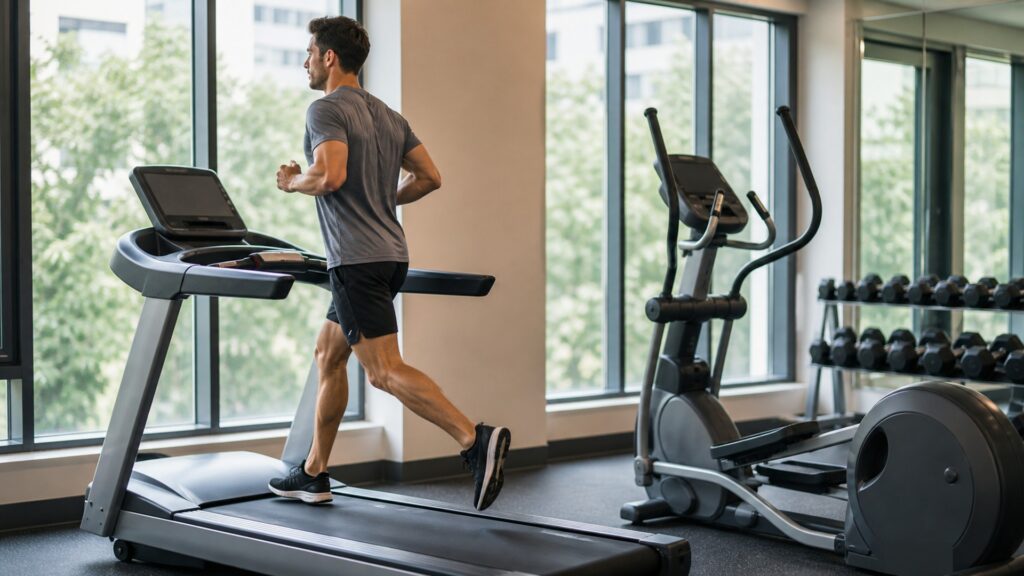
This decision boundary asks whether the reader wants gait freedom on a belt or guided elliptical motion.
Tip: Ask whether the user wants to place each step freely; that answer usually separates treadmill intent from elliptical intent.
These definitions connect the main idea to the variables, limits, and practical signals readers need to compare options.
Choosing the treadmill because walking or running is the desired movement.
The linked pedal path supplied by an elliptical.
How workable the moving surface feels for the intended pace.
The active room an elliptical needs for pedal and handle travel.
Treadmill speed setting used to organize walking or running.
The elliptical option when the reader wants a smoother constrained path.
Tip: Keep belt pace and elliptical linkage in separate lanes.
The treadmill is the right choice when the reader specifically wants gait on a belt rather than a guided elliptical foot loop.
Choose the treadmill for gait, not vague intensity.
An elliptical places the feet on linked pedals that trace an oval path and may add moving handles. That guidance can help or get in the way.
The elliptical is not worse; it solves a different motion problem.
Treadmill speed and incline are not the same as elliptical resistance, stride length, or ramp settings.
The decision should not pretend the metrics translate.
A treadmill needs belt length and step-off room. An elliptical needs room for pedal travel and handle swing.
The room can decide which movement is practical.
If the reader wants lower footpath freedom, moving handles, or a smoother guided loop, the elliptical may fit better.
A useful decision names when the other category wins.
This comparison is useful when it stays with gait, guidance, controls, and room shape.
It clarifies why treadmill pace and elliptical stride settings answer different needs.
It names cases where guided motion is the better choice.
It cannot prove safety, calorie burn, or personal training outcomes.
It does not replace trying a specific model.
Common shortcuts and misunderstandings can make the topic seem simpler than it is.
Running is useful only when running is the desired activity.
They guide a different standing motion rather than copying belt gait.
They change different machine behaviors.
Natural-feeling movement still depends on user and product fit.
Tip: Treat strong claims as starting points for comparison, not final answers.
Concise answers to common questions readers may have after the main explanation.
Use it when walking or running gait on a moving belt is the goal.
Choose the elliptical when guided stride and linked handles are preferred.
The elliptical usually guides the foot path more than the treadmill.
Yes. Treadmills need deck and step-off clearance; ellipticals need stride and handle clearance.
No. It is an equipment decision boundary.
Use a treadmill instead of an elliptical when self-directed walking or running on a belt is the feature that matters.
Use the elliptical when guided standing stride is the better fit for the session and space.
Use these Review Streets paths to connect the explainer to related categories, comparisons, and next decisions.
Use this for the treadmill mechanism behind this topic.
Browse treadmill options after clarifying the title-specific issue.
Use this for the bicycle-side mechanical baseline.
Choose a retailer
Prices checked regularly. We may earn a commission at no cost to you.