
Theft Risk
A bounded unauthorized-entry, start, removal, vandalism, or recovery exposure described by context, likelihood indicators, and consequence.
- Risk guides controls
- Not every event is preventable
- Evidence limits remain
Use a vehicle security system when the unmet outcome is a defined protected boundary, access rule, start-authorization function, alarm response, remote notice, or recovery aid. The decision should begin with exposure and existing factory capability, not with how visible or loud the proposed hardware appears.
Use a car audio system when the missing result concerns source compatibility, calls, processing, amplification, speaker output, control, or listening quality. Security warnings can enter the audio chain, and both systems can share battery or data interfaces, but neither product creates the other's core result. Diagnose common resets, noise, and sleep-current problems before concluding that both categories need replacement.
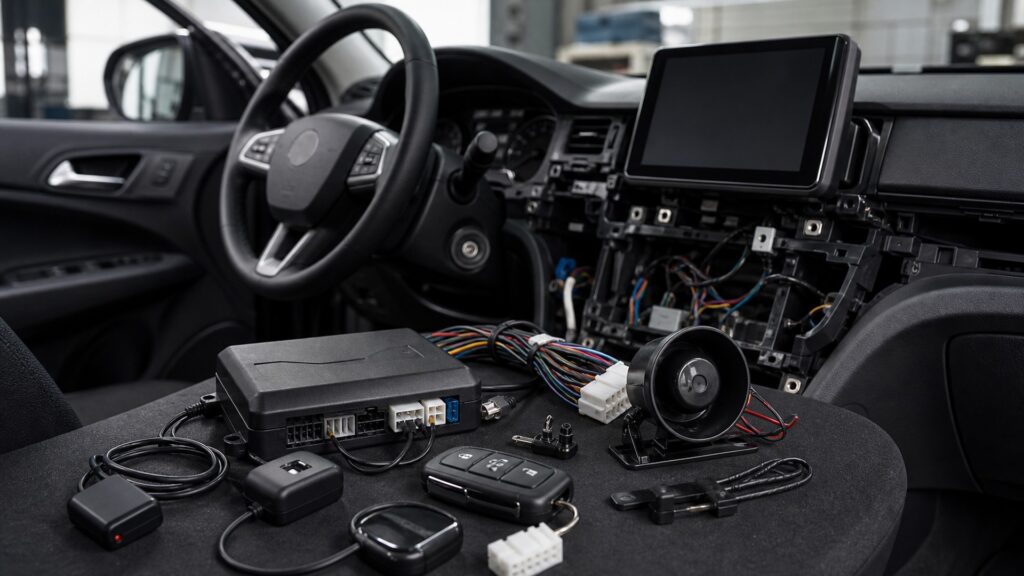
The decision distinguishes risk controls, audio objectives, shared faults, integration, and category-specific evidence.
Tip: A purchase earns its place by resolving the named outcome at the stage that physically produces it.
These definitions keep two expensive dashboard projects from borrowing each other's justification.
A bounded unauthorized-entry, start, removal, vandalism, or recovery exposure described by context, likelihood indicators, and consequence.
A specific source, level, clarity, frequency-balance, distortion, channel, or cabin-listening result expected from the audio chain.
A supported authorization control that prevents normal starting or operation when valid credential conditions are absent.
A routed electrical signal path from source or processor through amplification and wiring to a speaker output.
Battery, ground, fuse, accessory, or network-sleep behavior capable of affecting both security electronics and audio equipment.
Evidence that a proposed system controls the defined gap without claiming unrelated benefits or damaging existing functions.
Tip: Use measurable protection and listening outcomes rather than product labels.
Match sensors, authorization, local response, notification, or tracking support to a named risk. Confirm factory protection and avoid duplicated controllers whose interaction, battery demand, or recovery path cannot be tested.
Security value comes from controlled permissions and response evidence, not speaker volume.
Trace poor listening results from source files and phone behavior through decoding, equalization, gain, amplifier channels, wiring, speakers, installation, and cabin acoustics before deciding which stage requires change.
Audio value appears in the selected program's path to the listener.
A weak supply can reset alarms and receivers; poor grounding can add audio noise; an interface can keep networks awake; and a damaged harness can interrupt both. Measure shared dependencies before expanding the purchase scope.
One electrical cause can create several unrelated-looking symptoms.
Security tones may duck music or use vehicle speakers, while dashboard controls may display status. Verify alert latency, intelligibility, calls, required warnings, local fallback, reconnection, and normal playback restoration.
Integration is successful only when it improves presentation without transferring core ownership.
Security acceptance covers zones, credentials, alarms, immobilization, notification, faults, sleep, and recovery. Audio acceptance covers sources, processing, every channel, noise, controls, calls, startup, and shutdown under comparable conditions.
Buying both is justified only when two distinct unmet outcomes remain after diagnosis.
The speaker can present an alarm and music, but upstream sensing, authorization, media processing, and acceptance evidence remain separate.
A defined security gap remains while the existing audio chain meets its documented listening requirements.
An audio-stage fault is proven while factory protection and legitimate recovery already meet the security need.
Independent protection and acoustic outcomes remain unmet after common dependencies are corrected.
Both installations can preserve factory functions, parked reserve, priority, and authorized recovery.
These myths turn a loud cabin output or an electrical symptom into the wrong category decision.
Amplifiers and speakers reproduce sound but do not authenticate keys, monitor closures, classify intrusion events, deny starting, deliver security notices, or support authorized recovery. Theft deterrence requires a separate defined and verified security function.
A siren may attract attention, yet it cannot improve media decoding, equalization, gain structure, amplifier headroom, speaker response, installation, or cabin acoustics. Evaluate the audio chain with reference sources and channel-specific evidence.
Shared voltage drop, weak ground, overloaded wiring, network sleep problems, or a failing battery can reset otherwise healthy equipment. Correct the common dependency and then repeat independent security and audio acceptance tests.
Extra routing can add delay, lost alerts, failed reconnection, call conflicts, warning-priority errors, battery wakeups, and ambiguous faults. Integrate only a supported function that improves a tested outcome while retaining independent fallback.
Tip: Trace each complaint to the first stage that could produce it.
These answers define a disciplined sequence for selecting protection, audio improvement, or both.
Document the specific unauthorized event or recovery gap, existing factory behavior, required zone or credential control, desired local and remote response, supported vehicle interface, parked-current result, legitimate users, and authorized recovery acceptance test.
Identify the failing source, phone behavior, processing stage, amplifier channel, speaker, control, retained interface, noise condition, or cabin response using repeatable listening material, channel tests, measurements where useful, and a written target.
Test battery and charging health, crank voltage, grounds, fuse and accessory circuits, adapters, cable routing, shared interfaces, wireless accessories, and network sleep. Isolate each added device before assigning the fault to either category.
Use that path only when supported compatibility, delay, volume, priority, calls, media restoration, reconnection, and local fallback outperform the security device's independent output. A shared speaker must never become the sole unverified warning path.
Write separate protection and acoustic outcomes, test current capability at each owning stage, correct shared faults, and buy both only when independent evidence still shows two gaps and the combined installation passes coexistence and recovery checks.
Use vehicle security instead of car audio when the missing result is protected access, intrusion response, start authorization, notification, or recovery support. Use audio equipment for source-to-speaker limitations.
Correct shared electrical faults before choosing either category. If both needs remain, retain separate specifications and acceptance tests so one audible output never validates the wrong system.
These explainers show how each system creates its distinct outcome and where shared dependencies can couple faults.
Follow security from armed state and credentials through sensors, decisions, responses, and recovery.
Follow media sources through processing, amplification, speakers, and cabin output.
Compare their inputs, decisions, outputs, parked behavior, and shared interfaces directly.
Choose a retailer
Prices checked regularly. We may earn a commission at no cost to you.