
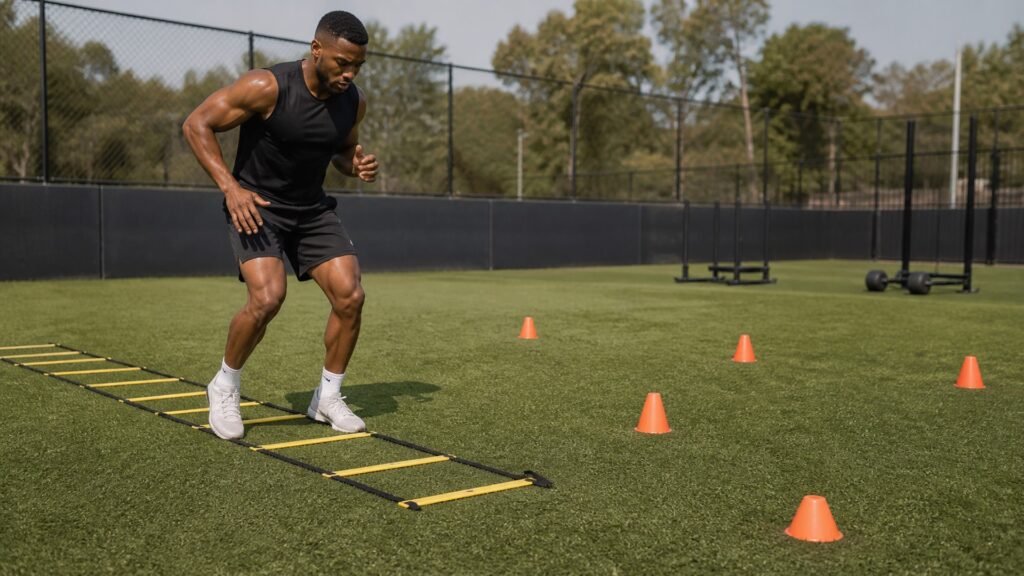
Why Agility Training Equipment Workout Role Matters

Workout role matters in agility training equipment because these tools are not meant to replace every part of a fitness routine. Cones, ladders, hurdles, marker discs, and reaction cues are most useful when they have a clear job: organizing quick footwork, acceleration, deceleration, direction change, and body control.

Without that role, agility gear can turn into random movement. A ladder drill may look athletic, but it only helps when it fits the session's goal, the user's ability, the available space, and the rest of the training plan.

By: Review Streets Research Lab
Updated: October 2, 2026
Explainer · 8-12 min read
agility training equipment workout role explainer hero image for Review Streets
What You'll Learn

How Agility Gear Fits Into A Real Workout

A practical look at when agility equipment should lead the session, support a warm-up, or stay out of the plan.

  • Why agility equipment needs a defined job inside the workout
  • How warm-ups, skill work, conditioning, and sport prep use agility tools differently
  • Where ladders, cones, hurdles, and cues add value
  • Why agility drills should not replace strength, mobility, or recovery work
  • How to scale drill complexity without losing control
  • What to check before buying agility gear for a home or team setup

Tip: Name the drill's job before setting up the equipment. Speed, coordination, conditioning, and reaction work are not the same target.

Definitions

Key Concepts Behind Agility Equipment Workout Role

These concepts explain how agility tools earn a place inside a broader training session.

Workout Role

Workout role is the specific job a tool performs in the session, such as warm-up, coordination, skill practice, or conditioning.

  • Example: using cones for a short change-of-direction block after dynamic warm-up
  • Check: decide what the drill should improve before placing equipment
  • Limit: one drill cannot cover the whole workout

Footwork Practice

Footwork practice uses patterns or markers to help the user place feet quickly and accurately.

  • Example: stepping through a ladder pattern while keeping posture controlled
  • Check: watch whether accuracy stays clean as speed rises
  • Limit: fast feet do not automatically mean better sport movement

Direction-Change Block

A direction-change block trains stopping, cutting, turning, and restarting with control.

  • Example: shuttle runs around cones with planned deceleration
  • Check: look for safe braking and balanced body position
  • Limit: fatigue can make cutting mechanics worse

Reaction Cue

A reaction cue tells the user when or where to move instead of letting the pattern stay fully predictable.

  • Example: moving to a colored cone after a coach callout
  • Check: keep the cue simple enough to preserve movement quality
  • Limit: random cues are not useful if the drill loses purpose

Conditioning Use

Conditioning use turns agility drills into repeated work for heart rate, stamina, or repeat-effort practice.

  • Example: short cone shuttles with measured rest intervals
  • Check: manage volume so speed and control do not collapse
  • Limit: conditioning should not hide poor movement

Training Balance

Training balance is how agility work fits beside strength, mobility, skill, and recovery work.

  • Example: pairing low-volume agility drills with lower-body strength training on separate days
  • Check: confirm the rest of the plan supports the agility goal
  • Limit: too much quick-movement work can overload joints and coordination

Tip: Agility equipment is most useful when it has a narrow, intentional role instead of being added for excitement.

Purpose

The Equipment Should Match The Session Goal

Agility tools can support different goals, but the setup should change with the goal. A warm-up ladder pattern, a cutting drill, and a conditioning shuttle should not be judged the same way.

  • Use simple patterns for warm-up coordination.
  • Use cones and markers for direction-change practice.
  • Use timed or repeated drills only when conditioning is the target.

A clear purpose keeps the drill from becoming movement for its own sake.

Placement

Agility Work Usually Belongs Early Or In A Defined Block

Quick, precise movement is easiest to train before the user is exhausted. Agility equipment often works best after a warm-up and before heavy fatigue changes mechanics.

  • Do skill-focused drills while movement is still sharp.
  • Keep high-speed cuts away from sloppy fatigue.
  • Use conditioning formats only when the plan calls for them.

Where the drill sits in the workout changes what it can safely accomplish.

Progression

Difficulty Should Rise Without Losing Control

Agility equipment makes progression easy to overdo. More cones, faster cues, shorter rests, and tighter turns can all make the drill harder, but the user still needs clean movement.

  • Progress one variable at a time.
  • Add reaction cues only after the base pattern is stable.
  • Stop a drill when control breaks down.

Progression should create better movement, not just busier movement.

Limits

Agility Gear Does Not Replace The Rest Of Training

A cone set cannot replace strength, mobility, recovery, or sport-specific practice. It can organize movement, but the user still needs the physical capacity to move well.

  • Strength helps braking and re-acceleration.
  • Mobility helps the user reach positions safely.
  • Recovery keeps quick work from becoming sloppy work.

Agility equipment belongs inside a complete routine rather than standing in for one.

Fit

The Best Role Depends On The User

A youth athlete, general fitness user, team coach, and rehab-informed trainer may use the same cones very differently. The equipment's role should reflect the user's goal and current control.

  • Beginners may need slower coordination drills.
  • Athletes may need reactive and sport-like changes of direction.
  • Home users may need compact setups with lower impact.

The same tool becomes useful only when the role fits the person using it.

Quick Reality Check

Where Agility Equipment Helps And Where It Does Not

The role is strong when agility gear supports a clear movement goal.

Where It Helps

It gives structure to footwork, cutting, reaction, acceleration, and deceleration drills.

It can make warm-ups, skill blocks, and conditioning work easier to organize.

Where It Falls Short

It does not build a complete strength or mobility plan by itself.

It can encourage messy speed if drill volume and complexity are not controlled.

Common Myths

Misconceptions About Agility Equipment Workout Role

Agility tools are useful, but only when the session gives them the right job.

Agility ladders automatically make athletes faster

They can support coordination, but speed also depends on strength, mechanics, power, and practice context.

Harder patterns are always better

A harder pattern is useful only if the user can still move with control and purpose.

Agility equipment is only for athletes

General fitness users can use it for coordination and movement practice when drills are scaled appropriately.

Agility drills can replace lower-body training

They complement strength and mobility work. They do not replace it.

Tip: Use agility equipment to solve a defined movement problem, not to decorate the workout.

FAQ

Frequently Asked Questions About Agility Equipment Workout Role

Short answers for placing agility tools inside a practical routine.

When should agility equipment appear in a workout?

Skill-focused agility drills usually fit after a warm-up and before heavy fatigue. Conditioning drills can appear later when repeat effort is the goal.

Can agility equipment be used for beginners?

Yes, if the patterns are simple, the surface is safe, and the focus stays on control rather than speed.

What is the most common mistake?

The common mistake is adding complexity too quickly and letting movement quality collapse.

Does agility equipment replace strength work?

No. Strength, mobility, recovery, and sport practice still matter. Agility gear organizes quick movement drills.

What is the practical takeaway?

Agility equipment matters when it has a clear workout role: coordination, direction change, reaction, warm-up, or conditioning.

Bottom Line

Agility training equipment workout role matters because the same tool can help or distract depending on how it is used.

Use agility gear for a defined movement job, scale complexity carefully, and keep it connected to the rest of the training plan.

Next Steps

Go Deeper or Compare Your Options

Use these Review Streets paths to compare related categories and practical next decisions.