
Running Sock Role
A sock role built around running-shoe fit and repeated forward motion.
- Cushion, seams, and heel hold can matter.
- Routes vary.
- It does not prevent injuries.
Athletic socks workout role matters because a running shoe, lifting shoe, court shoe, cycling shoe, trail shoe, or general gym shoe can ask for different sock height, cushion, yarn, and fit behavior.
A sock that works for a snug cycling shoe may not be the same sock a reader wants for trail debris, court cuts, lifting shoe volume, or a week of laundry rotation.
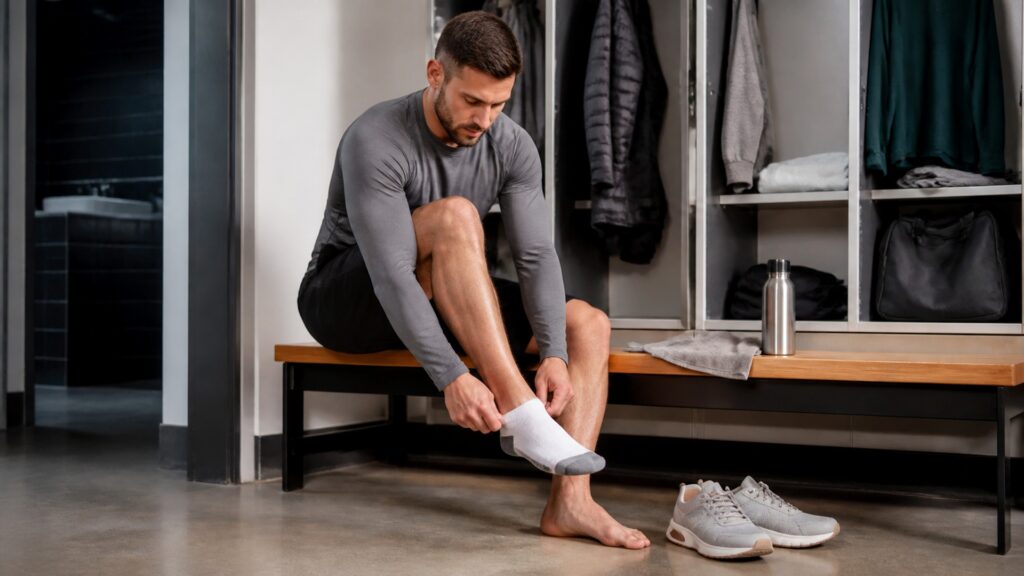
This explains why sock role should follow the workout and footwear.
Tip: Name the shoe and activity before judging the sock.
These definitions connect the main idea to the variables, limits, and practical signals readers need to compare options.
A sock role built around running-shoe fit and repeated forward motion.
A sock role built around stable shoe volume and contact in lifting footwear.
A sock role for side-to-side movement in court shoes.
A sock role for cycling shoes, cleats, and ventilation.
A sock role for uneven surfaces, debris, moisture, and shoe collar interaction.
The practical need for enough pairs to dry, wash, and maintain fit across workouts.
Tip: Use these terms to match sock traits to workout role instead of ranking socks generically.
The same sock can behave differently in running, lifting, court, cycling, trail, and gym settings.
Workout role gives sock features meaning.
No-show, ankle, quarter, crew, and taller socks change collar contact, coverage, and style expectations by activity.
Height should not be treated as quality by itself.
Thin, medium, dense, or targeted cushion can help a role or make the shoe too tight.
Cushion belongs to role and footwear.
A weekly workout role may require enough pairs, reasonable drying time, and fabric that holds shape after washing.
Repeated role use reveals durability.
Matching a sock to a role can improve product fit logic, but it cannot guarantee speed, comfort, injury prevention, or recovery.
Role is practical, not predictive.
Workout-role analysis explains why socks should match activity, shoe type, height, cushion, material, and rotation needs.
It separates running, lifting, court, cycling, trail, and gym roles.
It prevents generic best-sock language.
It does not guarantee comfort, injury prevention, speed, or recovery.
It does not prescribe training choices.
Common shortcuts and misunderstandings can make the topic seem simpler than it is.
Different shoes and movements stress socks differently.
Height can affect shoe-collar contact and coverage.
Extra cushion can crowd snug shoes.
Socks support fit and contact; they do not create adaptation.
Tip: Treat strong claims as starting points for comparison, not final answers.
Concise answers to common questions readers may have after the main explanation.
It is the activity-and-shoe context the sock is expected to support.
Cycling shoes may have tighter volume and different ventilation or cuff preferences.
They need to fit the lifting shoe; too much cushion can change shoe volume.
It can, depending on shoe collar, coverage needs, and activity.
Performance claims need evidence beyond sock role.
Athletic socks workout role matters because socks work inside a specific shoe for a specific activity.
Running, lifting, court, cycling, trail, and gym roles all change the meaning of height, cushion, material, and fit.
Use these Review Streets paths to connect the explainer to related categories, comparisons, and next decisions.
Use this for sock construction behind role choices.
Read this for repeated-session sock support.
Browse socks after naming the workout and shoe type.
Choose a retailer
Prices checked regularly. We may earn a commission at no cost to you.