
Auxiliary Lamp
Added lighting device supplementing rather than replacing required vehicle lamps.
- Its task must be defined
- Installation cannot impair required equipment
- Road use may be restricted
Auxiliary lighting matters because required vehicle lamps are designed around standardized road functions, not every work site, trail, recovery, loading, reversing, or long-distance condition. A properly selected lamp can place useful light into a specific blind, lateral, near-field, or distant zone that the original system does not cover.
The benefit exists only when the added lamp has one defined job. Optics, height, aim, shielding, color, switching, wiring, current demand, reflections, weather, and surrounding road users control the result. A bright fixture used without containment can erase turn signals, create glare, illuminate dust or the hood, overload circuits, or encourage speed beyond the combined beam's recognizable distance.
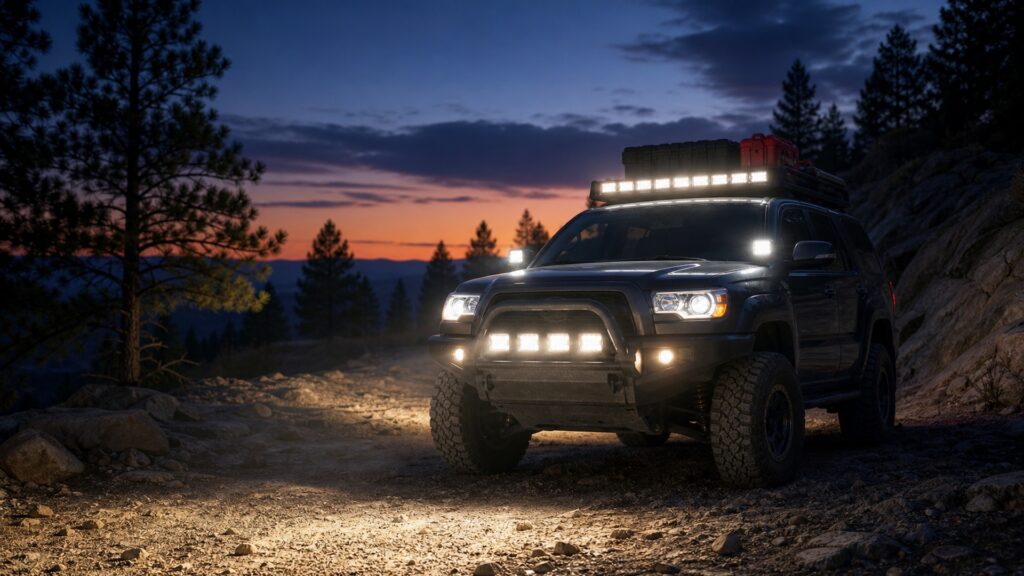
Repair required lighting first, map the unmet viewing zone, choose an optical pattern for it, and control when the lamp can operate.
Tip: Verify the installed system from the driver's seat and from the positions of oncoming, preceding, crossing, working, and trail users; useful illumination cannot be judged from behind the lamp alone.
These terms distinguish supplemental function from uncontrolled brightness.
Added lighting device supplementing rather than replacing required vehicle lamps.
Narrow forward distribution intended to extend distance with high-beam operation.
Broad nearby lamp intended to illuminate a task area rather than the public roadway.
Light falling outside the intended target zone because of optic shape, mounting, reflections, or aim.
Low-current control signal that commands a separately fused high-current lamp circuit.
Loss of a required lamp's recognizability because nearby light overwhelms its color, location, or timing.
Tip: Federal rules, state laws, vehicle instructions, and site policies can regulate auxiliary-lamp color, number, height, aim, covers, switching, and use; confirm the exact application.
Driving, fog, cornering, ditch, reverse, cargo, rock, camp, and scene lights solve different angular and distance problems. Spots concentrate intensity; floods widen nearby coverage; asymmetric optics limit light on one side.
A lamp is auxiliary because of its function, not because it is sold in an accessory aisle.
High intensity, poor aim, elevated mounting, wet-road reflection, and bright foreground can reduce contrast. Light near a turn signal or marker can mask its standardized message; unusual colors or flashing can be confused with emergency or traffic control signals.
The added information for one driver must not remove information from another.
Roof lamps illuminate hoods and airborne particles; bumper lamps face impact, obstruction, and spray; rear lamps can blind spotters or mirrors. Bracket flex makes distant beams bounce, while cargo and suspension change vehicle pitch.
Mounting position is an optical decision and a structural one.
Auxiliary lamps draw current through connectors, conductors, grounds, relays, fuses, alternators, batteries, and electronic modules. Voltage drop reduces output, undersized wiring heats, water corrodes terminals, and indiscriminate taps can trigger faults.
A safe circuit isolates a failure so required lighting and starting power remain available.
A broad scene lamp may be appropriate at a stationary recovery but dangerous while following another vehicle. A long-range driving lamp may help on an empty lawful road yet blind traffic around a crest or curve.
Good auxiliary lighting includes a reliable decision about when not to turn it on.
Beam task, containment, integration, and disciplined use matter more than total lumens or fixture count.
The original system is sound, a specific zone remains inadequately visible, an appropriate optical pattern exists, and the lamp can be mounted, powered, aimed, and operated without confusing others.
The installation has protected wiring, rigid structure, lawful switching, accessible controls, and a verification method for both the driver and exposed people.
Dirty glazing, failed headlamps, bad aim, unsafe speed, dense scatter, driver vision limits, unstable mounts, or inadequate electrical capacity require correction before another fixture.
General flood bars cannot substitute for certified required lamps, and off-road labels do not remove responsibility for glare around workers, camps, trails, or neighboring property.
These myths treat auxiliary lighting as harmless output added on top of the original system.
Additional light can increase foreground adaptation, hood reflections, weather scatter, electrical load, and glare while masking required signals. Safety improves only when a controlled pattern reveals a defined target early enough without reducing anyone else's contrast.
Trail users, spotters, workers, animals, camps, mirrors, dust, snow, and nearby property can still receive dangerous glare. Off-road status changes the legal setting, not the optical energy or operator's responsibility.
The circuit also needs conductors sized for current and length, compatible relay or controller, protected routing, sound grounds, sealed connectors, strain relief, heat management, charging-capacity review, and switching logic that fails safely.
Required lamps should be restored, correctly sourced, clear, securely mounted, electrically sound, and aimed before supplementation. Add-ons cannot recreate compliant low-beam glare control, required signaling, or automatic interactions lost from the factory system.
Tip: Start with the missing information and test every unintended viewer, reflection, and failure path.
These answers cover selection, switching, legality, aiming, and electrical capacity.
Choose from the target backward: distance and narrow width favor a spot or driving pattern; nearby lateral work favors flood or scene optics; fog, cornering, reverse, and ditch tasks need purpose-specific vertical control.
Where required or appropriate, an interlock lets them operate only with high beam and extinguish immediately during dimming. Preserve a separate enable control, follow current jurisdiction rules, and verify vehicle-network compatibility.
Not by itself. Legality can depend on the actual standard, lamp function, installation height, number, color, aim, spacing, covers, switching, vehicle type, and state or local rules governing use in practice.
Use the manufacturer's photometric or wall-aim procedure on a level surface with normal tire pressure and load. Then verify real target coverage, foreground balance, reflections, signal visibility, and glare from other road-user positions.
Calculate continuous lamp current with other vehicle loads, account for idle output, voltage drop, heat, battery reserve, and duty cycle, and consult qualified guidance. Efficient LEDs still create meaningful electrical and thermal demand.
Auxiliary lighting matters when it places controlled light into a specific task zone that required lamps do not cover, improving recognition for driving, recovery, loading, work, or off-road maneuvering.
Its value depends on repaired original lighting, purpose-built optics, rigid mounting, correct aim, protected wiring, lawful switching, glare containment, and an operating rule that keeps it off when conditions change.
These explainers separate broad versus long-range add-ons and show how weather, glazing, signals, and human vision bound every lamp.
Decide when broad light bars fit a controlled low-speed area and when paired driving lights better serve directed lawful road reach.
Place added lamps inside the full chain of sources, optics, aim, weather, glazing, signaling, electrical supply, and human adaptation.
Review why a low, wide fog pattern addresses suspended moisture differently from general floods and long-range beams.
Choose a retailer
Prices checked regularly. We may earn a commission at no cost to you.