
Identity Record
The product name, variant, lot or date code, purchase or opening date, dilution, working-bottle date, and source instructions kept with each chemical.
- Names survive decanting
- Lots support traceability
- Dates guide retirement
A detailing kit changes after its first use. Bottles are opened and decanted, concentrates are diluted, sprayers retain chemistry, clay collects particles, pads load with paint and abrasive, brushes deform, and towels absorb wax, solvent, dye, or grit. Without maintenance, the kit name stays the same while its operating behavior drifts.
Maintenance preserves identity, cleanliness, function, and usable capacity. Labels, dates, sealed storage, compatible containers, sprayer flushing, pad cleaning, media segregation, residue-aware laundering, complete drying, and retirement criteria keep later test areas meaningful. It also prevents false escalation, where stronger chemistry or pressure is added because a clogged sprayer, hardened pad, contaminated towel, or expired product underperforms.
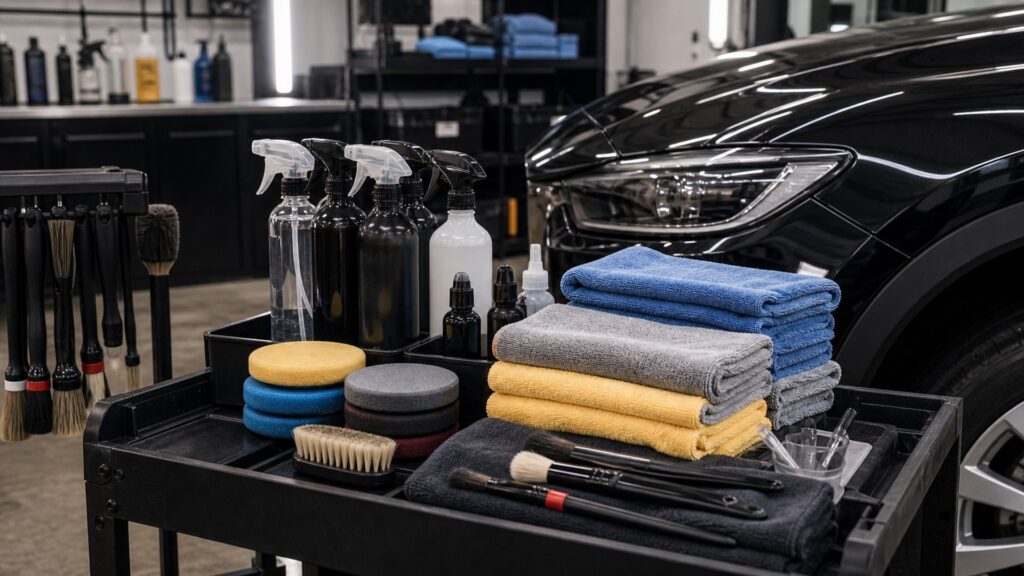
Kit maintenance is an information-and-contamination system: every product and medium must return to service with known contents, condition, assigned zone, and expected behavior.
Tip: Use a quarantine bin for unknown bottles, dropped clay, chemically incompatible towels, damaged pads, and unverified sprayers so uncertainty cannot reenter the active kit.
These terms connect storage and cleaning decisions to chemistry strength, media friction, cross-contamination, safety, and repeatable results. Baseline records cover product identity record, lot and date code, shelf-life condition, working-bottle dilution, sprayer chemical compatibility, clay contamination, pad face loading, brush bristle deformation, microfiber residue, media segregation, temperature-controlled storage, and inventory retirement.
The product name, variant, lot or date code, purchase or opening date, dilution, working-bottle date, and source instructions kept with each chemical.
The observed and specified storage state of a product, including seal, temperature, light, separation, odor, viscosity, contamination, pressure, and container integrity.
The ability of bottle, pickup tube, seals, trigger, nozzle, label, and wetted materials to tolerate and meter the assigned chemical.
Accumulation of spent abrasive, paint residue, product, removed material, moisture, or hardened deposits within a polishing or cleaning pad surface.
A group of towels or reusable media cleaned together because their products, soils, colors, lint, solvents, coatings, and contamination risk are compatible.
A defined condition requiring permanent removal from active use, such as lost identity, chemical change, embedded grit, delamination, hardened coating, torn edge, deformation, or failed cleaning.
Tip: Follow product and tool instructions; heat, freezing, sunlight, moisture, air exposure, and incompatible containers can change materials even when the retail expiration date has not passed.
Working bottles must remain linked to the original product, directions, hazards, ratio, date, and lot. Unlabeled liquids defeat compatibility, safety, inventory, and root-cause analysis even when their color seems familiar.
Identity is the first maintenance control because every other decision depends on it.
Close containers promptly, use compatible pumps and sprayers, store within specified conditions, and inspect separation, crystallization, thickening, odor, color, gas, leaks, or damaged packaging before use.
A full bottle can have zero usable capacity when its condition is unknown.
Dropped clay can trap grit; pad faces load; bristles bend or retain particles; applicators can harden with protection. Clean promptly using supported methods, dry completely, store protected, and inspect before reassignment.
Reusable does not mean indefinitely recoverable.
Separate glass, paint, drying, interior, wheel, compound, polish, wax, coating, and heavy-soil loads as needed. Use compatible detergent and temperature, avoid contaminating additives, rinse fully, dry appropriately, and inspect fibers and edges.
A clean smell does not prove a clean fiber structure.
Record product yield, pad and towel retirement, sprayer failures, storage excursions, unexpected results, and corrected causes. A known baseline distinguishes changing vehicle conditions from changing kit components.
Maintenance converts a collection of leftovers back into a controlled process system.
When product identity and media condition are known, surface behavior can be attributed to the treatment rather than hidden contamination or degradation.
Every chemical is identified, in condition, within supported storage, correctly diluted, sealed, and paired with a compatible clean dispenser; quantities are sufficient and hazard information remains accessible.
Clay, pads, brushes, applicators, towels, and tools are clean, dry, undamaged, assigned, protected from contamination, and counted; records explain any unusual result from the previous use.
Identity, dilution, age, container integrity, storage history, product appearance, compatibility, or contamination is uncertain; a sprayer leaks; clay is dropped; or pad, brush, towel, or applicator cannot be restored.
Do not hide uncertainty by mixing remnants, topping an unlabeled bottle, applying more product, increasing abrasion, laundering incompatible residues together, or downgrading chemically hardened media to another vehicle surface.
Maintenance myths assume caps, laundry, or visual cleanliness automatically restore the original chemistry and media behavior.
Heat, freezing, air, moisture, contamination, solvent loss, separation, crystallization, microbial growth, or container attack can end usability earlier. Follow storage and shelf guidance and inspect condition before relying on remaining volume.
Wheel grit, glass residues, dyes, oily dressings, abrasives, waxes, solvents, and curing coatings can transfer or harden differently. Segregate loads by contamination and product compatibility, then inspect after laundering. safely
Clay can embed abrasive particles that wiping cannot reveal or remove, turning decontamination into scratching. Discard or permanently retire the contaminated portion according to the product design rather than returning it to paint.
Pad faces can load during a single section, reducing cut, changing finish, and raising heat. Clean or exchange pads throughout correction according to the system, then perform full cleaning and drying afterward.
Tip: Use identity, condition, contamination class, functional inspection, and retirement rules rather than sentiment or replacement cost.
These answers cover product dates, freezing, separation, sprayers, clay, pads, brushes, microfiber, coating towels, storage, and the records needed for repeated work.
Include the exact product and variant, measured dilution, preparation date, intended use, and linkage to hazard and direction information, following workplace rules. Never put detailing chemistry in food, drink, or ambiguous household containers.
Only if the manufacturer indicates separation is normal and remixing restores the specified state. Unusual color, odor, gas, crystals, thickening, curdling, freezing history, or contamination warrants quarantine and manufacturer guidance.
Use the system's approved brush, air, washer, or replacement method to remove spent abrasive and paint safely; monitor heat and delamination; keep compounds separated; and use enough pads that no saturated face is forced onward.
Reactive protection can cure within fibers, leaving hard deposits that survive washing and scratch later surfaces. Follow product handling and disposal instructions, isolate those towels, and never assume apparent softness proves the fibers are residue-free.
Track products, lot and dates, dilution, storage, usable quantity, clean pads and towels, assigned zones, sprayers, brushes, PPE, failures, quarantined items, retirement, and the replacement needed before the next complete job.
Detailing-kit maintenance matters because every use changes product identity, container condition, sprayer metering, clay cleanliness, pad behavior, brush shape, towel residue, and available capacity.
Restore or retire each component by documented rules, keep contamination classes separate, and preserve traceability. The next test area is meaningful only when the kit returning to it has a known baseline.
Related explainers show the operating functions maintenance protects, the fitment information labels preserve, and the safety barriers that contamination or lost identity can defeat.
Trace the chemical, mechanical, transfer, preparation, and protection functions whose behavior maintenance must preserve.
Match the maintained products and media to substrate, soil, machines, conditions, quantities, and handoffs.
Review chemical identity, mixture, exposure, powered-tool, vehicle-residue, and waste controls.
Choose a retailer
Prices checked regularly. We may earn a commission at no cost to you.