
Surfactant Wetting
Reduction of liquid surface tension so solution spreads, reaches soil interfaces, and helps suspend released contamination for transfer or rinsing.
- Concentration affects behavior
- Agitation renews contact
- Residue needs removal
A detailing kit works only when each component has a precise job. Surfactants wet and suspend compatible soils; solvents dissolve selected residues; chelants or reactive products address minerals or metals; clay shears bonded particles; abrasive liquid and pad action refine a finish; towels transfer loosened material; panel preparation removes oils; protection leaves a controlled film.
These functions are not interchangeable. Stronger cleaner cannot correct a scratch, extra polish cannot remove grit safely, and a coating cannot compensate for preparation residue. Operating-function knowledge prevents random product stacking, explains why one stage has stopped improving, and defines the evidence required before moving to the next bottle or tool.
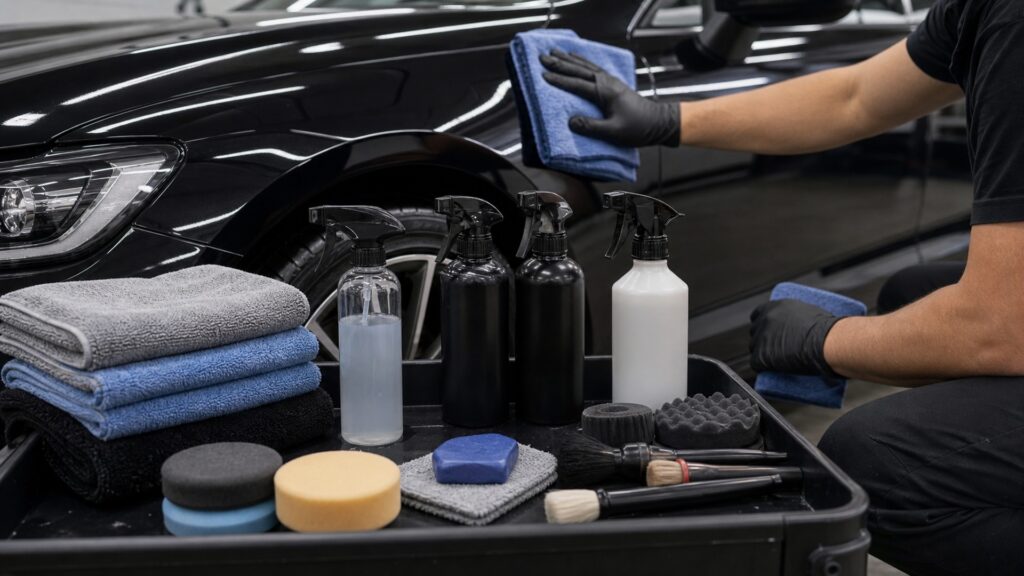
The kit becomes an intelligible system when chemistry, media, mechanical energy, residue, and the next-stage condition are tracked separately.
Tip: If two products appear to perform the same function, compare their supported substrates, soil mechanisms, residue, aggressiveness, and next-stage compatibility instead of assuming redundancy is harmless.
These terms connect product ingredients and media behavior to observable changes at the surface. The function map includes surfactant wetting, solvent dissolution, chelation function, reactive decontamination, clay shear, abrasive particle cut, pad mechanical action, lubrication film, towel residue pickup, panel preparation, and protection crosslinking.
Reduction of liquid surface tension so solution spreads, reaches soil interfaces, and helps suspend released contamination for transfer or rinsing.
Use of a compatible liquid phase to dissolve or soften selected oils, adhesives, tar, ink, or residues without unacceptable substrate change.
A chemical reaction that converts or releases a targeted contaminant, such as iron-bearing particles or mineral deposits, under controlled dwell and removal.
Microscopic material removal produced by abrasive particles, pad behavior, motion, pressure, time, lubrication, and the hardness of the contacted finish.
Transfer of soil, spent chemistry, abrasive, oil, water, or excess protection from the surface into a clean towel, pad, rinse stream, or recovery system.
An inspection point with explicit pass, repeat, escalate, stop, or skip criteria before a new product or mechanical action begins.
Tip: Marketing outcomes such as shine or deep clean are not operating functions; require a mechanism, controlled variable, and acceptance evidence.
Detergents can surround particulate and oily film; solvents address soluble residues; chelants bind selected ions; reactive decontaminants transform particular deposits. Label conditions and substrate tolerance define the useful window.
Chemical activity is useful only when its target and exit path are known.
Clay or synthetic media glides over a lubricated surface and shears protruding bonded contamination. Loading, dropped media, inadequate lubrication, or excessive pressure can transfer particles and mar the finish.
Mechanical decontamination is a selective tool, not a substitute for washing.
A compound or polish acts through abrasive particles while pad material, machine motion, speed, pressure, pass count, temperature, and paint response determine effective cut and finish. One-variable test spots guide escalation.
Correction trades a finite amount of surface for defect improvement.
Panel preparation removes polishing oils and residues so the actual finish can be inspected and a protection product can wet, level, adhere, or cure. Application media then distribute a deliberately retained layer.
The handoff fails when leftover material interferes with the layer meant to remain.
Released contamination must leave through rinse, towel pickup, pad cleaning, vacuum, or extraction. Clean media capacity and consistent lighting reveal whether the function succeeded, stalled, or created an unintended change.
A product has not worked merely because it was applied.
When every item has one explicit job and acceptance test, unnecessary stages, conflicting residues, and aggressive compensation become easier to detect.
The targeted soil, bond, defect, or surface condition changes in the test area as predicted; the substrate remains within acceptable color, gloss, texture, temperature, thickness, and integrity boundaries.
Released material and product residue are removed, media condition remains controlled, and the resulting surface meets the documented requirements for inspection, another treatment, or final use.
Stop when color transfers, texture swells, gloss changes unexpectedly, residue smears, drag rises, pads load rapidly, heat climbs, correction stops, odor intensifies, or the next stage rejects the surface.
Do not answer a chemical mismatch with more abrasion, an abrasive limit with stronger solvent, or contaminated media with additional product; identify the failed function and choose a new controlled test.
Function myths treat foam, color change, product quantity, or gloss as universal proof that chemistry and contact performed the intended job.
Color or foaming can show that a reaction or surfactant process occurred, but not that every deposit was reached or removed. Rinse, inspect, feel where appropriate, and repeat only within product and substrate limits.
Abrasives can diminish, pads can clog, heat can rise, and remaining defects can be too deep or unsafe to chase. Clean the pad, inspect honestly, and stop at the accepted preservation boundary.
Preparation products are chosen to remove specific oils or residues without leaving material that interferes with inspection or protection. General cleaners can introduce surfactant, gloss, fragrance, or compatibility problems at the critical handoff.
Towels perform pickup, leveling, residue removal, drying, or final buffing depending on weave and load. A saturated or cross-used towel can redeposit abrasive, coating, oil, lint, moisture, or contamination. repeatedly
Tip: Judge the specific bond changed, material preserved, residue removed, and stage gate passed.
These answers explain why products foam or change color, how clay and polish differ, when panel preparation matters, why pads load, and what a useful stage gate observes.
Read the label and technical information for supported soil, substrate, concentration, application, dwell, agitation, removal, and safety. Translate the claim into an observable change, then test that mechanism on a small representative area.
Abrasive may be spent, the pad face can load with paint or residue, fibers can mat, temperature can alter behavior, or the remaining defect can exceed safe correction. Clean, inspect, and reassess rather than pressing harder.
After loose soil is removed, clay is useful for compatible bonded contamination that protrudes from a lubricated surface and resists appropriate chemistry. It is not suited to scratches, oxidation, embedded staining, or unwashed grit.
It removes selected polishing oils, fillers, dust, or residue so inspection reflects the actual finish and protection meets its surface requirements. Use compatible chemistry and clean towels without assuming every coating needs identical preparation.
Record product, dilution, material, temperature, dwell, tool or pad, passes, residue removal, media condition, observed change, unintended effects, and the pass, repeat, escalate, stop, or skip decision for the next stage.
Detailing-kit operating function matters because chemistry, media, abrasion, transfer, preparation, and protection create different surface changes and residues.
Give each component a defined target, controlled variables, exit path, and acceptance test. That turns a collection of bottles into a causal process and prevents product stacking from replacing diagnosis.
Related explainers show the full kit sequence, test whether every component fits, and detail the maintenance required to preserve product and media behavior.
Follow the complete inspection-to-protection sequence that orders these component functions.
Verify substrate, soil, dilution, machine, media, quantity, environment, and stage compatibility.
Maintain products, sprayers, clay, pads, brushes, towels, labels, and storage so their functions remain predictable.
Choose a retailer
Prices checked regularly. We may earn a commission at no cost to you.