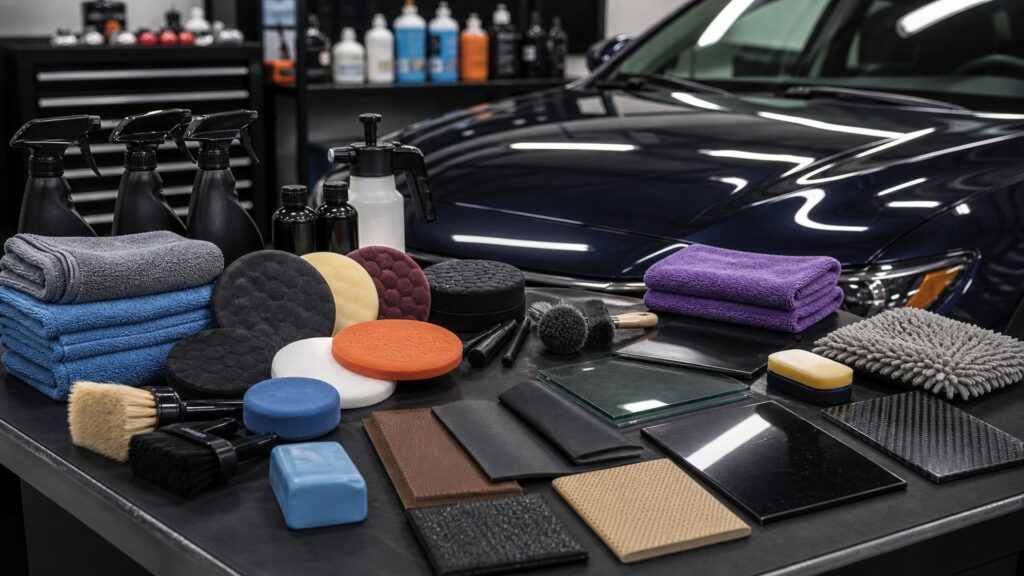
Why Detailing Kits Fitment Matters

Detailing-kit fitment is the match between a treatment set and the surface problem it must solve. A bottle may be labeled for paint, leather, fabric, glass, or plastic, yet the vehicle can contain coatings, repairs, dyes, films, matte finishes, delicate screens, perforations, and adhesives that narrow compatibility. The soil or defect also determines whether chemistry, contact, or abrasion is justified.

The pieces must fit each other as well. Concentrates need accurate dilution; pads need compatible backing plates and machine motion; clay needs lubrication; towels need suitable weave and contamination history; protection needs a prepared surface and workable cure conditions. A kit fits only when its entire stage sequence can be completed safely.

By: Review Streets Research Lab
Updated: September 1, 2026
Explainer · 8-12 min read
detailing kits fitment explainer hero image for Review Streets
What You'll Learn

Fit the Treatment Chain to the Actual Surface

Fitment joins substrate, contamination, product label, media, machine, quantity, environment, and handoff conditions; a missing link can turn a coherent bundle into incompatible parts.

  • Identify every material and prior treatment
  • Classify soil before choosing chemistry
  • Confirm machine and pad interfaces
  • Calculate usable product and clean-media quantity
  • Test colorfastness and finish response
  • Verify the next stage can accept the residue state

Tip: Photograph labels and lot information before decanting, and mark every working bottle with product, dilution, date, and intended surface so compatibility survives outside the retail package.

Definitions

Key Concepts That Define Detailing Kit Fitment

These terms describe the interfaces that determine whether a detailing bundle can complete its claimed process on a specific vehicle.

Substrate Identification

Determination of the actual material and finish beneath contamination, including coatings, films, dyes, repairs, textured plastics, leather, fabric, and display layers.

  • Appearance can mislead
  • Hidden tests reveal sensitivity
  • Repairs may change tolerance

Soil Chemistry

The chemical and physical character of contamination, such as mineral, metallic, petroleum, organic, protein, particulate, adhesive, or product residue.

  • Different soils need different mechanisms
  • Mixtures complicate removal
  • Unknown soil favors conservative testing

Dwell Window

The allowed period a product remains active and wet before agitation, removal, rinsing, or damage risk changes.

  • Temperature changes timing
  • Porous materials absorb product
  • Drying can concentrate residues

Machine Interface

The dimensional and operating relationship among polisher, backing plate, pad, spindle, orbit, speed range, power source, and guarding.

  • Diameter affects edge exposure
  • Motion changes heat
  • Ratings must be compatible

Coverage Quantity

The usable amount of product and clean media required for surface area, soil severity, repeated passes, replacement, and waste.

  • Sample sizes may be insufficient
  • Large vehicles consume more
  • Contaminated towels leave capacity

Stage Compatibility

The ability of one completed step to leave a surface condition accepted by the next product, abrasive, coating, adhesive, or inspection gate.

  • Oils can obstruct bonding
  • Residues can change cut
  • Water can delay cure

Tip: Treat words such as universal, all-surface, or complete as claims to verify against the product directions, vehicle guidance, test area, and full workflow.

Match the Problem

Soil and Finish Condition Choose the Product Function

A cleaner, iron remover, clay medium, compound, polish, dressing, or coating addresses a different mechanism. Fit begins by naming what is attached to the surface and what finish change is acceptable.

  • Inspect dry under controlled light
  • Separate contamination from defects
  • Check prior films and coatings
  • Choose the least aggressive relevant function

A product that fits the material can still be wrong for the problem.

Match the Material

Vehicle Surfaces Have Different Chemical and Mechanical Limits

Clear coat, matte paint, wrap, soft trim, coated leather, textile, glass, display film, and open-pore materials respond differently to solvents, pH, friction, heat, and moisture. Vehicle-specific restrictions can override a broad kit claim.

  • Read product and vehicle instructions
  • Test a concealed representative area
  • Avoid assuming one interior material
  • Stop at color, texture, or gloss change

Fitment is proven on the installed surface, not by package artwork.

Match the Tools

Pads, Plates, Brushes, Clay, and Towels Need Compatible Geometry and Behavior

A pad can overhang or expose a backing plate, a brush can be too stiff, and a towel can drag or redeposit residue. Machine motion, pad thickness, product lubrication, pressure, and surface contours interact.

  • Confirm backing-plate and pad diameters
  • Assign brush stiffness by substrate
  • Keep clay lubricated and clean
  • Reserve towels by product and zone

Contact media is an active process variable, not neutral packaging.

Match the Conditions

Dilution, Temperature, Ventilation, Dwell, and Cure Define the Working Envelope

Chemistry that works on a cool shaded panel may dry too rapidly on heat. Interior solvents and aerosols require ventilation; coatings need specified humidity, leveling time, and water avoidance; concentrates need accurate water ratios.

  • Measure rather than guess dilution
  • Work within temperature limits
  • Plan air movement and drying
  • Reserve cure time before exposure

Environmental fitment determines whether labeled instructions can actually be followed.

Match the Complete Job

Quantity and Handoffs Decide whether the Kit Can Finish

A kit can contain the right categories but too little product, too few clean pads, or no residue-removal step. Each stage must finish cleanly enough for inspection and the next treatment.

  • Estimate surface area and repeat passes
  • Carry replacement media
  • Identify missing lighting or PPE
  • Confirm final cleanup and storage

Completeness means an executable workflow, not a high item count.

Quick Reality Check

Fitment Is a Multi-Interface Contract

A useful kit must fit the vehicle, contamination, desired change, operator, machine, site, and sequence simultaneously.

Evidence of Good Fit

Directions explicitly support the identified substrate and soil; the test area improves without color, gloss, texture, swelling, haze, residue, or excessive abrasion; and the next stage accepts the result.

Pads, plates, brushes, towels, bottles, dilution tools, protective equipment, ventilation, lighting, product quantity, cure time, and storage all support the complete job rather than only application.

Reasons to Reject the Fit

Reject vague material identity, unknown prior treatment, incompatible machine geometry, missing dilution data, insufficient clean media, uncontrolled heat, no ventilation, uncertain chemical residue, or a product that cannot be removed as directed.

Do not force fit by increasing concentration, dwell, pressure, speed, or abrasion; revise the treatment, obtain missing tools or guidance, or use a qualified service when the test area remains uncertain.

Common Myths

Misconceptions About Detailing Kit Fitment

Fitment myths replace a chain of verified interfaces with vehicle type, brand matching, piece count, or physical attachment.

A vehicle-specific kit fits every surface on that model

One vehicle can contain paint repairs, wraps, aftermarket tint, coatings, replacement upholstery, delicate displays, and option-specific materials. Confirm each installed substrate and prior treatment instead of treating the model name as universal fitment.

Products from one brand are automatically compatible

Shared branding can simplify directions but does not prove that every residue, solvent, abrasive, dressing, or coating can follow another. Read the specified sequence, removal method, cure requirement, and cross-product restrictions.

If a pad attaches to the polisher, it fits

Hook-and-loop engagement alone does not establish safe diameter, centering, speed, orbit, thickness, edge protection, or product pairing. Use the machine and pad manufacturers' supported interfaces and inspect stability before touching paint.

A hidden test proves whole-vehicle compatibility

A test area reduces uncertainty only for a representative material, contamination, temperature, and technique. Other panels, repairs, dyes, films, wear zones, and prior chemicals can respond differently and require additional tests.

Tip: Require product directions, vehicle guidance, a test area, and a complete handoff plan before treating the kit as compatible.

FAQ

Frequently Asked Questions About Detailing Kit Fitment

These answers address universal claims, machine and pad matching, dilution, quantity, mixed materials, and how to verify a kit before committing to an entire vehicle.

What information should be checked first?

Identify the substrate, finish condition, soil or defect, prior treatment, desired outcome, product directions, vehicle restrictions, machine interface, environmental limits, and removal method. Those facts reveal whether the advertised kit purpose matches the actual job.

How is a concentrate fitted to the task?

Use the labeled ratio for the intended surface and soil, measure product and water with compatible tools, label the working bottle, test a small area, observe dwell, and never strengthen a mixture merely because results seem slow.

Can one towel type fit every kit stage?

No. Pile, weave, absorbency, edge, softness, lint, and contamination history affect pickup and drag. Separate towels for glass, paint, compound, coating, interiors, drying, and dirty zones, then launder or retire appropriately.

How much product and media are enough?

Estimate vehicle area, severity, pad or towel loading, repeated passes, spills, and replacement needs. A complete kit has enough clean capacity to finish without stretching contaminated media or applying protection too thinly to follow directions.

What proves the kit fits after a test spot?

The intended soil or defect improves; the substrate retains acceptable color, gloss, texture, and integrity; residue removes completely; tools behave predictably; and the resulting surface meets the documented requirements of the next stage.

Bottom Line

Detailing-kit fitment matters because every stage must match the installed material, actual contamination or defect, chosen tool, working conditions, available quantity, and the requirements of what follows.

Verify that contract with labels, vehicle guidance, measured dilution, compatible interfaces, clean media, and representative test areas. A bundle is not complete when one incompatible component prevents a safe finish.

Next Steps

Prove Compatibility across the Whole Treatment Chain

Related explainers show the kit sequence, explain each component's operating role, and distinguish targeted treatment sets from durable wash capacity.

How Detailing Kits Work

Follow inspection, washing, decontamination, correction, preparation, protection, and media separation as one ordered detailing workflow.