
Free Path
A free path lets the hand and arm move without being locked into a machine track.
- Example: adjusting the angle of a dumbbell press
- Check: see whether the path feels natural and repeatable
- Limit: too much freedom can make the lift unstable
Movement pattern matters with dumbbells because the tool gives each hand its own load and lets the body move through freer paths than many machines allow. That freedom is useful only when the exercise path matches the goal, the user's control, and the available space.
A dumbbell can support presses, pulls, hinges, squats, carries, raises, and rotational work, but the same freedom can also expose poor setup. The movement pattern determines whether the dumbbell helps the target muscles work or simply makes the lift harder to control.
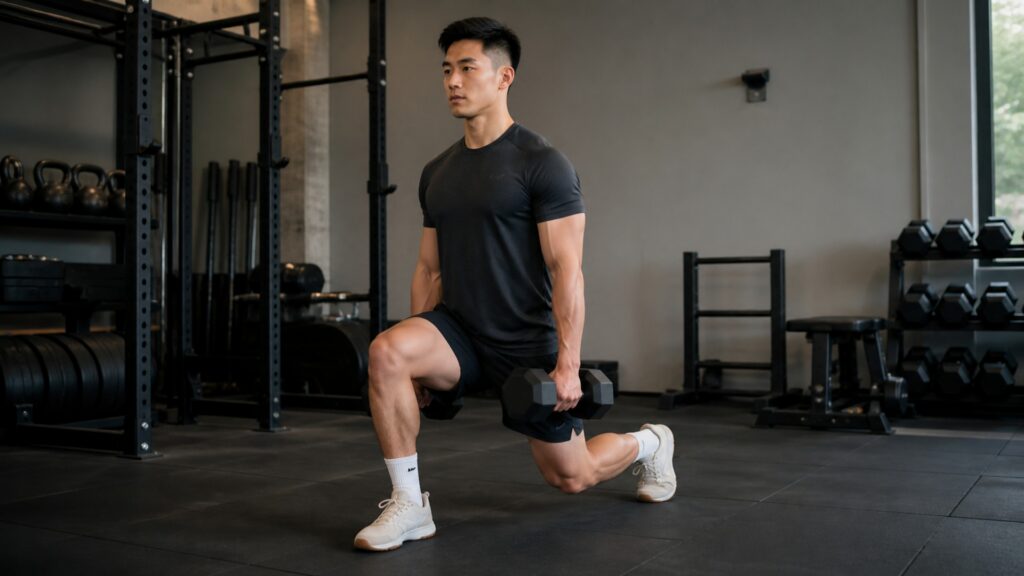
A practical look at how dumbbells change exercise path, control, stability, and exercise selection.
Tip: Judge the pattern before the load. A heavier dumbbell is not useful if the exercise path falls apart.
These concepts explain how dumbbells affect exercise mechanics and training quality.
A free path lets the hand and arm move without being locked into a machine track.
Unilateral control means each side of the body has to manage its own weight.
Stability demand is the extra control needed to keep the weight and body position steady.
Range of motion is how far the joint and weight travel during the exercise.
Exercise angle is the direction of the limb and load during the movement.
Pattern fit is how well the dumbbell version serves the intended exercise goal.
Tip: Good dumbbell training starts with the movement the user can repeat well, not the most impressive variation.
Because dumbbells are not fixed to a track, the user can adjust hand position and joint angle during the lift. That can make presses, rows, and raises feel more natural for some bodies.
Freedom helps when it improves control rather than adding guesswork.
Dumbbells make left and right sides manage separate loads. That can reveal strength differences and improve control, especially in rows, presses, lunges, and carries.
Separate loading is one of the clearest reasons to choose dumbbells.
Some dumbbell exercises ask the user to stabilize the load while moving. That can be valuable, but it can also reduce the load the target muscles receive.
Stability is useful when it supports the training target.
Dumbbells can allow deeper or freer ranges than some equipment. The extra range is helpful only when the user can own the position at the bottom and top of the lift.
A repeatable range matters more than chasing the longest path.
A dumbbell movement should be chosen because it solves a training need. Presses, rows, split squats, hinges, carries, and raises all ask for different amounts of balance, range, and coordination.
Movement pattern fit turns dumbbells from general equipment into a useful training tool.
Dumbbells are flexible, but that flexibility needs control.
They let users adjust exercise paths to their body and goal.
They make each side manage its own load.
They can be harder to stabilize than machines or barbells.
Some power or fixed-path goals may fit other tools better.
Exercise freedom is useful only when the movement stays controlled.
Freedom helps only when the user can control the path.
Dumbbells separate the hands and change balance, range, and setup.
Instability can help control, but it can also reduce useful loading.
The substitute has to preserve the target pattern and training effect.
Tip: Use dumbbells when their freedom improves the exercise, not just because the variation looks harder.
Short answers for matching dumbbells to exercise mechanics.
They determine whether the dumbbell exercise trains the intended muscles and skills.
Sometimes. Dumbbells allow more freedom, while machines can provide more guidance and stability.
They work well for many presses, rows, squats, lunges, hinges, raises, carries, and unilateral exercises.
Choose another tool when the goal needs heavier fixed loading, cable tension, swing mechanics, or machine stability.
Use dumbbells for movement patterns you can control through a repeatable range.
Movement pattern matters because dumbbells give the user freedom and responsibility at the same time.
The best dumbbell exercises match the goal, body position, range of motion, and control the user can repeat.
Use these Review Streets paths to compare related categories and practical next decisions.
Review the basic dumbbell training setup.
See how control and setup affect safe use.
Explore the dumbbells category.
Choose a retailer
Prices checked regularly. We may earn a commission at no cost to you.