
Finished-Product Concentration
The proportion of fragrance mixture in the complete consumer product.
- Use: Compare broad format expectations
- Variable: brand formula and market practice
- Tradeoff: The exact percentage may be undisclosed
Fragrance concentration matters because the proportion of aromatic concentrate in a finished product influences how much scented material can be deposited with a given volume. It may affect intensity, texture, diffusion, development, and price, but it is only one part of the formula.
Terms such as eau de toilette and eau de parfum are useful market descriptors, not internationally fixed percentage guarantees. Their common ranges overlap, and two versions of one named scent may be reformulated around different materials rather than created by simply adding or removing alcohol. Atomizer output, spray count, volatile balance, skin, fabric, climate, and nose adaptation can outweigh the label. Compare finished products at controlled doses and follow each through its full wear.
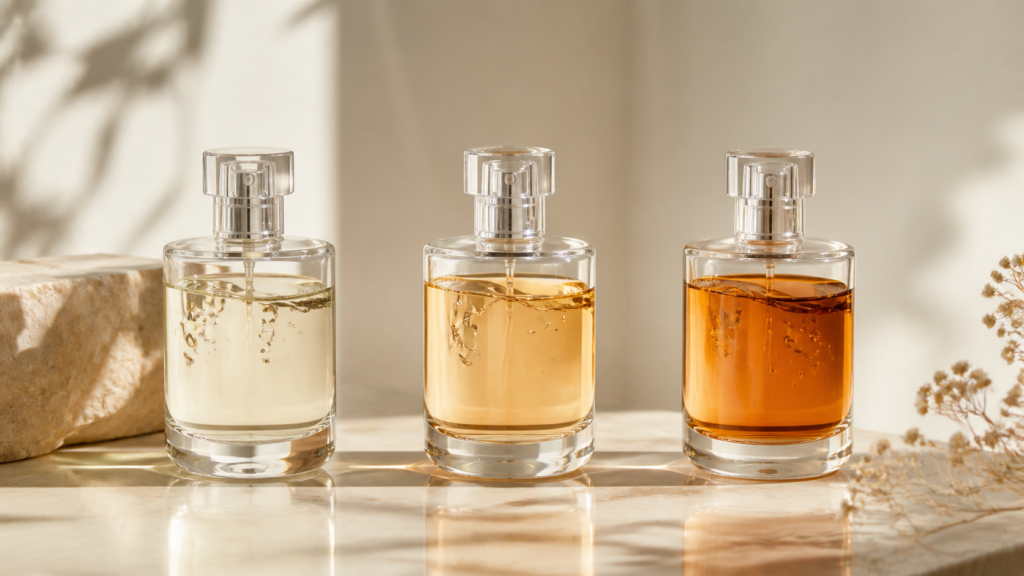
Percentage language helps orient shoppers, but composition, spray dose, structure, surface, and context determine how that concentration is experienced.
Tip: Treat the label as a sampling clue, then let controlled wear decide.
These distinctions separate aromatic proportion, product labeling, delivered dose, formula character, diffusion, and value.
The proportion of fragrance mixture in the complete consumer product.
A label such as eau de toilette, eau de parfum, or extrait.
The finished liquid deposited per activation multiplied by spray count.
Changes to material proportions between concentration versions.
How quickly and widely the scent moves into surrounding air.
Purchase price divided by the number of satisfying applications obtained.
Tip: A percentage without atomizer output and composition cannot describe the complete wear.
Concentration normally refers to aromatic mixture relative to the finished product, not a percentage of essential oils or a purity score. The concentrate itself may contain natural and synthetic materials, solvents, diluents, and functional ingredients.
A higher number describes proportion, not craftsmanship or safety.
IFRA notes that these terms are not strictly defined by international standards. Common practice places eau de toilette and eau de parfum in different typical ranges, but overlap means the words cannot verify an exact percentage.
The product name narrows expectations; it does not finish the comparison.
A perfumer may change bright, floral, woody, sweet, or musky proportions so an EDP remains coherent at a different load. Consequently, an EDT can emphasize lift while the related EDP emphasizes body or warmth.
Choose the version's scent character before choosing its tier.
Different pumps can deposit very different volumes. Use the same surface and a known spray count, while noting plume width and wetness; an oversized atomizer can deliver more finished product than a higher percentage bottle's small spray.
Concentration without deposited volume is an incomplete dose.
A higher concentration may need fewer sprays but cost more, sit closer, feel richer, or become tiring in heat. A lighter version may support controlled reapplication and shared-space wear better.
The best concentration is the one whose dose fits the day.
Concentration can frame likely richness and dose, but it cannot independently predict longevity, projection, quality, allergen response, or personal preference.
The descriptor helps select which versions of a fragrance line deserve side-by-side sampling.
Bottle price, required sprays, and reapplication can be translated into realistic cost per wear.
Material volatility and formula balance can reverse a simple stronger-versus-weaker expectation.
No descriptor guarantees comfort, suitability for a setting, or equal performance across people.
EDT, EDP, and extrait are not guaranteed steps on a universal ladder of strength, projection, quality, or value.
The descriptors do not specify a universal ratio, and their typical concentration ranges overlap. Atomizer output and formula changes further prevent a simple strength calculation, even within versions sharing the same fragrance name.
Greater aromatic load can help some formulas persist, but volatility, material substantivity, skin, fabric, climate, spray dose, and adaptation also matter. A tenacious EDT may outlast a diffusive or delicate EDP.
Projection depends on what enters the air, not percentage alone. Some high-concentration formulas remain dense and close, while lower-concentration compositions built with diffusive materials can create a more noticeable early cloud.
Brands may rebalance materials to preserve clarity, stability, character, or safety at another concentration. Related versions can emphasize different notes and should be treated as separate finished formulas during sampling.
Value depends on enjoyment, usable dose, bottle size, setting, shelf habits, and reapplication. Paying more for richness that feels excessive can produce fewer satisfying wears and leave more unused product.
Tip: Compare the exact finished products, not imagined dilution ratios.
Practical answers for translating a format label into a controlled side-by-side test.
IFRA lists typical ethanol-based ranges of about five to fifteen percent for eau de toilette and ten to twenty percent for eau de parfum, while emphasizing that no universal fixed definitions govern them.
Separate full wears reduce carryover, nose fatigue, and expectation bias. Use comparable spray counts and settings, then note character, projection, comfort, drydown, longevity, and whether reapplication would actually be convenient.
Often it can, but atomizer size and formula matter. Begin conservatively with the exact product, evaluate from normal distance, and increase only if the setting permits; do not copy another bottle's spray count.
Exposure and formula both matter, so concentration alone cannot determine tolerance. Patch-test when appropriate, follow label directions, avoid irritated skin, and stop if rash, burning, swelling, or other concerning symptoms develop.
Compare bottle volume, realistic sprays per wear, frequency, need for reapplication, and which version you genuinely prefer after complete wear. Cost per milliliter alone can undervalue a lower-dose product—or overvalue one rarely worn.
Richer concentrated styles may feel comfortable in cool conditions, but material balance and intended setting matter more than the tier. Test the exact formula with normal clothing and indoor heating before generalizing.
Fragrance concentration matters because it changes aromatic proportion and often the expected dose, richness, and price. It remains only one input alongside composition, atomizer output, surface, environment, and perception.
Use concentration terms to organize sampling, not to declare a winner. Compare the exact EDT, EDP, or extrait through complete wear and judge scent character, comfort, presence, reapplication, and cost together.
These guides help shoppers sample concentration versions and evaluate long-wear priorities.
Compare scent families, concentrations, testing methods, sizes, and first-purchase tradeoffs.
Evaluate composition, format, wear, bottle size, setting, and value before buying perfume.
Test wear duration, projection, fabric use, climate, and reapplication without relying on concentration alone.
Choose a retailer
Prices checked regularly. We may earn a commission at no cost to you.