Why Full Size Pickup Trucks Safety Factors Matters

Safety factors matter in a full-size pickup because its size, load, and visibility can change substantially between an empty commute and a family towing trip. A tall driving position can help you see farther ahead while still leaving areas close to the vehicle hidden. Passengers, cargo, and a trailer also change the weights the truck must support and control.

Start with a suitable vehicle and load, then use restraints, sound tires and brakes, secure cargo, and deliberate low-speed maneuvering. Cameras and driver assistance are useful aids with defined limits. A large truck is not a substitute for checking the space around it or for adapting to the load and road.

By: Review Streets Research Lab
Updated: October 5, 2026
Explainer · 8-12 min read
full size pickup trucks explainer hero image for Review Streets
What You'll Learn

Check Safety From the Driveway to the Loaded Trip

Focus on people nearby, occupants inside, and the weight carried or towed.

  • Check blind areas before pulling away or reversing
  • Use the right occupant restraints and keep cabin cargo secure
  • Count passengers and hitch load in the weight budget
  • Maintain tire condition and specified pressures
  • Understand the limits of cameras and assistance systems

Tip: Walk around before maneuvering when practical, and keep checking because people can enter the area afterward.

Definitions

Six Safety Factors for Everyday Full-Size Use

These checks address different risks; passing one does not eliminate the others.

Near-vehicle blind area

A near-vehicle blind area is space close to the truck that is not adequately visible from the driver's position.

  • Example: a low object hidden near a tall hood
  • Check: check the surroundings and available views before moving
  • Limit: a clear view into the distance does not mean the ground nearby is clear

Occupant restraint

An occupant restraint is a correctly used seat belt or appropriate child restraint that helps protect a person during a crash.

  • Example: a properly installed child seat in an approved seating position
  • Check: follow the vehicle and restraint instructions
  • Limit: a roomy cab does not remove installation or seating restrictions

Carried load

Carried load includes the people, cargo, equipment, and downward trailer load supported by the truck.

  • Example: passengers and luggage sharing capacity with trailer tongue weight
  • Check: compare the complete load with the actual vehicle's limits
  • Limit: an almost-empty bed does not prove the truck is lightly loaded

Cargo securement

Cargo securement restrains items against movement during travel.

  • Example: a toolbox fastened using suitable rated equipment and attachment points
  • Check: secure items in both the cab and bed
  • Limit: a cover or closed tailgate is not a complete restraint system

Cold tire pressure

Cold tire pressure is the tire inflation pressure checked before driving has warmed the tire, using the vehicle's instructions.

  • Example: checking the tires before a trip
  • Check: use the specified pressure for the vehicle and approved tire setup
  • Limit: the tire sidewall maximum is not automatically the vehicle's recommended setting

Driver assistance

Driver assistance comprises systems that warn or help with specified driving tasks within stated limits.

  • Example: a blind-spot warning or rear camera
  • Check: learn the fitted system's capabilities and restrictions
  • Limit: an alert's absence is not proof that a maneuver is safe

Tip: Make separate checks for the people, the load, the equipment, and the space needed to move.

Around the Truck

A High Seating Position Still Leaves Close Blind Areas

Before leaving a driveway or parking space, check for people, pets, objects, and other traffic around the vehicle. Mirrors and cameras show different areas and can be obstructed or dirty. A walkaround helps establish the situation, but someone can move into the path after it is completed, so continue monitoring while moving slowly.

  • Keep children away from the vehicle's maneuvering area.
  • Use a spotter when visibility is inadequate and stop if contact is lost.
  • Check both the direction of travel and the space swept by the turn.

The driver's ability to see over traffic should never be mistaken for a complete view around the truck.

Inside the Cab

Passenger Space Needs Correct Restraints and Secure Storage

Every occupant needs the appropriate restraint and seating position. Check child-restraint compatibility and installation using both sets of instructions. Store tools, bags, and other objects so they cannot become loose hazards or interfere with pedals and controls. A large rear seating area is useful only when it is arranged for the people and equipment traveling in it.

  • Buckle every occupant for every trip.
  • Follow seating and restraint instructions for children.
  • Keep loose objects away from footwells and controls.

Do not trade an occupant's proper seating position for extra cargo space.

Weight

Passengers and Trailer Load Can Consume the Allowance Quickly

An illustrative truck with a 1,500-pound occupant-and-cargo allowance has 700 pounds left after 600 pounds of people and 200 pounds of added equipment and luggage. A 650-pound tongue load would leave only 50 pounds in that simple calculation. That is not proof of suitability: axle, tire, hitch, trailer, and combined-weight limits must also pass.

  • Use actual loaded weights, not an empty-trailer figure.
  • Count installed accessories and hitch hardware.
  • Obtain loaded axle weights when checking a towing setup.

The example explains why a truck can approach a carrying limit even when its bed looks mostly empty.

Road Contact

Tires and Brakes Matter in Empty and Loaded Driving

Correct tires, specified pressures, and sound brakes are essential throughout the truck's use. Added load and a trailer change the demands on the setup; wet or icy roads reduce available grip. Four-wheel drive can assist propulsion in appropriate conditions, but it does not make stopping or turning independent of the tires and surface.

  • Inspect truck and trailer tires for damage and condition.
  • Resolve abnormal braking, vibration, or pressure loss.
  • Adapt speed and following distance to load, weather, and visibility.

The ability to pull away on a slippery surface does not establish that the next stop will be easy.

Assistance and Towing

Use Technology Within Its Intended Role

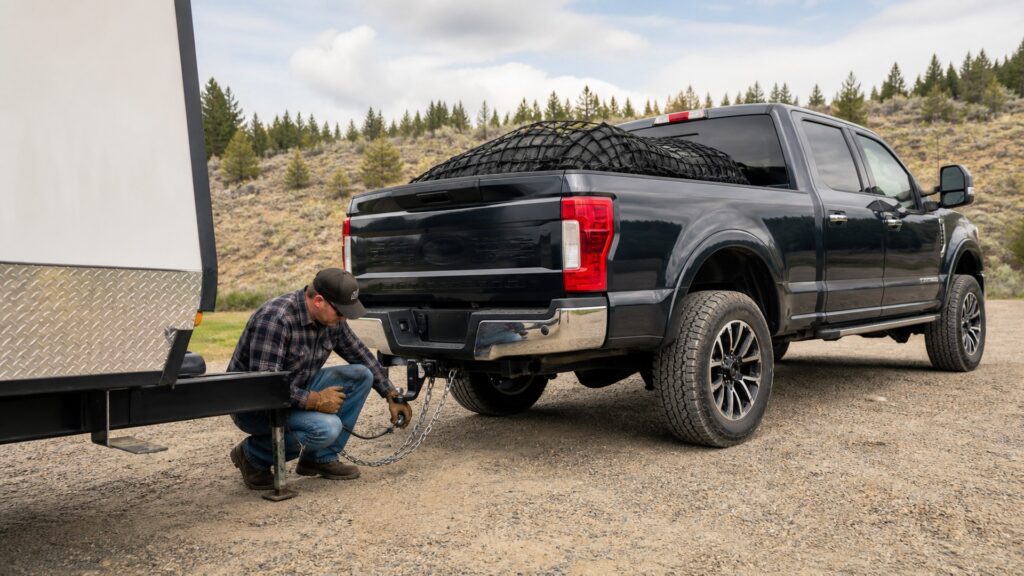
Read the manual for fitted cameras, parking aids, collision warnings, and trailer-related systems. Equipment can have restrictions when towing, when sensors are blocked, or under certain conditions. Before travel, check the hitch connection, required lights, and trailer brakes using the applicable procedures. Assistance does not correct an overloaded truck or faulty connection.

  • Keep required camera and sensor areas unobstructed.
  • Check whether the system supports the attached trailer.
  • Retain responsibility for clearance, speed, and the path of travel.

A warning system provides information or limited help; the driver still has to establish that the maneuver and setup are suitable.

Quick Reality Check

What Helps and What Still Needs Judgment

The vehicle's equipment supports safe use when its limitations are understood.

Useful Safeguards

Proper restraints, maintained tires and brakes, compatible towing equipment, and secured cargo.

Mirrors, cameras, and assistance features used for their intended tasks.

Checks the Driver Must Make

The complete load fits all relevant ratings and the space around the truck is clear.

Speed, spacing, and maneuvering remain appropriate for the conditions and visibility.

Common Myths

Misconceptions About Full-Size Pickup Safety

Size and technology do not remove the need for basic checks.

Sitting high means I can see everything.

Close blind areas can remain around a tall vehicle even with a good distant view.

An empty bed means plenty of payload remains.

Passengers, installed equipment, and hitch load also use the carrying allowance.

A bed cover secures the cargo.

A cover may protect cargo but does not necessarily restrain it against movement.

No warning means the path is clear.

Assistance has limits. Continue checking the surroundings and do not rely on a missing alert.

Tip: Resolve a load, equipment, or visibility problem before continuing with the maneuver or trip.

FAQ

Questions About Full-Size Pickup Safety

Answers for everyday travel, passengers, and towing.

What should I check before backing out?

Check around the vehicle, keep people clear, use available mirrors and cameras, and keep monitoring while moving slowly. Use a spotter when needed.

Does vehicle size replace seat belts?

No. Correct restraints remain necessary for every occupant.

Why count tongue weight as truck load?

It is downward force supported by the truck, using capacity alongside people and cargo.

Which tire pressure should I use?

Follow the vehicle's specified cold pressure and approved setup, not an assumed value taken from the sidewall maximum.

Can assistance compensate for an overloaded trailer setup?

No. The truck, trailer, hitch, tires, and axle loads must satisfy their limits independently of assistance features.

Bottom Line

Full-size pickup safety depends on clear surroundings, protected occupants, a suitable load, and maintained equipment.

Use the truck's technology as assistance while making deliberate checks for the people and conditions around it.

Next Steps

Go Deeper or Compare Your Options

Use these Review Streets paths to compare related categories and practical next decisions.

Manufacturer references: NHTSA child safety around vehicles; NHTSA driver assistance guidance; NHTSA tire safety; Ford towing information and model-year guides. Use the manual and ratings for your own model year and configuration.