
Antenna Sky View
The radio environment available to the receiver antenna, including visible satellite directions and attenuation or reflection from nearby materials.
- Metal can block signals
- Coatings may attenuate reception
- Buildings create multipath
GPS navigation fit begins before a route is calculated. The receiver needs a workable radio view, the driver needs a brief readable glance, and the mount must stay controlled without blocking road, mirrors, instruments, cameras, airbags, or controls. Power and cable routing must also survive real vehicle states.
Digital compatibility matters just as much. The installed map must cover the travel region, the routing profile must represent the vehicle, prompts must reach an audible path, and storage must support updates. Fitment therefore joins radio environment, geometry, electrical behavior, data coverage, human use, heat, and serviceability. A suction cup that sticks proves only one small boundary.
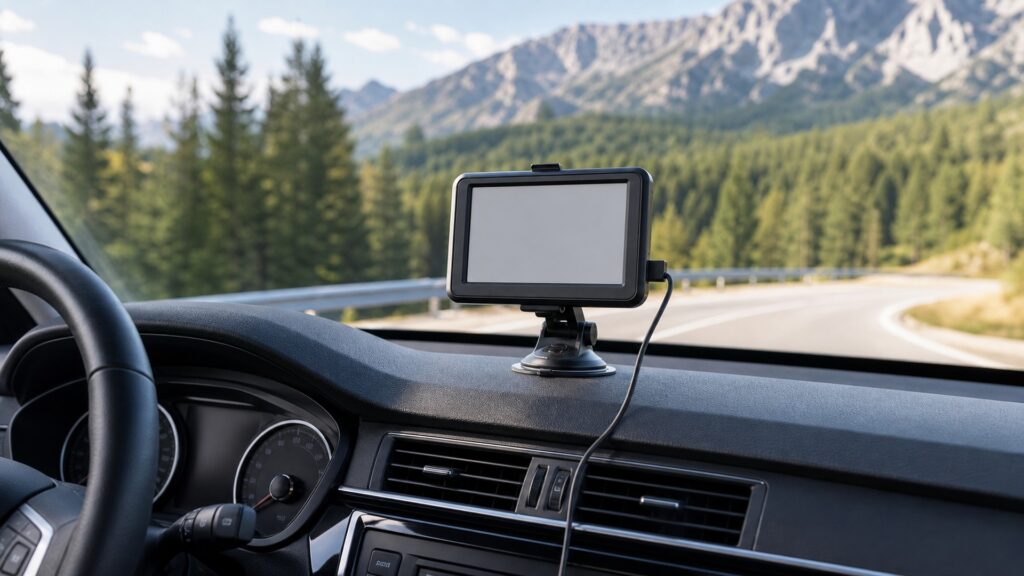
A navigation device fits only when it can establish trustworthy position, present suitable guidance, remain safely installed, and retain those functions throughout the intended trip.
Tip: Test the exact device in the exact vehicle with the intended maps, profile, driver positions, power states, and route types; catalog compatibility alone cannot reproduce that system.
These definitions separate physical mounting from radio, electrical, geographic, and vehicle-specific compatibility.
The radio environment available to the receiver antenna, including visible satellite directions and attenuation or reflection from nearby materials.
The combined space occupied by the device, cradle, adjustment travel, power connector, cable bend, and removal motion.
Compatibility with the vehicle outlet or hardwire behavior during start, crank, accessory mode, running, shutdown, and sleep.
The geographic area and road data included in an installed map product, which is separate from where satellites can be received.
Routing attributes describing vehicle dimensions, weight, class, restrictions, preferences, or capabilities for supported navigation products.
The route by which maneuver speech or alerts reach the driver through the device speaker, wireless link, receiver, or vehicle audio system.
Tip: State the intended vehicle, region, route class, and installation position before claiming fit.
Windshield coatings, metalized tint, heated glass, roof structures, dashboards, tall vehicles, and nearby electronics can attenuate or reflect weak satellite signals. Test acquisition and tracking at the intended mount rather than assuming any location behind glass behaves alike.
Reception fit concerns measurements; it does not guarantee correct road data.
Driver eye point, reach, screen angle, glare, mount articulation, bracket retention, cable loops, and removal motion define the usable envelope. A small object near the windshield can obscure a distant hazard or enter an airbag path.
Placement passes only when readability and vehicle safety clearances pass together.
The correct adapter must match device voltage and current while the vehicle outlet may switch, sag during cranking, or remain energized after parking. Hardwiring adds fuse, routing, battery, and sleep-current obligations beyond connector shape.
A powered home screen does not prove stable trip operation or safe battery behavior.
A device may receive GPS worldwide yet lack detailed maps for the destination. Route suitability also depends on current roads, restrictions, selected avoidances, and any supported height, weight, hazardous-material, towing, or surface profile.
Satellite availability cannot fill missing roads or validate a vehicle-inappropriate route.
The driver needs understandable speech and visuals without deep interaction. The device also faces parked-cabin heat, repeated attachment, connector wear, map downloads, storage limits, cleaning, and theft-conscious removal. Service access belongs in initial placement.
Long-term fit is the ability to operate and maintain the device without degrading the vehicle or guidance.
A receiver may calculate coordinates wherever signals are usable while its installed maps, search data, language, traffic service, road restrictions, or update entitlement cover a much smaller region.
A suitable location can improve reception, sightlines, reach, restraint, cable routing, thermal exposure, and prompt use.
Vehicle-state testing can prove power and shutdown compatibility.
Map regions, update support, storage, routing profiles, live services, and restriction coverage depend on the exact model and data product.
No consumer route overrides posted signs or actual vehicle limits.
These myths mistake one successful connection or a visible map for complete vehicle and route compatibility.
Vehicle glass, coatings, metal, roof structure, electronics, and mount location can change weak-signal reception and reflections. Test acquisition and tracking at the intended installation point under representative conditions instead of extrapolating from open sky.
The cup may attach while the device blocks road view, mirrors, instruments, cameras, airbags, controls, or wipers. Heat, surface texture, bracket leverage, cable routing, and driver geometry determine whether the complete mount remains suitable.
Satellite positioning and map data are independent. A receiver can produce coordinates where detailed roads, addresses, restrictions, search data, traffic, or updates are missing. Verify the installed region and product support before travel.
A supported vehicle profile can filter modeled restrictions, but maps may be incomplete or outdated and temporary conditions change. Confirm critical clearances independently and obey posted limits, closures, permits, and official route requirements.
Tip: Make each fit claim name the layer it proves.
These answers cover windshield placement, metalized glass, power, map regions, and final installation proof.
Use a manufacturer-supported location that preserves a useful antenna view, road and instrument sightlines, airbag clearance, reach, ventilation, and cable control. Verify local mounting rules and test the view from every regular driver position.
Compare acquisition time and signal status at the proposed location with an open-sky or documented antenna-friendly area. Heated or coated glass may have designated zones; consult vehicle information before adding antennas or altering trim.
No. Connector shape alone does not establish voltage, current, signaling, cable resistance, charging behavior, or electromagnetic compatibility. Use specified hardware and verify operation through cranking, accessory transitions, full brightness, shutdown, and any intended parked state.
Confirm the correct region, current supported version, available storage, destination search, planned border coverage, route preferences, vehicle profile, and any required offline data. Review critical restrictions and keep an independent fallback for unfamiliar areas.
Verify secure retention, clear sightlines, comfortable reach, satellite acquisition, stable tracking, correct maps and profile, prompt audibility, day and night readability, cranking behavior, shutdown, vehicle sleep, thermal stability, and serviceable removal without cable damage.
GPS navigation fitment matters because reception, driver view, restraint, power states, map coverage, vehicle profile, prompt delivery, heat, updates, and service access can fail independently.
Test the complete installed system against its real route and vehicle requirements. A device that powers up and shows a map has not yet proved suitable reception, guidance, safety, or ownership fit.
These explainers show what each installed interface must support, how positioning becomes guidance, and which states should be tested before relying on the device.
Trace satellite measurement, position solution, map matching, route search, and maneuver delivery.
Test acquisition, route calculation, prompt delivery, recalculation, connectivity, and fallback as explicit states.
Audit obstruction, distraction, route suitability, degraded position, heat, and power consequences.
Choose a retailer
Prices checked regularly. We may earn a commission at no cost to you.