Why Hatchbacks Operating Function Matters

A hatchback's operating function is how well its rear opening, folding seats, luggage floor, passenger space, and driving controls work together in daily use. A large capacity figure is less helpful if you cannot reach the hatch handle, lift a regular load over the sill, or keep the seats you need available.

The best assessment follows a complete trip: approach the parked car, open it, arrange the seats, load your belongings, drive, and unload. Small inconveniences become important when repeated. Judge the actual car with your own passengers and typical cargo rather than relying on the promise of flexible space.

By: Review Streets Research Lab
Updated: October 5, 2026
Explainer · 8-12 min read
hatchbacks explainer hero image for Review Streets
What You'll Learn

Follow a Hatchback Through a Real Journey

Find out whether the useful space is also easy to access, arrange, and use.

  • Check the opening path and handle reach.
  • Try the folding-seat sequence rather than only looking at it.
  • Assess the sill, floor, and cargo shape together.
  • Keep weight limits separate from volume.
  • Evaluate ordinary driving with the seating arrangement you expect to use.

Tip: A realistic loading trial can reveal a poor fit before a test drive does.

Definitions

The Functions Behind Hatchback Versatility

These details connect the rear-door design to everyday ease of use.

Opening clearance

Opening clearance is the space the hatch needs as it swings upward.

  • Example: raising the hatch beneath a garage ceiling
  • Check: its path near walls, shelves, and overhead obstructions
  • Limit: the car fitting in the garage does not prove the hatch can open there

Handle reach

Handle reach is how easily the user can operate the release and close the open hatch.

  • Example: reaching the intended interior pull handle
  • Check: the actual user's comfortable reach
  • Limit: powered operation and opening-height adjustment are not fitted to every car

Seat conversion

Seat conversion is the sequence used to change between passenger seating and cargo space.

  • Example: releasing one backrest and restoring it afterward
  • Check: head-restraint, belt, and front-seat clearance
  • Limit: the manual may require more steps than pulling one lever

Load-floor geometry

Load-floor geometry is the shape, height, and continuity of the cargo surface.

  • Example: a step between the luggage floor and folded backrests
  • Check: whether the object rests securely without forcing panels
  • Limit: an adjustable floor may have position-specific limits

Usable cargo length

Usable cargo length is the space available for an item in the seating configuration required.

  • Example: a long package behind a correctly positioned front seat
  • Check: the length with all necessary seats in use
  • Limit: moving the driver into a poor position is not a suitable way to gain space

Low-speed drivability

Low-speed drivability is the ease of controlling the car during starts, stops, and tight maneuvers.

  • Example: moving smoothly into a parking space
  • Check: response, visibility, and turning room
  • Limit: a compact-looking body does not guarantee easy maneuvering

Tip: Test the steps you will repeat, including putting everything back into passenger use.

Approach

The Hatch Must Work Where You Park

An upward-opening door needs room beyond the closed body. Try the release, observe the swing path, and check comfortable reach once it is open. If the car has a powered hatch, learn its intended controls and any opening-height adjustment from the manual. Do not assume a feature is present because another trim offers it.

  • Check the real garage or parking-space dimensions.
  • Allow space to stand behind the car with the load.
  • Make sure the hatch remains securely open before loading.

Convenience begins with access you can use at home, not just a wide-open showroom demonstration.

Rearrangement

Folding Seats Should Be a Practical Sequence

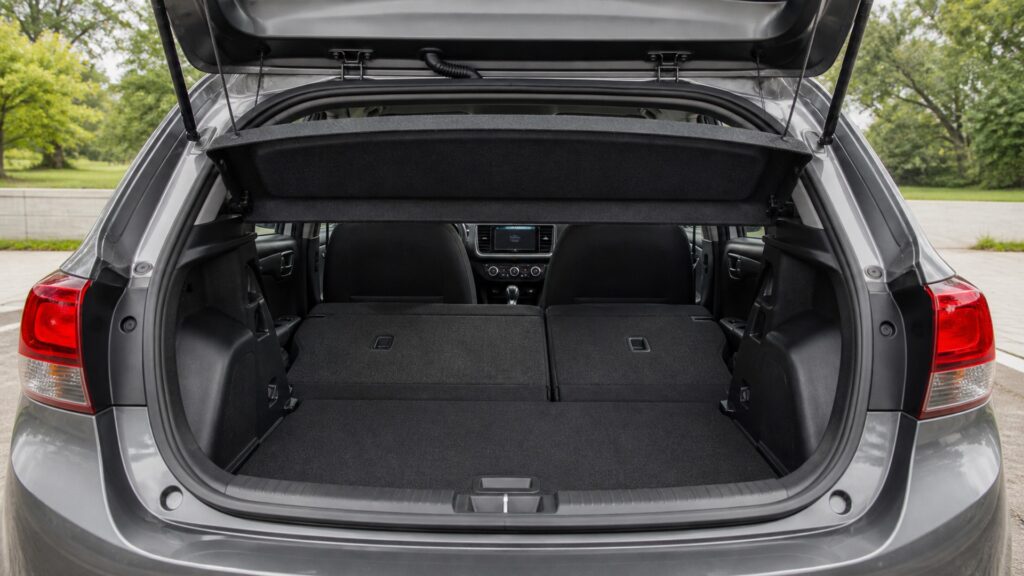
A folding seat may need the head restraint adjusted, a belt moved clear, or the front seat repositioned first. Some release handles are reached from the cabin; others are accessible from the luggage area. Try the complete process without forcing any part, then restore the seats and check the specified locking confirmation.

  • Follow the exact folding instructions.
  • Keep belts and stored objects clear of the mechanism.
  • Check the passenger position after the backrest is restored.

A quick conversion is valuable only if the seating arrangement can be returned correctly and comfortably. Mazda: folding and restoring rear seatbacks.

Loading

The Floor and Opening Must Suit the Object

Width at the entrance, space between the wheel housings, sill height, and the angle of folded seats all affect a real load. A long flat package and a tall upright box can expose different limitations. If a movable floor or cover must be removed, consider where it will go during the trip.

  • Try the largest item you carry regularly.
  • Check any step or gap in the supporting floor.
  • Confirm room to close the hatch without pressing on cargo.

A cargo demonstration is most useful when it includes lifting, positioning, and unloading, not merely proving that the object fits somewhere inside.

Capacity

Room for Cargo Is Not Permission for More Weight

A hatchback can offer considerable space once the seats are folded, but that does not change its carrying limit. Passengers and other carried weight reduce what remains for luggage. Use the vehicle's label and instructions, and choose a suitable alternative when the task exceeds them.

  • Check the occupant-and-cargo allowance for the exact car.
  • Consider the weight of dense items as well as their size.
  • Use the designated securing provisions.

Honda's Civic Hatchback loading guidance directs owners to the doorjamb label; it is the vehicle-specific allowance, not the shape of the opening, that governs the load. Honda: Civic Hatchback load limits.

The Journey

Drive the Configuration You Actually Need

A car that works well as an empty demonstration vehicle still needs to suit your passengers and routine. Check seating comfort, rearward view, control reach, and gentle low-speed response. Account for the belongings you expect to carry without deliberately testing the car at its limits.

  • Set the driver's seat correctly before evaluating space.
  • Ask rear passengers about comfort and access.
  • Check visibility with cargo arranged according to the manual.

The hatchback succeeds when loading flexibility and ordinary driving remain convenient together, rather than one requiring you to compromise the other.

Quick Reality Check

Where Versatility Becomes Useful or Awkward

Use a complete task to evaluate the design.

A Useful Arrangement

The hatch opens where you park, the load passes through easily, and required seats remain comfortable.

Seat conversion and restoring passenger use are clear and manageable.

A Recurring Compromise

The object fits only after an awkward lift or an unsuitable change to the driver's position.

The removed floor or cover has nowhere to go, or the necessary passengers lose their seats.

Common Myths

Misconceptions About Hatchback Operation

Useful space is more than a maximum-capacity number.

A larger cargo figure always means easier loading

The aperture, sill, floor shape, and seating arrangement can make a smaller space more usable for a particular item.

Every folding seat creates a flat floor

Backrest angle, floor height, and seat design vary. Inspect the complete surface.

A powered hatch removes every access problem

It may reduce lifting effort, but you still need clearance and the correct operating procedure.

Compact cars always feel easy to park

Visibility, turning circle, control response, and the available space also matter.

Tip: Repeat the full process once before deciding that a clever feature will be convenient to live with.

FAQ

Questions About Everyday Hatchback Function

Practical answers about access, conversion, and real cargo space.

What should I bring to a hatchback test?

Bring a representative bulky item, its dimensions, and your usual passengers when practical. Also note the parking-space and overhead-clearance limits at home.

Should I compare cargo volume with the seats folded?

Only if that is the arrangement you can actually use. Start with the seats that must remain occupied.

Can I remove the parcel cover or adjust the floor?

Only as allowed by the vehicle instructions. Check how removed pieces are stored and any restrictions on floor position or load.

What reveals a poor fit most quickly?

Trying a complete ordinary task: open the car, arrange the seats, load, close, and unload. Awkward reach or lost passenger space becomes obvious.

Bottom Line

Hatchback versatility is useful when the entire sequence of access, loading, travel, and unloading works for you.

Test the actual opening and seat conversion with a realistic load, respect the carrying limits, and keep the driving position and required passenger seats usable.

Next Steps

Go Deeper or Compare Your Options

Use these Review Streets paths to compare related categories and practical next decisions.