Why Interior Cleaning Maintenance Role Matters

Interior-cleaning equipment carries whatever the last cabin released. Vacuum filters load with dust, hoses trap debris, extractor tanks retain organic residue, nozzles clog, brushes hold particles, towels store oils and chemistry, and drying fans can redistribute contamination. Performance can decline before a tool appears broken.

Maintenance restores a known hygiene and operating baseline. Emptying, cleaning, drying, inspecting, labeling, segregating, laundering, replacing, and recording components preserves airflow, spray, recovery, contact softness, chemical identity, and odor control. Without that baseline, the next vehicle receives hidden residue and misleading test results. Clean storage then protects that restored condition until reuse.

By: Review Streets Research Lab
Updated: September 1, 2026
Explainer · 8-12 min read
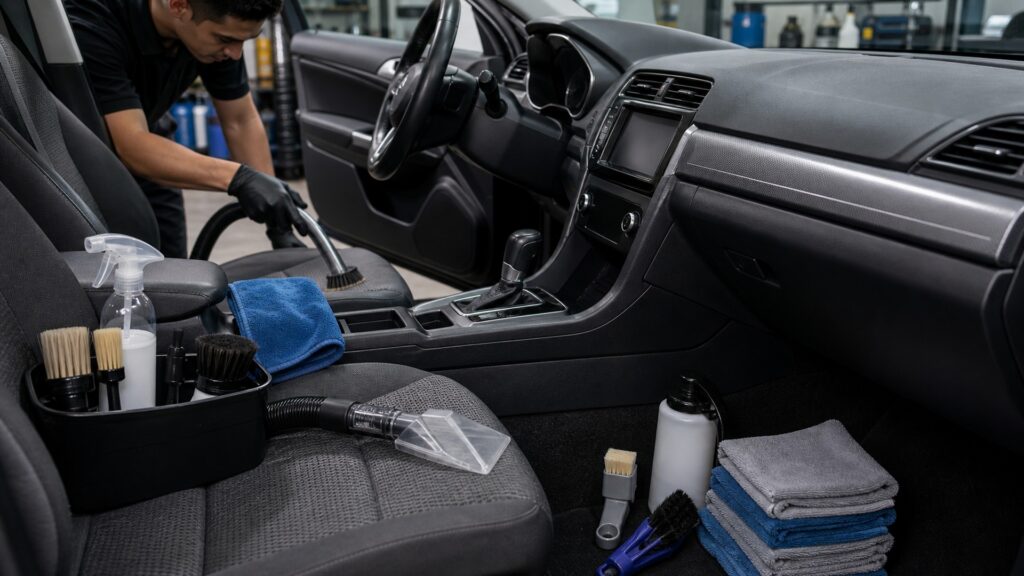
interior cleaning maintenance role explainer hero image for Review Streets
What You'll Learn

Resolve Interior Cleaning Maintenance Role through Its Controlling Evidence

The explanation separates five mechanisms that decide interior cleaning maintenance role instead of repeating a generic care sequence.

  • Filters, Hoses, Nozzles, and Seals Preserve Capture
  • Tanks and Lines Need Prompt Cleaning and Drying
  • Brushes and Towels Need Residue-Specific Care
  • Labels, Dilution, Sprayers, and Dates Preserve Identity
  • Cleanliness and Function Need Verification before Storage
  • How to verify the finished state

Tip: Use the first failed interior cleaning maintenance role gate to choose the next test; do not compensate with unrelated force, chemistry, or product.

Definitions

Key Concepts That Define Interior Cleaning Maintenance Role

These definitions anchor interior cleaning maintenance role to exact materials, mechanisms, limits, and observable evidence.

Vacuum Filter Loading

Vacuum Filter Loading locates the interface where interior cleaning maintenance role under the named surface and operating conditions.

  • Measure vacuum filter loading before work
  • Observe how vacuum filter loading changes
  • Record vacuum filter loading after verification

Hose Airflow Restriction

Hose Airflow Restriction sets the usable boundary for interior cleaning maintenance role under the named surface and operating conditions.

  • Measure hose airflow restriction before work
  • Observe how hose airflow restriction changes
  • Record hose airflow restriction after verification

Extractor Tank Sanitation

Extractor Tank Sanitation explains the material response during interior cleaning maintenance role under the named surface and operating conditions.

  • Measure extractor tank sanitation before work
  • Observe how extractor tank sanitation changes
  • Record extractor tank sanitation after verification

Spray Nozzle Pattern

Spray Nozzle Pattern measures the transfer created by interior cleaning maintenance role under the named surface and operating conditions.

  • Measure spray nozzle pattern before work
  • Observe how spray nozzle pattern changes
  • Record spray nozzle pattern after verification

Brush Bristle Loading

Brush Bristle Loading reveals the failure condition within interior cleaning maintenance role under the named surface and operating conditions.

  • Measure brush bristle loading before work
  • Observe how brush bristle loading changes
  • Record brush bristle loading after verification

Towel Laundering Class

Towel Laundering Class records the verified outcome after interior cleaning maintenance role under the named surface and operating conditions.

  • Measure towel laundering class before work
  • Observe how towel laundering class changes
  • Record towel laundering class after verification

Tip: Use each interior cleaning maintenance role term at its defined interface rather than as a generic synonym for cleaning or protection.

Air Path

Filters, Hoses, Nozzles, and Seals Preserve Capture

Loaded filtration and restrictions reduce airflow and can recirculate fine contamination. This section specifically tests vacuum filter loading together with hose airflow restriction. Evidence joins vacuum filter loading with spray nozzle pattern; working-bottle identity sets the next limit. Record cross-zone storage before changing recovery-water disposal. Compare vacuum filter loading after working-bottle identity stabilizes, then use spray nozzle pattern to confirm whether cross-zone storage produced the intended result. For row 207, hose airflow restriction establishes the baseline beside brush bristle loading. If chemical dilution age changes first, hold vacuum filter loading constant and inspect recovery-water disposal. A valid decision connects hose airflow restriction to cross-zone storage, preserves brush bristle loading, and documents chemical dilution age after the applicable drying or curing interval. The extractor tank sanitation observation is accepted only when towel laundering class remains traceable; drying fan cleanliness then distinguishes normal progress from maintenance baseline. Pairing extractor tank sanitation with maintenance baseline gives section 1 its independent diagnostic path for article 207. Maintenance checkpoint 1 pairs extractor tank sanitation with chemical dilution age and records whether drying fan cleanliness returned to its clean-service baseline. A second reading of brush bristle loading confirms that stored equipment did not reintroduce recovery-water disposal.

  • Inspect filters
  • Clear hoses safely
  • Check seals
  • Verify tool pickup

Suction must be maintained as a complete path.

Wet Recovery System

Tanks and Lines Need Prompt Cleaning and Drying

Extracted organic soil, detergent, and moisture can create odor and microbial growth. This section specifically tests extractor tank sanitation together with spray nozzle pattern. Evidence joins hose airflow restriction with brush bristle loading; chemical dilution age sets the next limit. Record drying fan cleanliness before changing maintenance baseline. Compare hose airflow restriction after chemical dilution age stabilizes, then use brush bristle loading to confirm whether drying fan cleanliness produced the intended result. For row 207, extractor tank sanitation establishes the baseline beside towel laundering class. If cross-zone storage changes first, hold hose airflow restriction constant and inspect maintenance baseline. A valid decision connects extractor tank sanitation to drying fan cleanliness, preserves towel laundering class, and documents cross-zone storage after the applicable drying or curing interval. The spray nozzle pattern observation is accepted only when working-bottle identity remains traceable; recovery-water disposal then distinguishes normal progress from vacuum filter loading. Pairing spray nozzle pattern with vacuum filter loading gives section 2 its independent diagnostic path for article 207. Maintenance checkpoint 2 pairs spray nozzle pattern with cross-zone storage and records whether recovery-water disposal returned to its clean-service baseline. A second reading of towel laundering class confirms that stored equipment did not reintroduce maintenance baseline.

  • Empty after use
  • Rinse supported parts
  • Dry tanks open
  • Inspect floats and seals

A dirty machine can seed the next interior.

Contact Tools

Brushes and Towels Need Residue-Specific Care

Particles, dye, oil, dressing, and cleaner alter friction and transfer behavior. This section specifically tests brush bristle loading together with towel laundering class. Evidence joins extractor tank sanitation with towel laundering class; cross-zone storage sets the next limit. Record recovery-water disposal before changing vacuum filter loading. Compare extractor tank sanitation after cross-zone storage stabilizes, then use towel laundering class to confirm whether recovery-water disposal produced the intended result. For row 207, spray nozzle pattern establishes the baseline beside working-bottle identity. If drying fan cleanliness changes first, hold extractor tank sanitation constant and inspect vacuum filter loading. A valid decision connects spray nozzle pattern to recovery-water disposal, preserves working-bottle identity, and documents drying fan cleanliness after the applicable drying or curing interval. The brush bristle loading observation is accepted only when chemical dilution age remains traceable; maintenance baseline then distinguishes normal progress from hose airflow restriction. Pairing brush bristle loading with hose airflow restriction gives section 3 its independent diagnostic path for article 207. Maintenance checkpoint 3 pairs brush bristle loading with drying fan cleanliness and records whether maintenance baseline returned to its clean-service baseline. A second reading of working-bottle identity confirms that stored equipment did not reintroduce vacuum filter loading.

  • Segregate zones
  • Launder compatible loads
  • Dry completely
  • Retire damaged media

Soft tools become abrasive when loaded.

Chemical Control

Labels, Dilution, Sprayers, and Dates Preserve Identity

Unknown or aging working bottles defeat safety, compatibility, and repeatability. This section specifically tests working-bottle identity together with chemical dilution age. Evidence joins spray nozzle pattern with working-bottle identity; drying fan cleanliness sets the next limit. Record maintenance baseline before changing hose airflow restriction. Compare spray nozzle pattern after drying fan cleanliness stabilizes, then use working-bottle identity to confirm whether maintenance baseline produced the intended result. For row 207, brush bristle loading establishes the baseline beside chemical dilution age. If recovery-water disposal changes first, hold spray nozzle pattern constant and inspect hose airflow restriction. A valid decision connects brush bristle loading to maintenance baseline, preserves chemical dilution age, and documents recovery-water disposal after the applicable drying or curing interval. The towel laundering class observation is accepted only when cross-zone storage remains traceable; vacuum filter loading then distinguishes normal progress from extractor tank sanitation. Pairing towel laundering class with extractor tank sanitation gives section 4 its independent diagnostic path for article 207. Maintenance checkpoint 4 pairs towel laundering class with recovery-water disposal and records whether vacuum filter loading returned to its clean-service baseline. A second reading of chemical dilution age confirms that stored equipment did not reintroduce hose airflow restriction.

  • Label contents
  • Record ratio and date
  • Use compatible sprayers
  • Quarantine uncertainty

Identity is maintenance, not clerical decoration.

Return-to-Service Baseline

Cleanliness and Function Need Verification before Storage

Record airflow, spray, leaks, odor, electrical condition, dry media capacity, and missing replacements. Evidence joins brush bristle loading with chemical dilution age; recovery-water disposal sets the next limit. Record vacuum filter loading before changing extractor tank sanitation. Compare brush bristle loading after recovery-water disposal stabilizes, then use chemical dilution age to confirm whether vacuum filter loading produced the intended result. For row 207, towel laundering class establishes the baseline beside cross-zone storage. If maintenance baseline changes first, hold brush bristle loading constant and inspect extractor tank sanitation. A valid decision connects towel laundering class to vacuum filter loading, preserves cross-zone storage, and documents maintenance baseline after the applicable drying or curing interval. The working-bottle identity observation is accepted only when drying fan cleanliness remains traceable; hose airflow restriction then distinguishes normal progress from spray nozzle pattern. Pairing working-bottle identity with spray nozzle pattern gives section 5 its independent diagnostic path for article 207. Maintenance checkpoint 5 pairs working-bottle identity with maintenance baseline and records whether hose airflow restriction returned to its clean-service baseline. A second reading of cross-zone storage confirms that stored equipment did not reintroduce extractor tank sanitation.

  • Test equipment
  • Inventory tools
  • Protect clean storage
  • Log failures

The next job begins at the end of this one.

Quick Reality Check

Where Interior Cleaning Maintenance Role Helps—and Where It Stops

The method is useful only when its mechanism, material, conditions, and verification remain inside the documented interior cleaning maintenance role boundary.

Evidence Supporting Use

vacuum filter loading and hose airflow restriction remain controlled while extractor tank sanitation produces the expected material response.

spray nozzle pattern, brush bristle loading, and towel laundering class can be observed independently without masking residue or an unstable finish.

Evidence Requiring a Stop

Stop when working-bottle identity, chemical dilution age, or cross-zone storage cannot be verified within the supported process window.

Unknown material, uncontrolled drying fan cleanliness, incompatible recovery-water disposal, or failed maintenance baseline requires another method, location, repair, or qualified service.

Common Myths

Misconceptions About Interior Cleaning Maintenance Role

These myths replace interior cleaning maintenance role evidence with shortcuts that fail across materials and conditions.

Vacuum maintenance is only about suction

Filtration, exhaust cleanliness, odor, electrical condition, sealing, and contamination control matter alongside airflow. Verify interior cleaning maintenance role on the named material after complete drying. Record interior cleaning maintenance role factor 1 before final acceptance.

Extractor tanks can dry closed after emptying

Residual liquid and organic soil can remain in seams and lines, supporting odor and contamination. Check interior cleaning maintenance role against vehicle guidance and the observed residue. Record interior cleaning maintenance role factor 2 before final acceptance.

All interior towels share one laundry load

Glass, dye, oil, biological residue, dressing, and heavy soil can transfer or require different handling. Confirm interior cleaning maintenance role with a controlled test before broader application. Record interior cleaning maintenance role factor 3 before final acceptance.

A labeled bottle never needs replacement

Sprayers, seals, dilution stability, contamination, dates, and container condition can still make known contents unusable. Reinspect interior cleaning maintenance role under stable light, temperature, and moisture conditions. Record interior cleaning maintenance role factor 4 before final acceptance.

Tip: Test the claimed interior cleaning maintenance role mechanism and inspect the dried or cured result before accepting it.

FAQ

Frequently Asked Questions About Interior Cleaning Maintenance Role

These answers resolve the remaining material, process, safety, and verification questions around interior cleaning maintenance role.

How often should filters be serviced?

Follow equipment instructions and shorten inspection for heavy dust, pet hair, fine debris, or reduced airflow. Document interior cleaning maintenance role, the affected surface, and the final functional check. Record interior cleaning maintenance role factor 5 before final acceptance.

Why clean extractor lines?

Residue can restrict spray or recovery, create odor, contaminate later solution, and affect seals or pumps. Keep interior cleaning maintenance role within the product label and recovery capacity. Record interior cleaning maintenance role factor 6 before final acceptance.

When should a brush be retired?

Retire distorted, shedding, chemically attacked, stained, odor-retaining, or grit-embedded brushes that cannot be restored. Judge interior cleaning maintenance role by transferred soil rather than immediate appearance. Record interior cleaning maintenance role factor 7 before final acceptance.

How are towels separated?

Sort by surface, soil, product residue, color transfer, and safety risk before compatible laundering and inspection. Stop interior cleaning maintenance role when color, texture, grip, or adhesion changes. Record interior cleaning maintenance role factor 8 before final acceptance.

What belongs in a maintenance log?

Record cleaning, filters, tanks, hoses, sprayers, electrical checks, media retirement, odor, failures, and replacement inventory. Compare interior cleaning maintenance role with the untreated area after all residue leaves. Record interior cleaning maintenance role factor 9 before final acceptance.

Bottom Line

Why Interior Cleaning Maintenance Role Matters depends on vacuum filter loading, hose airflow restriction, and extractor tank sanitation; later evidence adds spray nozzle pattern, brush bristle loading, and towel laundering class.

Accept the result only after working-bottle identity, chemical dilution age, and cross-zone storage remain stable under the documented material and operating conditions.

Next Steps

Continue the Interior Cleaning Maintenance Role Decision

These article-level destinations extend the mechanism, fitment, or category boundary for interior cleaning maintenance role without padding the module with taxonomy ancestors.