Why Interior Cleaning Safety Factors Matters

Interior cleaning occurs in a small enclosure containing chemicals, electrical tools, concealed sharp objects, bodily residues, food, moisture, heat, and safety systems. Sprays and vapors concentrate near the breathing zone; wet cords and extractors operate beside liquid; brushes and steam can injure; contaminated recovery material remains hazardous.

The vehicle itself adds consequences. Residue must not make pedals, steering, mats, seats, or controls slippery; moisture must stay out of modules and retractors; cleaners must not affect airbags, webbing, child-seat interfaces, or display visibility. Labels, PPE, ventilation, isolation, restrained application, and final functional inspection are independent gates.

By: Review Streets Research Lab
Updated: September 1, 2026
Explainer · 8-12 min read
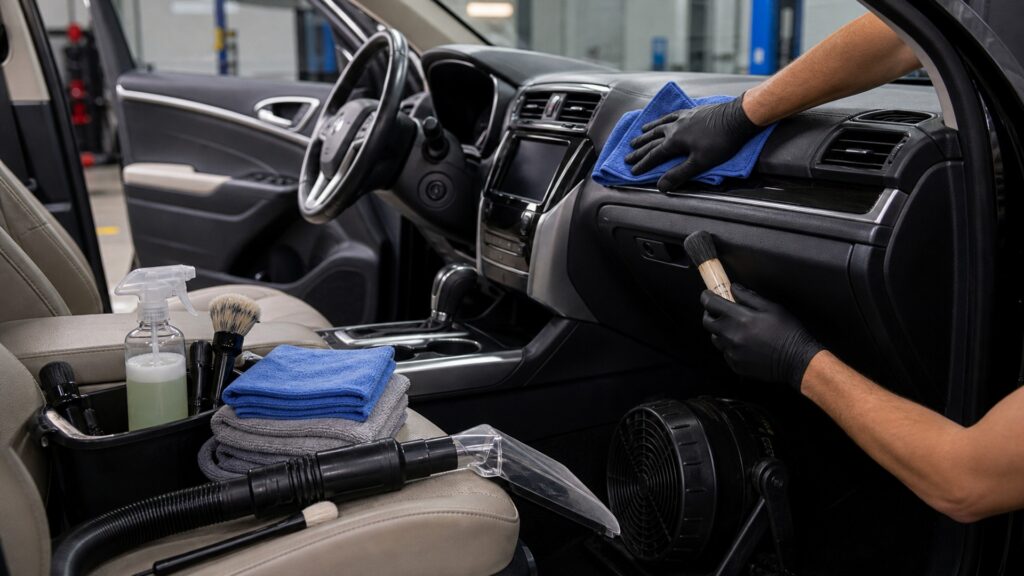
interior cleaning safety factors explainer hero image for Review Streets
What You'll Learn

Resolve Interior Cleaning Safety Factors through Its Controlling Evidence

The explanation separates five mechanisms that decide interior cleaning safety factors instead of repeating a generic care sequence.

  • Labels, PPE, and Ventilation Address Chemical Routes
  • Sharps, Seat Motion, and Confined Posture Need Prework Controls
  • Wet Tools and Cabin Electronics Need Separate Boundaries
  • Airbags, Belts, and Child-Seat Interfaces Cannot Be Treated as Trim
  • Grip, Visibility, Vapor, Moisture, and Loose Tools Need Final Checks
  • How to verify the finished state

Tip: Use the first failed interior cleaning safety factors gate to choose the next test; do not compensate with unrelated force, chemistry, or product.

Definitions

Key Concepts That Define Interior Cleaning Safety Factors

These definitions anchor interior cleaning safety factors to exact materials, mechanisms, limits, and observable evidence.

Chemical Exposure Route

Chemical Exposure Route locates the interface where interior cleaning safety factors under the named surface and operating conditions.

  • Measure chemical exposure route before work
  • Observe how chemical exposure route changes
  • Record chemical exposure route after verification

Cabin Vapor Concentration

Cabin Vapor Concentration sets the usable boundary for interior cleaning safety factors under the named surface and operating conditions.

  • Measure cabin vapor concentration before work
  • Observe how cabin vapor concentration changes
  • Record cabin vapor concentration after verification

Wet Electrical Connection

Wet Electrical Connection explains the material response during interior cleaning safety factors under the named surface and operating conditions.

  • Measure wet electrical connection before work
  • Observe how wet electrical connection changes
  • Record wet electrical connection after verification

Hidden Sharp Object

Hidden Sharp Object measures the transfer created by interior cleaning safety factors under the named surface and operating conditions.

  • Measure hidden sharp object before work
  • Observe how hidden sharp object changes
  • Record hidden sharp object after verification

Biological Contamination

Biological Contamination reveals the failure condition within interior cleaning safety factors under the named surface and operating conditions.

  • Measure biological contamination before work
  • Observe how biological contamination changes
  • Record biological contamination after verification

Pedal Slip Residue

Pedal Slip Residue records the verified outcome after interior cleaning safety factors under the named surface and operating conditions.

  • Measure pedal slip residue before work
  • Observe how pedal slip residue changes
  • Record pedal slip residue after verification

Tip: Use each interior cleaning safety factors term at its defined interface rather than as a generic synonym for cleaning or protection.

Exposure Control

Labels, PPE, and Ventilation Address Chemical Routes

Eyes, skin, inhalation, and ingestion require product-specific barriers. Evidence joins chemical exposure route with hidden sharp object; steam burn hazard sets the next limit. Record airbag deployment seam before changing child-restraint interface. Compare chemical exposure route after steam burn hazard stabilizes, then use hidden sharp object to confirm whether airbag deployment seam produced the intended result. For row 205, cabin vapor concentration establishes the baseline beside biological contamination. If electronic moisture path changes first, hold chemical exposure route constant and inspect child-restraint interface. A valid decision connects cabin vapor concentration to airbag deployment seam, preserves biological contamination, and documents electronic moisture path after the applicable drying or curing interval. The wet electrical connection observation is accepted only when pedal slip residue remains traceable; seat-belt webbing then distinguishes normal progress from post-cleaning ventilation. Pairing wet electrical connection with post-cleaning ventilation gives section 1 its independent diagnostic path for article 205.

  • Read labels and SDS
  • Ventilate before spraying
  • Wear specified PPE
  • Wash before eating

Pleasant odor does not establish low exposure.

Physical Survey

Sharps, Seat Motion, and Confined Posture Need Prework Controls

Inspect under seats and protect hands before vacuuming unknown debris or moving powered seats. Evidence joins cabin vapor concentration with biological contamination; electronic moisture path sets the next limit. Record seat-belt webbing before changing post-cleaning ventilation. Compare cabin vapor concentration after electronic moisture path stabilizes, then use biological contamination to confirm whether seat-belt webbing produced the intended result. For row 205, wet electrical connection establishes the baseline beside pedal slip residue. If airbag deployment seam changes first, hold cabin vapor concentration constant and inspect post-cleaning ventilation. A valid decision connects wet electrical connection to seat-belt webbing, preserves pedal slip residue, and documents airbag deployment seam after the applicable drying or curing interval. The hidden sharp object observation is accepted only when steam burn hazard remains traceable; child-restraint interface then distinguishes normal progress from chemical exposure route. Pairing hidden sharp object with chemical exposure route gives section 2 its independent diagnostic path for article 205.

  • Disconnect tools before clearing
  • Use suitable gloves
  • Keep keys controlled
  • Maintain stable access

Hidden objects turn routine reach into injury.

Moisture and Electricity

Wet Tools and Cabin Electronics Need Separate Boundaries

Keep connectors protected, cords intact, circuits suitable, and liquid away from switches, modules, and openings. Evidence joins wet electrical connection with pedal slip residue; airbag deployment seam sets the next limit. Record child-restraint interface before changing chemical exposure route. Compare wet electrical connection after airbag deployment seam stabilizes, then use pedal slip residue to confirm whether child-restraint interface produced the intended result. For row 205, hidden sharp object establishes the baseline beside steam burn hazard. If seat-belt webbing changes first, hold wet electrical connection constant and inspect chemical exposure route. A valid decision connects hidden sharp object to child-restraint interface, preserves steam burn hazard, and documents seat-belt webbing after the applicable drying or curing interval. The biological contamination observation is accepted only when electronic moisture path remains traceable; post-cleaning ventilation then distinguishes normal progress from cabin vapor concentration. Pairing biological contamination with cabin vapor concentration gives section 3 its independent diagnostic path for article 205.

  • Inspect equipment
  • Use rated protection
  • Elevate connections
  • Stop at electrical symptoms

Recovery capacity does not waterproof the vehicle.

Restraint Integrity

Airbags, Belts, and Child-Seat Interfaces Cannot Be Treated as Trim

Vehicle guidance governs chemicals, moisture, heat, disassembly, and damage response around life-safety systems. Evidence joins hidden sharp object with steam burn hazard; seat-belt webbing sets the next limit. Record post-cleaning ventilation before changing cabin vapor concentration. Compare hidden sharp object after seat-belt webbing stabilizes, then use steam burn hazard to confirm whether post-cleaning ventilation produced the intended result. For row 205, biological contamination establishes the baseline beside electronic moisture path. If child-restraint interface changes first, hold hidden sharp object constant and inspect cabin vapor concentration. A valid decision connects biological contamination to post-cleaning ventilation, preserves electronic moisture path, and documents child-restraint interface after the applicable drying or curing interval. The pedal slip residue observation is accepted only when airbag deployment seam remains traceable; chemical exposure route then distinguishes normal progress from wet electrical connection. Pairing pedal slip residue with wet electrical connection gives section 4 its independent diagnostic path for article 205.

  • Locate deployment seams
  • Keep retractors dry
  • Inspect webbing
  • Document removed restraints

Cosmetic improvement never outranks restraint function.

Return-to-Service Safety

Grip, Visibility, Vapor, Moisture, and Loose Tools Need Final Checks

Dry controls, clear glass, stable mats, working electronics, ventilated air, and removed equipment are prerequisites to driving. Evidence joins biological contamination with electronic moisture path; child-restraint interface sets the next limit. Record chemical exposure route before changing wet electrical connection. Compare biological contamination after child-restraint interface stabilizes, then use electronic moisture path to confirm whether chemical exposure route produced the intended result. For row 205, pedal slip residue establishes the baseline beside airbag deployment seam. If post-cleaning ventilation changes first, hold biological contamination constant and inspect wet electrical connection. A valid decision connects pedal slip residue to chemical exposure route, preserves airbag deployment seam, and documents post-cleaning ventilation after the applicable drying or curing interval. The steam burn hazard observation is accepted only when seat-belt webbing remains traceable; cabin vapor concentration then distinguishes normal progress from hidden sharp object. Pairing steam burn hazard with hidden sharp object gives section 5 its independent diagnostic path for article 205.

  • Test pedal grip
  • Check screens and warnings
  • Smell after closure
  • Inventory tools

The final safety barrier occurs after cleaning.

Quick Reality Check

Where Interior Cleaning Safety Factors Helps—and Where It Stops

The method is useful only when its mechanism, material, conditions, and verification remain inside the documented interior cleaning safety factors boundary.

Evidence Supporting Use

chemical exposure route and cabin vapor concentration remain controlled while wet electrical connection produces the expected material response.

hidden sharp object, biological contamination, and pedal slip residue can be observed independently without masking residue or an unstable finish.

Evidence Requiring a Stop

Stop when steam burn hazard, electronic moisture path, or airbag deployment seam cannot be verified within the supported process window.

Unknown material, uncontrolled seat-belt webbing, incompatible child-restraint interface, or failed post-cleaning ventilation requires another method, location, repair, or qualified service.

Common Myths

Misconceptions About Interior Cleaning Safety Factors

These myths replace interior cleaning safety factors evidence with shortcuts that fail across materials and conditions.

Household cleaner packaging means low risk

Consumer products can still irritate, react, damage surfaces, or create vapor requiring label-specific controls. Verify interior cleaning safety factors on the named material after complete drying. Record interior cleaning safety factors factor 1 before final acceptance.

Open doors guarantee ventilation

Air movement depends on vapor generation, cabin geometry, weather, fans, and product instructions. Check interior cleaning safety factors against vehicle guidance and the observed residue. Record interior cleaning safety factors factor 2 before final acceptance.

Steam is only hot water

Steam adds burn risk, pressure, condensation, and heat exposure to adhesives, electronics, coatings, and skin. Confirm interior cleaning safety factors with a controlled test before broader application. Record interior cleaning safety factors factor 3 before final acceptance.

Dry dressing cannot affect driving

A thin residue can migrate with heat, reduce grip, increase glare, or transfer to clothing and restraints. Reinspect interior cleaning safety factors under stable light, temperature, and moisture conditions. Record interior cleaning safety factors factor 4 before final acceptance.

Tip: Test the claimed interior cleaning safety factors mechanism and inspect the dried or cured result before accepting it.

FAQ

Frequently Asked Questions About Interior Cleaning Safety Factors

These answers resolve the remaining material, process, safety, and verification questions around interior cleaning safety factors.

How should unknown debris be handled?

Stop vacuuming, illuminate the area, use appropriate sharps and biological controls, and isolate uncertain material. Document interior cleaning safety factors, the affected surface, and the final functional check. Record interior cleaning safety factors factor 5 before final acceptance.

What protects cabin electricity?

Intact rated tools, dry connections, suitable circuits, restrained liquid, and immediate shutdown at abnormal behavior. Keep interior cleaning safety factors within the product label and recovery capacity. Record interior cleaning safety factors factor 6 before final acceptance.

Can seat belts be disinfected?

Follow the exact vehicle manual; unsupported chemicals, bleach, dye, heat, or saturation can damage webbing or retractors. Judge interior cleaning safety factors by transferred soil rather than immediate appearance. Record interior cleaning safety factors factor 7 before final acceptance.

When is professional remediation needed?

Use qualified help for hazardous chemicals, needles, biological contamination, flood damage, mold, or inaccessible reservoirs. Stop interior cleaning safety factors when color, texture, grip, or adhesion changes. Record interior cleaning safety factors factor 8 before final acceptance.

What is the final driveability check?

Confirm dry grip, secure mats, clear glass, functioning controls, stable seats, unobstructed restraints, and ventilated air. Compare interior cleaning safety factors with the untreated area after all residue leaves. Record interior cleaning safety factors factor 9 before final acceptance.

Bottom Line

Why Interior Cleaning Safety Factors Matters depends on chemical exposure route, cabin vapor concentration, and wet electrical connection; later evidence adds hidden sharp object, biological contamination, and pedal slip residue.

Accept the result only after steam burn hazard, electronic moisture path, and airbag deployment seam remain stable under the documented material and operating conditions.

Next Steps

Continue the Interior Cleaning Safety Factors Decision

These article-level destinations extend the mechanism, fitment, or category boundary for interior cleaning safety factors without padding the module with taxonomy ancestors.