Why Interior Cleaning Operating Function Matters

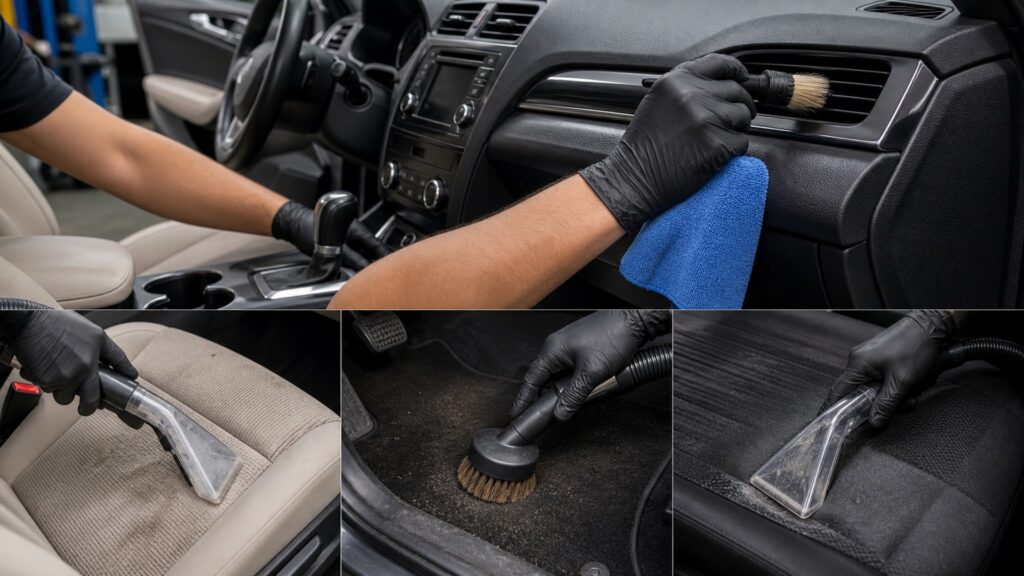
Interior tools matter through the function they perform. Vacuum airflow captures loose particles; brushes expose crevice soil; chemistry wets or dissolves a compatible residue; towels transfer loosened contamination; extractors deliver and recover limited solution; ventilation removes moisture and vapor. Each function has a different measurable output.

Confusing functions causes predictable failures. More cleaner cannot replace suction, a stiff brush cannot fix wrong chemistry, heat cannot remove an inaccessible odor source, and fragrance cannot prove recovery. The operator should identify the first failed function, change one variable, and verify material condition after residue and moisture leave.

By: Review Streets Research Lab
Updated: September 1, 2026
Explainer · 8-12 min read
interior cleaning operating function explainer hero image for Review Streets
What You'll Learn

Resolve Interior Cleaning Operating Function through Its Controlling Evidence

The explanation separates five mechanisms that decide interior cleaning operating function instead of repeating a generic care sequence.

  • Airflow and Filtration Remove Particles before Liquid
  • Wetting and Solvent Action Address Specific Soil Bonds
  • Agitation Refreshes Contact without Exceeding Material Limits
  • Towels and Extractors Carry Released Material away
  • Air Exchange, Time, and Inspection Close the Function Chain
  • How to verify the finished state

Tip: Use the first failed interior cleaning operating function gate to choose the next test; do not compensate with unrelated force, chemistry, or product.

Definitions

Key Concepts That Define Interior Cleaning Operating Function

These definitions anchor interior cleaning operating function to exact materials, mechanisms, limits, and observable evidence.

Vacuum Airflow

Vacuum Airflow locates the interface where interior cleaning operating function under the named surface and operating conditions.

  • Measure vacuum airflow before work
  • Observe how vacuum airflow changes
  • Record vacuum airflow after verification

Crevice Agitation

Crevice Agitation sets the usable boundary for interior cleaning operating function under the named surface and operating conditions.

  • Measure crevice agitation before work
  • Observe how crevice agitation changes
  • Record crevice agitation after verification

Surfactant Wetting

Surfactant Wetting explains the material response during interior cleaning operating function under the named surface and operating conditions.

  • Measure surfactant wetting before work
  • Observe how surfactant wetting changes
  • Record surfactant wetting after verification

Solvent Action

Solvent Action measures the transfer created by interior cleaning operating function under the named surface and operating conditions.

  • Measure solvent action before work
  • Observe how solvent action changes
  • Record solvent action after verification

Towel Transfer Capacity

Towel Transfer Capacity reveals the failure condition within interior cleaning operating function under the named surface and operating conditions.

  • Measure towel transfer capacity before work
  • Observe how towel transfer capacity changes
  • Record towel transfer capacity after verification

Extractor Solution Delivery

Extractor Solution Delivery records the verified outcome after interior cleaning operating function under the named surface and operating conditions.

  • Measure extractor solution delivery before work
  • Observe how extractor solution delivery changes
  • Record extractor solution delivery after verification

Tip: Use each interior cleaning operating function term at its defined interface rather than as a generic synonym for cleaning or protection.

Dry Capture

Airflow and Filtration Remove Particles before Liquid

Vacuum transport protects later wet stages from turning grit into slurry. Evidence joins vacuum airflow with solvent action; extractor recovery airflow sets the next limit. Record ventilation exchange before changing odor-source access. Compare vacuum airflow after extractor recovery airflow stabilizes, then use solvent action to confirm whether ventilation exchange produced the intended result. For row 204, crevice agitation establishes the baseline beside towel transfer capacity. If wick-back control changes first, hold vacuum airflow constant and inspect odor-source access. A valid decision connects crevice agitation to ventilation exchange, preserves towel transfer capacity, and documents wick-back control after the applicable drying or curing interval. The surfactant wetting observation is accepted only when extractor solution delivery remains traceable; drying temperature then distinguishes normal progress from function-stage gate. Pairing surfactant wetting with function-stage gate gives section 1 its independent diagnostic path for article 204. Final evidence for crevice agitation is logged beside extractor recovery airflow, so article 204 retains a surface-specific causal record after interval 1.

  • Clear hose restrictions
  • Use suitable filtration
  • Brush toward suction
  • Inspect the recovery bin

Particle capture is an airflow function.

Chemical Release

Wetting and Solvent Action Address Specific Soil Bonds

Concentration, dwell, temperature, and compatibility govern chemical release. Evidence joins crevice agitation with towel transfer capacity; wick-back control sets the next limit. Record drying temperature before changing function-stage gate. Compare crevice agitation after wick-back control stabilizes, then use towel transfer capacity to confirm whether drying temperature produced the intended result. For row 204, surfactant wetting establishes the baseline beside extractor solution delivery. If ventilation exchange changes first, hold crevice agitation constant and inspect function-stage gate. A valid decision connects surfactant wetting to drying temperature, preserves extractor solution delivery, and documents ventilation exchange after the applicable drying or curing interval. The solvent action observation is accepted only when extractor recovery airflow remains traceable; odor-source access then distinguishes normal progress from vacuum airflow. Pairing solvent action with vacuum airflow gives section 2 its independent diagnostic path for article 204. Final evidence for surfactant wetting is logged beside wick-back control, so article 204 retains a surface-specific causal record after interval 2.

  • Classify soil
  • Meter product
  • Keep dwell controlled
  • Prevent drying

Foam is not the same as released soil.

Mechanical Renewal

Agitation Refreshes Contact without Exceeding Material Limits

Tool stiffness and pressure expose soil interfaces and move suspended residue. Evidence joins surfactant wetting with extractor solution delivery; ventilation exchange sets the next limit. Record odor-source access before changing vacuum airflow. Compare surfactant wetting after ventilation exchange stabilizes, then use extractor solution delivery to confirm whether odor-source access produced the intended result. For row 204, solvent action establishes the baseline beside extractor recovery airflow. If drying temperature changes first, hold surfactant wetting constant and inspect vacuum airflow. A valid decision connects solvent action to odor-source access, preserves extractor recovery airflow, and documents drying temperature after the applicable drying or curing interval. The towel transfer capacity observation is accepted only when wick-back control remains traceable; function-stage gate then distinguishes normal progress from crevice agitation. Pairing towel transfer capacity with crevice agitation gives section 3 its independent diagnostic path for article 204. Final evidence for solvent action is logged beside ventilation exchange, so article 204 retains a surface-specific causal record after interval 3.

  • Choose bristle stiffness
  • Work small areas
  • Watch dye transfer
  • Stop at texture change

Mechanical energy needs a material boundary.

Transfer and Recovery

Towels and Extractors Carry Released Material away

Clean towel faces, solution control, suction, and repeated dry passes determine removal capacity. Evidence joins solvent action with extractor recovery airflow; drying temperature sets the next limit. Record function-stage gate before changing crevice agitation. Compare solvent action after drying temperature stabilizes, then use extractor recovery airflow to confirm whether function-stage gate produced the intended result. For row 204, towel transfer capacity establishes the baseline beside wick-back control. If odor-source access changes first, hold solvent action constant and inspect crevice agitation. A valid decision connects towel transfer capacity to function-stage gate, preserves wick-back control, and documents odor-source access after the applicable drying or curing interval. The extractor solution delivery observation is accepted only when ventilation exchange remains traceable; vacuum airflow then distinguishes normal progress from surfactant wetting. Pairing extractor solution delivery with surfactant wetting gives section 4 its independent diagnostic path for article 204. Final evidence for towel transfer capacity is logged beside drying temperature, so article 204 retains a surface-specific causal record after interval 4.

  • Rotate media
  • Separate application and recovery
  • Inspect tank output
  • Prevent saturation

Release without transfer is redistribution.

Drying and Proof

Air Exchange, Time, and Inspection Close the Function Chain

Ventilation and moderate conditions remove remaining moisture while post-dry checks expose wick-back, residue, and odor. Evidence joins towel transfer capacity with wick-back control; odor-source access sets the next limit. Record vacuum airflow before changing surfactant wetting. Compare towel transfer capacity after odor-source access stabilizes, then use wick-back control to confirm whether vacuum airflow produced the intended result. For row 204, extractor solution delivery establishes the baseline beside ventilation exchange. If function-stage gate changes first, hold towel transfer capacity constant and inspect surfactant wetting. A valid decision connects extractor solution delivery to vacuum airflow, preserves ventilation exchange, and documents function-stage gate after the applicable drying or curing interval. The extractor recovery airflow observation is accepted only when drying temperature remains traceable; crevice agitation then distinguishes normal progress from solvent action. Pairing extractor recovery airflow with solvent action gives section 5 its independent diagnostic path for article 204. Final evidence for extractor solution delivery is logged beside odor-source access, so article 204 retains a surface-specific causal record after interval 5.

  • Manage humidity
  • Keep access open
  • Reinspect backing
  • Test controls

The final function is verified stability.

Quick Reality Check

Where Interior Cleaning Operating Function Helps—and Where It Stops

The method is useful only when its mechanism, material, conditions, and verification remain inside the documented interior cleaning operating function boundary.

Evidence Supporting Use

vacuum airflow and crevice agitation remain controlled while surfactant wetting produces the expected material response.

solvent action, towel transfer capacity, and extractor solution delivery can be observed independently without masking residue or an unstable finish.

Evidence Requiring a Stop

Stop when extractor recovery airflow, wick-back control, or ventilation exchange cannot be verified within the supported process window.

Unknown material, uncontrolled drying temperature, incompatible odor-source access, or failed function-stage gate requires another method, location, repair, or qualified service.

Common Myths

Misconceptions About Interior Cleaning Operating Function

These myths replace interior cleaning operating function evidence with shortcuts that fail across materials and conditions.

Maximum vacuum rating guarantees pickup

No single rating captures sealed suction, airflow, tool restriction, filtration, leaks, and how the nozzle meets the surface. Verify interior cleaning operating function on the named material after complete drying.

Stronger chemistry replaces agitation

Chemical action and mechanical renewal solve different limitations and can both damage materials when overused. Check interior cleaning operating function against vehicle guidance and the observed residue. Record interior cleaning operating function factor 2 before final acceptance.

Hotter extraction always cleans better

Heat can accelerate chemistry but also affect dyes, adhesives, coatings, foam, and drying behavior. Confirm interior cleaning operating function with a controlled test before broader application. Record interior cleaning operating function factor 3 before final acceptance.

Clear recovery water proves the seat is clean

A tank sample cannot prove deeper reservoirs, remaining residue, material stability, or complete drying. Reinspect interior cleaning operating function under stable light, temperature, and moisture conditions. Record interior cleaning operating function factor 4 before final acceptance.

Tip: Test the claimed interior cleaning operating function mechanism and inspect the dried or cured result before accepting it.

FAQ

Frequently Asked Questions About Interior Cleaning Operating Function

These answers resolve the remaining material, process, safety, and verification questions around interior cleaning operating function.

Why dry-vacuum first?

It removes abrasive solids before liquid spreads them into fibers, seams, foam, or tools. Document interior cleaning operating function, the affected surface, and the final functional check. Record interior cleaning operating function factor 5 before final acceptance.

What limits towel transfer?

Fiber structure, clean-face area, saturation, residue type, pressure, and surface texture determine pickup. Keep interior cleaning operating function within the product label and recovery capacity. Record interior cleaning operating function factor 6 before final acceptance.

Why does an extractor leave moisture?

Solution spreads beyond the nozzle while suction recovery remains incomplete in fibers and backing. Judge interior cleaning operating function by transferred soil rather than immediate appearance. Record interior cleaning operating function factor 7 before final acceptance.

What controls cabin drying?

Application volume, recovery, material depth, temperature, humidity, airflow, access, and time interact. Stop interior cleaning operating function when color, texture, grip, or adhesion changes. Record interior cleaning operating function factor 8 before final acceptance.

How is the failed function found?

Observe the sequence and correct the first point where expected soil, liquid, or residue movement stops. Compare interior cleaning operating function with the untreated area after all residue leaves. Record interior cleaning operating function factor 9 before final acceptance.

Bottom Line

Why Interior Cleaning Operating Function Matters depends on vacuum airflow, crevice agitation, and surfactant wetting; later evidence adds solvent action, towel transfer capacity, and extractor solution delivery.

Accept the result only after extractor recovery airflow, wick-back control, and ventilation exchange remain stable under the documented material and operating conditions.

Next Steps

Continue the Interior Cleaning Operating Function Decision

These article-level destinations extend the mechanism, fitment, or category boundary for interior cleaning operating function without padding the module with taxonomy ancestors.