Why Passenger Vans Safety Factors Matters

Passenger-van safety depends on the group, the loaded vehicle, and the driver working within the same limits. Adding people and luggage changes the weight being carried, while a long body and several seating rows introduce visibility, access, and restraint needs that may be unfamiliar to someone used to a small car.

The useful checks are concrete: every occupant has an appropriate seating and restraint arrangement, the load stays within the vehicle's limits, tires and other equipment are serviceable, and the driver understands the vehicle and route. Electronic assistance supports those decisions; it does not make an unsuitable load or seating arrangement acceptable.

By: Review Streets Research Lab
Updated: October 6, 2026
Explainer · 8-12 min read
passenger vans explainer hero image for Review Streets
What You'll Learn

Understand the Risks Before the Group Boards

Connect the cabin, the load, and the driving conditions to practical decisions.

  • Why seat count and loaded weight are separate limits
  • How restraint use and luggage storage protect the occupied cabin
  • Why tire pressure and condition matter under load
  • What a long or tall van asks of its driver
  • Where driver-assistance systems have limits

Tip: Assess the actual vehicle and trip. Guidance for a 15-passenger van should not be treated as a specification for every passenger van.

Definitions

Six Safety Concepts for Group Transport

These concepts explain different parts of the same trip.

Seating capacity

Seating capacity is the number of occupants accommodated by the vehicle's designated seating configuration.

  • Example: counting the driver when checking available places
  • Check: the documentation for the exact layout
  • Limit: spare floor space is not an extra passenger position

Loaded vehicle weight

Loaded vehicle weight is the mass of the vehicle and everything aboard for the trip.

  • Example: the van with passengers, fuel, bags, and fitted equipment
  • Check: the applicable total and axle limits
  • Limit: being below the seat count does not prove the load is acceptable

Occupant restraint

An occupant restraint holds a person in the intended seating position during sudden motion or a crash.

  • Example: the seat belt used at a designated seat
  • Check: the correct restraint and its condition for that occupant
  • Limit: airbags do not replace belts

Center of gravity

The center of gravity is the point through which the combined weight of the vehicle and its load acts.

  • Example: adding load high above the floor changes the combined center of gravity
  • Check: the manufacturer's loading instructions
  • Limit: a large interior does not permit arbitrary load placement

Tire load capability

Tire load capability is the load a tire can support under its specified conditions.

  • Example: a specified tire used at the vehicle's required pressure
  • Check: correct size, load specification, pressure, and condition
  • Limit: a tire that physically fits may not meet the required specification

Driver assistance

Driver assistance warns or intervenes in defined situations to support the driver.

  • Example: an equipped van warning of a vehicle in a monitored blind area
  • Check: the exact system's operation and limitations
  • Limit: the driver remains responsible for observation and control

Tip: A passing check in one area does not clear a problem in another: seats, weight, tires, and driving conditions all need attention.

Occupants

Start with a Usable Restraint for Every Person

A passenger count is meaningful only when each person can occupy a suitable seat and use the required restraint correctly. Inspect for obvious damage or malfunction and follow the vehicle and restraint instructions. A seating problem should be resolved before the group departs. Where children or passengers with particular support needs travel, plan their arrangements in advance rather than improvising at pickup.

  • Count the driver and all passengers.
  • Check the actual seats and restraints to be used.
  • Keep bags and equipment out of occupied seating space.

NHTSA explains that airbags supplement seat belts. Their presence is not a reason to travel unrestrained.

Reference: NHTSA airbag and restraint guidance.

Loading

People and Luggage Share the Available Capacity

A van can have an unused seat yet reach a weight limit because of luggage or fitted equipment. Cargo placement matters as well as its total mass. Use the vehicle's loading instructions and secure items so they cannot move into occupied space. If the load cannot be accommodated within the applicable limits, change the transport arrangement instead of squeezing in the last bags.

  • Include passengers, baggage, and permanent equipment.
  • Check the relevant total and axle limits.
  • Keep access routes clear and use suitable load restraint.

For 15-passenger vans, NHTSA specifically advises keeping cargo forward of the rear axle and avoiding roof loads. Apply the guidance for the vehicle being used.

Reference: NHTSA 15-passenger-van precautions.

Tires

Check the Tires for the Van, Not for a Generic Pressure

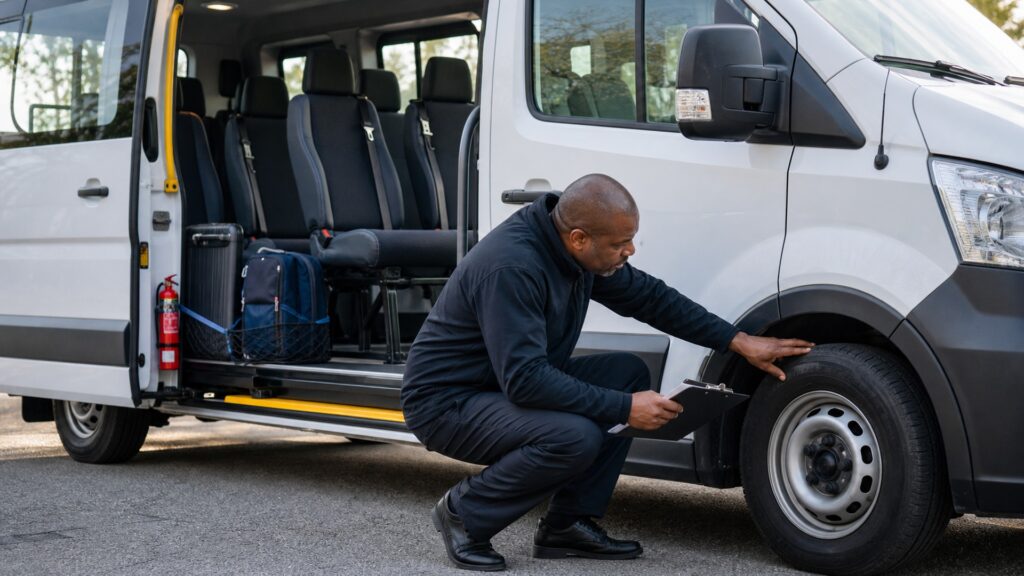
The correct pressure is the one specified for the vehicle and its conditions, not a number borrowed from another van or the maximum molded on a sidewall. Front and rear specifications may differ. Inspect for damage and wear, include the spare, and follow the applicable age and replacement guidance. A warning lamp is useful, but it is not a substitute for the prescribed checks.

  • Use the vehicle placard and owner's instructions.
  • Measure pressure under the specified cold-tire conditions.
  • Have damage or unexplained pressure loss assessed.

NHTSA's TireWise guidance explains how pressure, wear, and aging affect tire care; it also distinguishes a pressure warning from a routine gauge check.

Reference: NHTSA TireWise.

Driving

Allow for the Van's Size and the Day's Conditions

A driver unfamiliar with the van needs time to understand its sightlines, turning space, overall height, and controls before carrying a group. The route may include a low garage, a tight curbside pickup, or a busy parking area. Build time into the schedule so a delay does not create pressure to rush. When conditions deteriorate, reassess whether the trip can continue appropriately.

  • Check clearances along the intended route.
  • Arrange boarding where passengers can stay clear of moving traffic.
  • Plan breaks and avoid distractions while driving.

NHTSA emphasizes experienced drivers and additional maneuvering and braking room for 15-passenger vans; their behavior should not be assumed to match a small car.

Reference: NHTSA 15-passenger-van precautions.

Assistance

Know What the Vehicle Can Detect and What It Cannot

Cameras, warnings, and automatic interventions differ between vehicles and equipment packages. Learn which functions are fitted and what their instructions say about visibility, operating conditions, and driver responsibility. A camera view can help with a maneuver while still leaving areas the driver needs to check. Treat an unavailable or malfunctioning system according to its instructions, rather than assuming another feature will compensate.

  • Identify the fitted systems before the trip.
  • Keep required sensor and camera areas unobstructed.
  • Respond to system warnings and faults.

NHTSA's driver-assistance explanations distinguish warnings from systems that intervene. Neither description removes the need for an attentive driver.

Reference: NHTSA driver-assistance explanations.

Quick Reality Check

Equipment and Decisions Need to Support Each Other

A well-equipped van still needs a suitable trip plan.

Vehicle-side checks

Serviceable restraints, correct tires, and a load within the relevant limits.

Working visibility equipment and a cabin arranged for its occupants.

Trip-side checks

A prepared driver, appropriate route, and realistic schedule.

Boarding, storage, and arrival arrangements suited to the group.

Common Myths

Misconceptions About Passenger-Van Safety

Capacity and assistance features are useful only within their actual limits.

If everyone has a seat, the load must be acceptable

Seat count and loaded weight are different checks. Passengers and baggage both contribute to the load.

Airbags make seat belts optional

Airbags are supplemental protection. Occupants still need the appropriate restraint.

A tire-pressure warning replaces inspections

A warning system does not remove the need for pressure and condition checks.

A camera shows everything around the van

Coverage and limitations vary. The driver still needs to check the maneuver and surrounding area.

Tip: Resolve a known seating, loading, or vehicle-condition problem before departure.

FAQ

Questions About Passenger-Van Safety Factors

Practical answers before a group journey.

Does every passenger van need the same tire pressure?

No. Use the placard and instructions for the exact vehicle and applicable loading conditions.

Can we use empty aisle space for luggage?

Keep aisles and exits clear. Use suitable storage and restraint within the van's limits.

Is a lightly occupied van automatically within its limits?

No. Equipment and cargo can still create an excessive total or axle load.

Do safety systems remove the need for driver familiarization?

No. The driver needs to understand the vehicle's size, controls, visibility, and fitted assistance systems.

What should change if the intended group or luggage grows?

Recheck both seating and load accommodation. Use a different transport arrangement if the vehicle no longer suits the trip.

Bottom Line

Passenger-van safety depends on appropriate seating, controlled loading, vehicle condition, and a driver prepared for the actual trip.

Use the exact vehicle's instructions and resolve problems before departure. Extra electronic features cannot substitute for those basics.

Next Steps

Go Deeper or Compare Your Options

Use these Review Streets paths to compare related categories and practical next decisions.