
Approach Sight Distance
Length of roadway visible to an approaching driver before the disabled vehicle or warning device.
- Curves and crests shorten it
- Higher speed consumes it faster
- Placement aims to create recognition time
Roadside safety equipment matters because approaching drivers need enough distance to detect a stopped vehicle, understand that it is a hazard, choose a path, and slow or change lanes. Hazard flashers identify the vehicle, but curves, crests, darkness, rain, glare, and traffic speed can reveal it too late.
Warning triangles, compliant signals, reflective clothing, task lighting, communication tools, and a suitable extinguisher address different parts of the incident. Their value depends on placement and restraint: deploying a device must not require walking into traffic, lighting must not blind drivers, and occupants need a safer waiting location. The objective is not to illuminate the repair; it is to prevent the next crash.
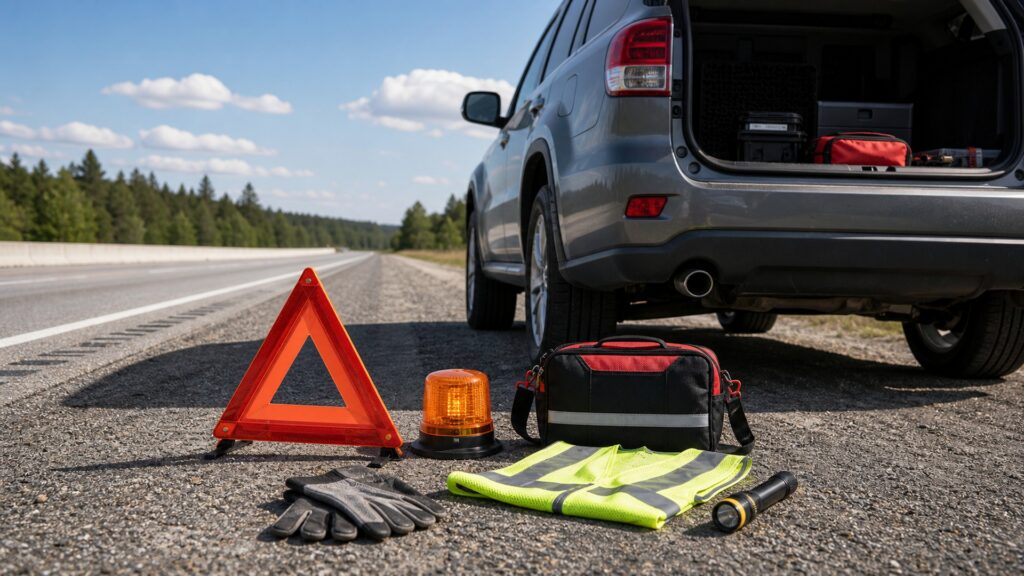
Stand at the hazard only in imagination: trace the road backward through speed, lane direction, curve, crest, weather, glare, and shoulder width to determine where recognition must begin and whether deployment is safe.
Tip: Commercial-vehicle triangle spacing is a useful illustration of road geometry, not a universal passenger-car instruction. Follow local law and never deploy a device where reaching the location would expose you to a live lane.
These concepts explain why warning effectiveness changes with road shape and observer position.
Length of roadway visible to an approaching driver before the disabled vehicle or warning device.
Return of incoming headlamp light toward its source so a material appears bright to the driver.
Positioning warning toward the direction from which traffic reaches the hazard.
Time a person or body part spends near the side facing moving vehicles.
Ability of an object to attract attention and be recognized correctly against its background.
Small early-stage fire that may be controllable with a suitable extinguisher and clear escape route.
Tip: Regulatory requirements differ for private and commercial vehicles; use equipment approved for the jurisdiction and situation, and defer to police, fire, road authority, or recovery personnel.
A driver first detects something unusual, then identifies a stopped vehicle, chooses a maneuver, and brakes or steers. Speed, attention, surface grip, heavy vehicles, and lane availability consume distance after visual detection.
Warning equipment cannot shorten braking distance; it can only begin the driver's decision earlier.
A fixed distance on a straight road can leave a device invisible beyond a hill or bend. Traffic may approach from one direction on divided roads and from both directions elsewhere. Obstructions should shift warning toward the lost sight line.
The road, not the packaging diagram, decides where advance notice would be useful.
A high-visibility garment helps drivers detect a person but does not create a barrier. Occupants should exit away from traffic only when safer than remaining belted, avoid standing between vehicles, and wait beyond a barrier when conditions permit.
Visibility reduces surprise; separation from traffic reduces consequence.
A flashlight or scene light helps locate tools and inspect damage, but uncontrolled strobes, white beams, or improvised colors can create glare, confusion, or legal problems. Reflective devices remain effective without battery dependence.
More light is useful only when it clarifies the scene without masking official signals or blinding traffic.
A suitable inspected extinguisher may address a small fire only from an escape-side position. Communication provides road, direction, marker, lane, injuries, and hazards so responders arrive prepared and can create formal traffic control.
Roadside equipment buys time; emergency responders create the controlled scene consumer gear cannot.
The stopped vehicle, advance devices, visible people, lighting, and communication must help approaching traffic recognize the hazard before its remaining road runs out.
It extends the first recognizable warning beyond the disabled vehicle while keeping the person deploying it out of an unacceptable traffic path.
It makes occupants and work visible without creating glare, preserves a safe waiting position, and gives responders an exact location and hazard description.
It cannot force distracted or impaired drivers to react, create a shoulder, stop traffic, or make a blind curve safe for a person walking with a triangle.
When the vehicle blocks a lane, sight distance is poor, traffic is fast, fire is present, or occupants cannot reach protection, emergency services and road authorities are the appropriate control layer.
These myths confuse being visible at the vehicle with giving traffic usable advance warning.
Flashers mark the vehicle after it becomes visible but may provide little advance notice beyond a crest, curve, truck, weather curtain, or glare. Additional lawful warning and a safer vehicle position can increase recognition distance.
Excess intensity, wrong color, poor aim, or rapid strobing can glare, distract, obscure depth, or conflict with regulated signals. Road users need recognizable information and time, not the highest possible lumen or flash rate.
Retroreflection can improve detection under headlamps, but a visible person can still be struck. Separation, barriers, protected exits, minimal exposure time, and professional traffic control remain more reliable than visibility alone.
Road direction, speed, hills, curves, obstructions, shoulder width, weather, and local rules change placement. If walking to a theoretical location requires entering traffic, the safe decision is to remain protected and call responders.
Tip: Evaluate the complete approach path and the person's deployment exposure before crediting any roadside product.
These answers address triangle placement, flares, visibility garments, extinguishers, and whether occupants should remain inside the vehicle.
Follow applicable law and the device instructions. Commercial regulations illustrate different patterns for straight, divided, one-way, hill, and curve conditions, but private drivers should never copy distances that require unsafe exposure.
Flares are bright and recognizable but burn for limited time and introduce flame, smoke, storage, disposal, and hazardous-material restrictions. Reflective triangles need headlamps yet remain reusable and energy-free; lawful context decides the choice.
Choose durable high-visibility color and retroreflective material suited to likely lighting and weather, with a fit that works over seasonal clothing. The vest supports detection but never replaces a barrier or protected waiting location.
Select an appropriately rated, securely mounted extinguisher permitted for the vehicle and likely hazards, inspect its condition, and learn its use. Battery-vehicle and fuel fires can exceed consumer capability rapidly, so preserve escape.
It depends on lane position, traffic, barriers, fire, fuel, weather, and available protected space. Seat-belted occupants may be safer inside in some settings; smoke, fire, flood, or exposed lane position can require evacuation.
Roadside safety equipment matters because it extends recognition time for approaching drivers while improving occupant visibility, protected movement, task lighting, communication, and early fire response.
Design warning around the real road geometry, minimize traffic-side exposure, avoid glare and improvised signals, and escalate whenever consumer devices cannot create a safely controlled scene.
The related explainers show how roadside visibility fits within emergency sequencing and trip-level preparation.
Sequence warning, location reporting, threat assessment, occupant protection, and mobility work from the first stopped second.
Plan route timing, weather thresholds, garment needs, communication backups, and equipment inspections before exposure begins.
Choose a distress path that can transmit the vehicle's road, direction, lane, occupants, and hazards when ordinary coverage is uncertain.
Choose a retailer
Prices checked regularly. We may earn a commission at no cost to you.