
Secondary Collision
A new crash involving traffic approaching an already stopped or disabled vehicle.
- Warning begins before repair
- Sight distance sets available reaction time
- Occupant location changes exposure
A breakdown becomes an emergency when traffic, fire, injury, weather, isolation, or poor visibility can worsen the original fault. Safety gear works by interrupting that escalation: hazard lights and warning devices buy approaching drivers time, communications bring outside help, medical and fire equipment address immediate threats, and shelter supplies protect occupants during delay.
Mechanical tools come later in the sequence. A jack, jump pack, tire kit, or recovery device is useful only when the scene is stable enough to use it and the failure is within the driver's competence. The right kit therefore follows an incident timeline—warn, communicate, assess, protect, then repair or wait—not a shopping checklist.
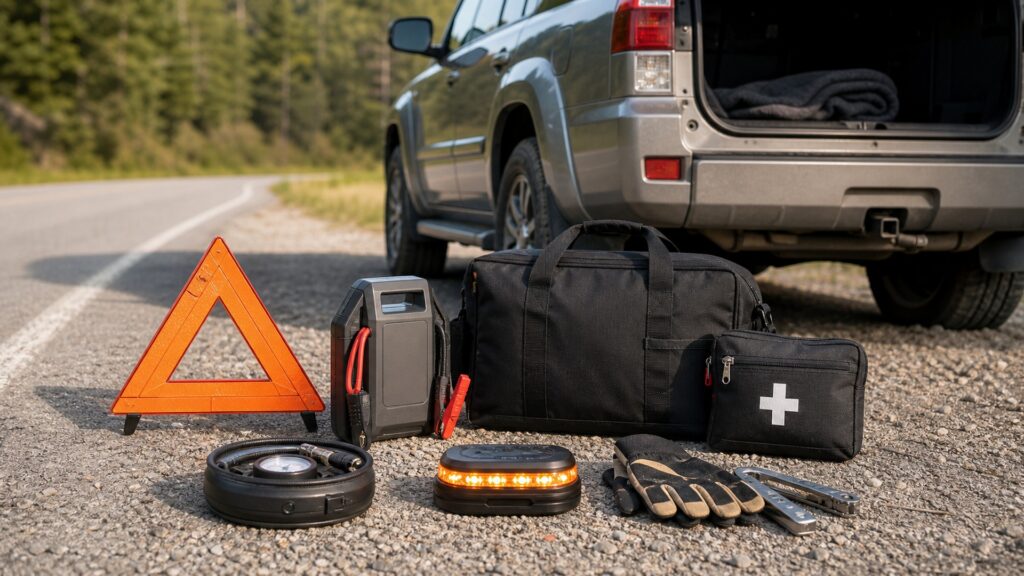
The kit should support the decisions a driver must make from the first stopped second through safe departure or professional handoff.
Tip: Pack by urgency: warning and communication equipment should be reachable without unloading cargo or standing between the vehicle and approaching traffic.
These concepts explain why emergency equipment succeeds or fails before any repair begins.
A new crash involving traffic approaching an already stopped or disabled vehicle.
A device or signal positioned toward approaching traffic so drivers receive notice before reaching the hazard.
Rapid check of traffic, vehicle position, injuries, smoke, fuel, weather, and escape routes.
Rule that preventing injury outranks protecting property or restoring the trip.
More than one viable path for sharing location, condition, and help needs.
Scheduled check of charge, expiration, pressure, corrosion, fit, and accessibility.
Tip: Commercial-vehicle placement rules illustrate sight-distance principles, but passenger drivers must follow local law and never enter a live lane to imitate a fixed spacing rule.
Activate hazard signals, assess whether the vehicle can move farther from traffic, and decide where occupants are least exposed. Smoke, fire, leaking fuel, unstable shoulders, floodwater, and high-speed traffic can make immediate evacuation or emergency calling more important than any diagnosis.
The safest roadside repair is the one declined because the scene cannot support it.
A useful call identifies road, direction, nearest marker or coordinates, vehicle description, lane position, injuries, fire, hazards, number of occupants, and communication limits. Prewritten contacts and offline maps reduce cognitive load when stress is high.
Communication equipment works only when the message contains operational details.
First-aid supplies support bleeding control, protection, and stabilization within the user's training. A rated extinguisher may stop a small incipient fire only when there is a clear exit, correct agent, and safe distance; a spreading vehicle fire demands evacuation and emergency services.
Equipment should extend safe action, never create a reason to approach an uncontrolled hazard.
A battery assist, tire inflation, plug, spare, traction aid, or recovery tool addresses one failure mode. Damage location, vehicle stability, traffic, weather, lighting, skill, and follow-up service decide whether self-help is appropriate.
Restoring motion is not success unless the vehicle can move without creating a new hazard.
Heat cycles age batteries, adhesives, medications, food, water containers, seals, and plastics. Extinguishers lose charge, compressors seize, flashlights corrode, and a spare can be dangerously underinflated even though every item remains present.
Inventory proves ownership; inspection and rehearsal prove readiness.
Useful gear protects the scene and supports a clean handoff before it attempts to restore the vehicle.
Drivers can reach warning, communication, medical, lighting, and weather protection without unpacking the entire vehicle.
Each mobility tool has a known use boundary, compatible hardware, current charge or pressure, and a planned professional follow-up.
No consumer kit creates safe working space beside fast traffic, stabilizes a burning vehicle, or substitutes for emergency medical care.
A broad inventory cannot compensate for an unknown location, inaccessible storage, expired supplies, missing skill, or a decision to continue driving damaged steering, brakes, tires, or structure.
These misconceptions put mechanical completion ahead of incident control.
Quantity says little about access, compatibility, condition, or skill. A compact kit arranged around warning, communication, exposure, and one credible mobility problem can outperform a cargo box of untested tools during a stressful roadside event.
Flashers identify a vehicle only after it enters a driver's view. Curves, crests, weather, glare, speed, and stopped-vehicle position can leave inadequate reaction time, so legal warning devices and safer occupant placement may still be needed.
A restart does not prove charging, fuel, cooling, tire, brake, or electrical reliability. Reentering traffic without understanding the failure can strand the vehicle again in a worse location or convert a manageable defect into damage.
Preserving supplies matters only after life safety. A blanket, extinguisher, first-aid dressing, beacon, or water reserve exists for defined threats; delaying necessary use to protect the item reverses the purpose of carrying it.
Tip: Judge emergency gear by the harm it prevents, the decision it supports, and the conditions under which the user must stop.
These answers focus on storage, seasonal changes, passenger needs, training, and the point where self-help should end.
Place the highest-priority items where they can be reached from a protected side of the vehicle without unloading luggage. Secure heavy objects against crash movement, label modules clearly, and keep weather-sensitive equipment within its rated storage conditions.
Check before long trips and at a regular seasonal interval. Verify battery charge, spare pressure, extinguisher indication, medication and food dates, flashlight operation, seal condition, clothing fit, contact information, and compatibility with the current vehicle.
Add insulation, dry layers, traction support, ice tools, and enough energy and medication for a longer wait. Cold also reduces battery output and tire pressure, so test jump equipment, compressors, and the vehicle's charging system beforehand.
First aid, extinguisher use, safe jacking, tire service, battery connection, recovery line awareness, and precise location reporting turn objects into capabilities. Practice in daylight on stable ground before attempting any task beside traffic.
Escalate for injuries, fire, fuel leaks, unstable vehicle position, floodwater, unsafe traffic exposure, wheel or sidewall damage, steering or brake faults, unknown high-voltage hazards, inadequate tools, or any condition outside the driver's training.
Safety and emergency gear works by buying time, transmitting useful information, controlling immediate threats, and supporting only those mobility tasks the scene and driver can safely handle.
Build the kit from the incident sequence, store critical modules for protected access, rehearse the decisions, and treat professional escalation as a designed capability rather than a failure of self-reliance.
The related explainers separate power assistance, roadside visibility, and trip-level planning so each receives its own decision rules.
Turn route, weather, passenger, communication, and delay risks into a pre-trip plan rather than an undifferentiated pile of supplies.
Learn how sight distance, device conspicuity, traffic direction, curves, crests, and occupant position shape a disabled-vehicle warning plan.
Understand what a portable jump source can and cannot do when the starting battery lacks available current.
Choose a retailer
Prices checked regularly. We may earn a commission at no cost to you.