
Dynamic Roof Load
Maximum roof-system mass permitted while the vehicle is moving under specified conditions.
- Tent mass counts fully
- Lowest component rating governs
- Off-road use may add restrictions
Roof top tents matter because they turn the vehicle's roof into a quickly deployable elevated sleeping platform. That can separate bedding from wet ground, reduce packing steps, preserve interior cargo space, and create a consistent mattress and shelter system that moves with the vehicle.
The tent also becomes one of the vehicle's largest and highest accessories. Its weight acts on the roof and rack while driving; occupants add a different parked load; the ladder may support part of the deployed platform; wind acts on fabric and shell; every relocation requires closure and inspection. The real benefit depends on verified compatibility, careful load accounting, stable parking, weather discipline, ventilation, and safe climbing—not elevation alone.
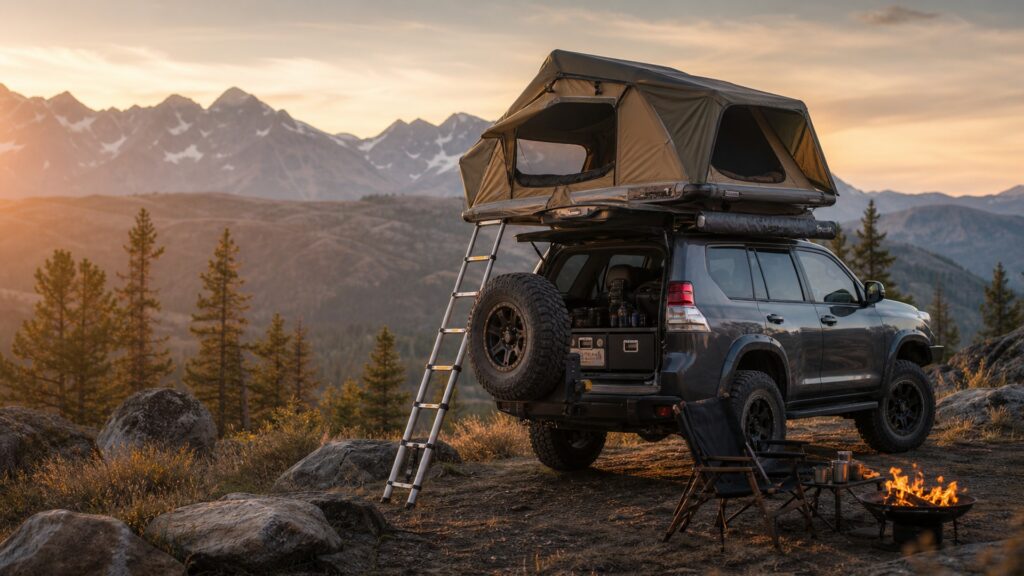
Verify every roof-system component for travel, then verify the deployed platform, ladder, ground, weather, clearance, and exits before anyone climbs inside.
Tip: Record tent, rack, bar, awning, and stored-item mass, compare it with the lowest vehicle or rack dynamic limit, then perform a complete day-and-night deployment without relying on level campsite assumptions.
These terms separate moving-vehicle loads from occupied parked loads and deployment geometry.
Maximum roof-system mass permitted while the vehicle is moving under specified conditions.
Permitted load on the deployed tent and support system while the vehicle is parked.
Fore-aft distance between crossbars supporting the tent mounting tracks.
Effective point through which combined vehicle and cargo mass acts.
Portion of deployed platform and occupant load transferred through the ladder into ground.
Space required for shell opening, fabric, ladder, annex, doors, and safe movement.
Tip: Use the tent, rack, and vehicle manufacturers' exact instructions; panoramic roofs, unsupported rails, clamp systems, crossbar types, and occupant capacities can create specific incompatibilities.
Acceleration, braking, cornering, bumps, vibration, and wind transfer tent forces through mounts and rack components into the roof structure. Capacity is limited by the weakest approved interface, not the sum or appearance of the parts.
A high static sleeping capacity does not authorize the same mass while driving.
Roof mass raises the center of gravity and adds frontal area. Steering response, body roll, crosswind sensitivity, braking, clearance, noise, and fuel or energy use may change, particularly on side slopes and abrupt maneuvers.
A tent's camp convenience is purchased with continuous vehicle consequences.
Once parked, occupant loads pass through hinges, platform, rack, roof, tires, suspension, ladder, and ground. Incorrect ladder length, soft soil, unstable parking, vehicle movement, or unlatched supports can distort or collapse the system.
Deployment is complete only when the support path is stable from mattress to terrain.
Wind loads a large elevated fabric surface; rain follows seams and openings; occupants release water vapor; the mattress base can cool below dew point. Ventilation, orientation, guying where specified, drying, and weather limits protect shelter and bedding.
Being above puddles does not make the shelter immune to atmospheric water or wind force.
Opening the tent may block doors, trails, or neighboring sites; the vehicle cannot leave without packing; nighttime ladder descent adds fall risk; children, pets, mobility limits, illness, fire, and storms complicate evacuation.
A good shelter matches how occupants actually enter, exit, and relocate—not only how quickly marketing footage shows it opening.
Its value comes from repeatable elevated shelter only when travel and parked load paths are both verified.
Frequent mobile camps gain integrated bedding, reduced ground preparation, quick setup, and interior cargo separation when the vehicle and rack are compatible.
A known platform can improve wet-ground isolation and packing consistency while preserving a compact campsite footprint.
Roof weight, cost, height, wind, fuel use, ladder access, daily closure, vehicle immobilization at camp, and difficult drying can outweigh setup convenience.
A roof top tent does not guarantee warmth, ventilation, bear safety, lightning protection, legal camping, level sleep, or compatibility with every roof and rack.
These myths confuse elevation and advertised capacity with complete vehicle and campsite suitability.
Static capacity describes a parked deployed condition, while dynamic limits account for motion and handling. The tent, rack, feet, rails, vehicle roof, and any stored items must remain within the lowest applicable travel rating.
Factory crossbars or rails may lack compatible bar spread, stiffness, clamp geometry, or static-load support. Glass roofs and unsupported rails add concerns. Confirm the exact vehicle, rack, tent, and mounting combination in current instructions.
Elevation avoids some ground water, but rain can enter openings and occupants create vapor that condenses on cold fabric or mattress bases. Ventilation, seam care, drainage, drying, and weather-aware setup remain necessary.
Deployed fabric and shells create substantial wind area, while gust direction and speed vary. Follow the manufacturer's limits and guying instructions, orient carefully, close early, and use a safer shelter when severe weather threatens.
Tip: Verify the moving system, deployed support path, weather behavior, and occupant access separately.
These answers cover roof ratings, ladders, bedding, uneven ground, and long-term mounting.
Add the closed tent, rack, mounting hardware, and anything carried inside during travel. Compare that total with every dynamic vehicle, rail, foot, bar, and rack limit; the lowest compatible rating governs.
Many fold-out designs use the ladder as a structural support, while others do not. Set the specified angle and length, fully engage locks, use firm level footing, and never improvise beyond the exact manual.
Only if the tent instructions allow it and closure, latch engagement, fabric clearance, dynamic mass, and roof capacity remain compliant. Extra bedding can prevent full closure, overload hardware, hold moisture, or become uneven mass.
Level the vehicle within the tent and vehicle guidance using stable rated methods. Check ladder footing and door operation afterward. Avoid unstable slopes, soft shoulders, drainage paths, unsupported wheels, and improvised lifting arrangements.
Consider manufacturer guidance, climate, ultraviolet exposure, salt, moisture, parking clearance, rack inspection, fuel use, security, and actual trip frequency. Removal can reduce continuous load and weathering but requires safe lifting and storage.
Roof top tents matter because they provide an integrated elevated sleeping platform that can accelerate mobile camp setup, protect bedding from some ground conditions, and preserve cabin space.
Their benefit depends on verified dynamic and static compatibility, correct bar and mounting geometry, restrained driving, stable ladder-supported deployment, weather management, ventilation, safe egress, and reliable closure before travel.
These explainers separate how the roof-mounted system works from when it is preferable to a ground tent.
Decide when frequent mobile setup and integrated bedding justify a roof top tent instead of a ground tent's lighter, vehicle-independent shelter.
Place the tent inside the complete overlanding system of payload, center of gravity, storage, water, power, recovery, and route margin.
Evaluate whether a reversible rack-and-tent installation solves the need without drilling, wiring, structural, sensor, or restoration consequences.
Choose a retailer
Prices checked regularly. We may earn a commission at no cost to you.