
Rail Clearance
The open space needed for the seat and handle path.
- It affects safe setup.
- It includes room behind the user.
- It differs from storage footprint.
Safety factors matter on rowing machines because the user moves on a rail while pulling a handle attached to a resistance system. Rail clearance, seat rollers, foot straps, handle return, flywheel cages, tank seals, folding latches, and floor contact all affect ordinary use.
The useful safety question is not whether rowing is universally safe. It is whether the machine's access path, moving parts, retention points, and setup controls behave predictably for the intended environment.
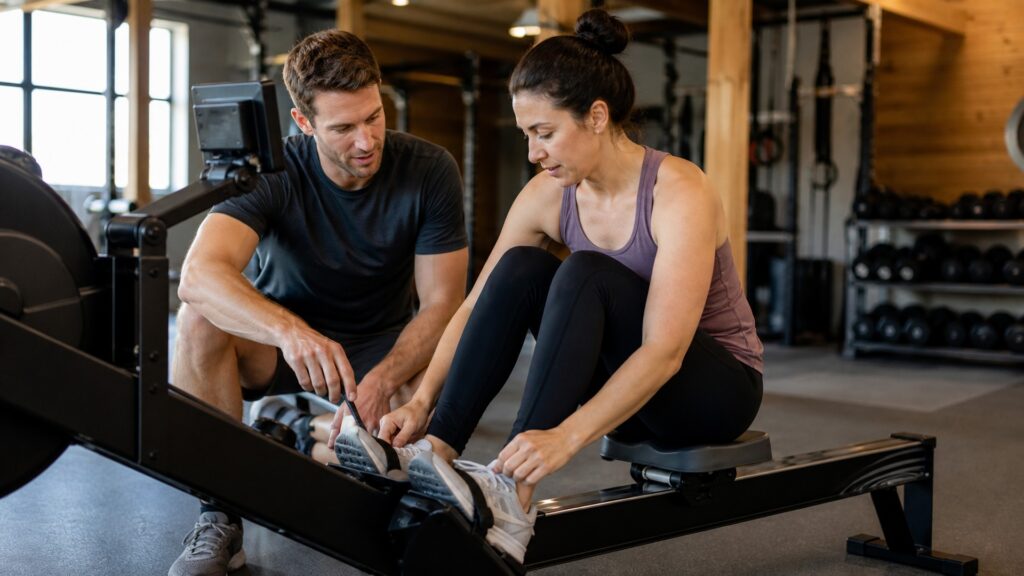
These factors explain how rower design affects access, contact, moving parts, storage, and practical checks.
Tip: Inspect a rower through the path of a stroke: sit, strap, pull, return, and then store or move the machine.
These definitions connect the main idea to the variables, limits, and practical signals readers need to compare options.
The open space needed for the seat and handle path.
The wheels or bearings that let the seat move on the rail.
The strap holding the foot against the footplate.
The way the handle moves back toward the flywheel.
The guard around fan or flywheel parts.
A lock used on some folding rowers.
Tip: A rower safety factor should point to something observable on the rail, handle, footplate, resistance housing, or manual.
A rowing machine's active footprint includes the sliding seat and handle path. A tight room can make mounting, finishing, or standing up awkward.
Rail clearance is a safety factor because rowing uses moving space, not just floor storage.
During use, the user depends on foot straps, seat rollers, and handle return. If any of these are loose, sticky, or uncontrolled, the stroke becomes less predictable.
Control points matter because the user is moving and pulling at the same time.
Air fans, water tanks, magnetic housings, chains, straps, and hydraulic arms bring different inspection points.
Safety factors follow the resistance design rather than a generic cardio checklist.
Many rowers are moved or stored between sessions. Folding locks, transport wheels, frame pins, and floor contact affect that process.
A rower that moves between sessions needs setup checks each time it returns to use.
Rower safety factors can address machine behavior, but they cannot decide whether rowing is appropriate for someone with pain, injury history, balance concerns, or medical restrictions.
The safe boundary is observable product behavior and manufacturer guidance.
Rower safety analysis is useful when it stays with machine setup, contact control, moving parts, and storage.
It identifies rower-specific checks that a generic equipment list can miss.
It explains why resistance type and folding design change what should be inspected.
It cannot certify personal medical suitability or technique quality.
It also cannot replace manufacturer instructions for a specific model.
Common shortcuts and misunderstandings can make the topic seem simpler than it is.
The seat moves, the handle returns, and the resistance system has moving parts, so checks still matter.
They should hold the foot for the stroke while allowing predictable release.
A folding latch or frame lock affects setup safety when the rower is moved often.
The tank and paddles still need seals, stable placement, and inspection.
Tip: Treat strong claims as starting points for comparison, not final answers.
Concise answers to common questions readers may have after the main explanation.
Check active rail clearance, because the seat and handle need room through the full stroke.
They help control the drive and recovery by keeping the feet braced on the footplates.
Yes. Releasing the handle uncontrolled can affect the machine and nearby users.
Yes. Latches, locks, and floor contact should be checked after storage or movement.
No. It covers product-level factors; personal health questions need qualified guidance.
Rowing-machine safety factors matter because the machine combines a sliding rail, braced feet, a returning handle, and resistance-specific moving parts.
Good checks stay concrete: clearance, straps, rollers, guards, latches, floor contact, manuals, and the boundary between product setup and personal suitability.
Use these Review Streets paths to connect the explainer to related categories, comparisons, and next decisions.
Use this to understand the moving systems behind the safety checks.
Read this to connect contact points with the catch-to-recovery stroke.
Browse rower options after identifying safety factors to compare.
Choose a retailer
Prices checked regularly. We may earn a commission at no cost to you.