
Workout Role
Workout role is the job a tool or drill serves inside the session.
- Example: using timing gates for testing rather than conditioning
- Check: name the role before choosing reps
- Limit: one tool should not carry every goal at once
Workout role matters in speed training equipment because a tool can be used for acceleration, mechanics, reaction, timing, warmups, conditioning, or testing. The same sled, cone, band, or timing system can support very different sessions depending on its role.
When the role is clear, it becomes easier to choose distance, load, rest, surface, and feedback. When the role is vague, speed tools can become random conditioning equipment instead of equipment for better speed.
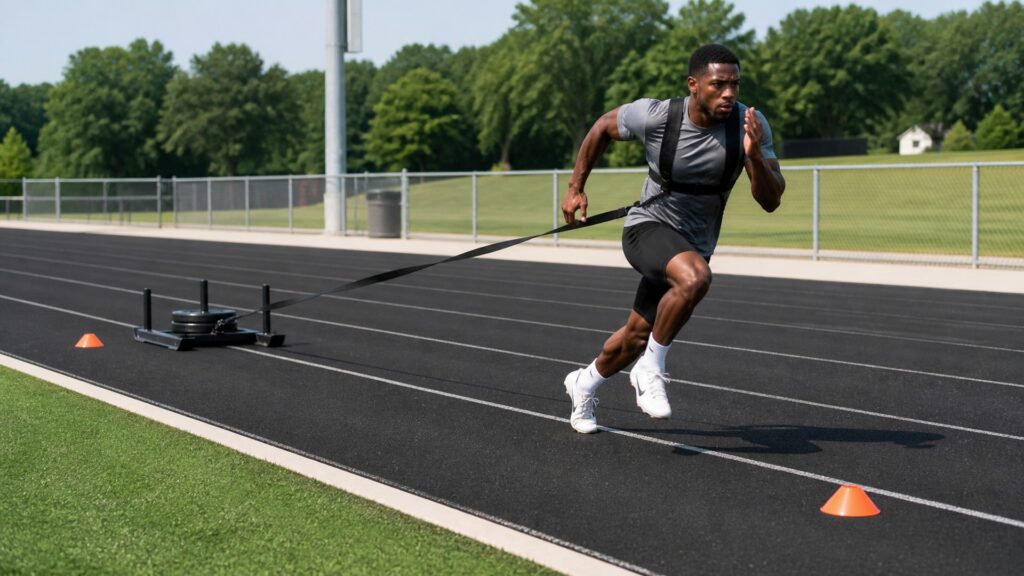
A practical way to decide whether speed tools belong in sprint work, testing, warmups, reaction drills, or conditioning.
Tip: Before using a speed tool, decide whether the session is testing, training, warming up, or conditioning.
These concepts clarify the practical signals readers should check before choosing equipment or planning workouts.
Workout role is the job a tool or drill serves inside the session.
An acceleration role trains fast starts and early sprint steps.
A mechanics role uses equipment to guide posture, rhythm, or stride pattern.
A testing role measures performance under consistent conditions.
A conditioning role uses speed-related tools to build repeated effort capacity.
A warmup role prepares the athlete for faster work without exhausting them.
Tip: The best equipment choice is the one that matches the training job, available space, and user's current ability.
Speed equipment works best when each drill has a clear role. A sled drill for acceleration should not be loaded like a strength test, and a timing setup should not change every rep.
A clear role keeps the session focused.
When speed equipment is used for testing, the setup matters as much as the tool. Start position, surface, distance, timing rules, and rest should stay consistent.
Testing is useful only when the comparison is fair.
Acceleration and mechanics work should protect fast, clean movement. That often means fewer reps, longer rest, and less clutter than a conditioning circuit.
Speed training is about quality, not constant activity.
Cones, shuttles, sleds, and bands can be used for conditioning, but that is different from maximum speed work. Calling every hard drill speed training can confuse the goal.
Honest labels lead to better programming.
The role should tell the coach what a successful rep looks like. It may be a faster time, cleaner rhythm, sharper reaction, or better repeatability.
The role turns equipment into a training decision.
Role-based planning keeps speed tools from becoming random drill props.
It clarifies whether the tool is for acceleration, mechanics, testing, warmup, or conditioning.
It guides distance, load, rest, and feedback choices.
It does not replace coaching or safe setup.
A clear role still needs appropriate athlete readiness.
A hard drill is not automatically a speed drill.
Some cone drills are conditioning or agility work rather than speed development.
Testing measures output; training builds the qualities behind it.
Too many reps can reduce quality and change the role.
A tool is useful when it supports a specific job well.
Tip: Treat strong claims as reasons to inspect the workout fit more closely.
Short answers for practical training and buying decisions.
It determines distance, load, rest, feedback, and whether the drill should be fast or fatiguing.
Yes, but conditioning should be named separately from true speed development.
Use timing when feedback will guide decisions, and keep the setup consistent.
Using speed equipment in circuits with too little rest and expecting max-speed improvement.
Give every speed tool a clear job before choosing the drill details.
Workout role matters because speed equipment can test, train, cue, warm up, or condition different qualities.
Defining the role keeps the session focused on the outcome that actually matters.
Use these Review Streets paths to compare related categories and practical next decisions.
Review the broader speed equipment category.
Connect tool function with workout role.
Check the safety side of speed setup.
Choose a retailer
Prices checked regularly. We may earn a commission at no cost to you.