
Hand paddles
Hand paddles increase the surface area of the hand during the pull.
- They amplify catch feedback.
- They can increase shoulder stress.
- Size matters.
Swim training equipment matters because it can make a hidden stroke variable easier to feel. Paddles, fins, buoys, boards, snorkels, and drag tools each change the water problem in a different way.
The value depends on transfer. A tool is useful when the swimmer can return to normal swimming with better awareness, not when the tool becomes a crutch that hides balance, kick, breathing, or catch problems.
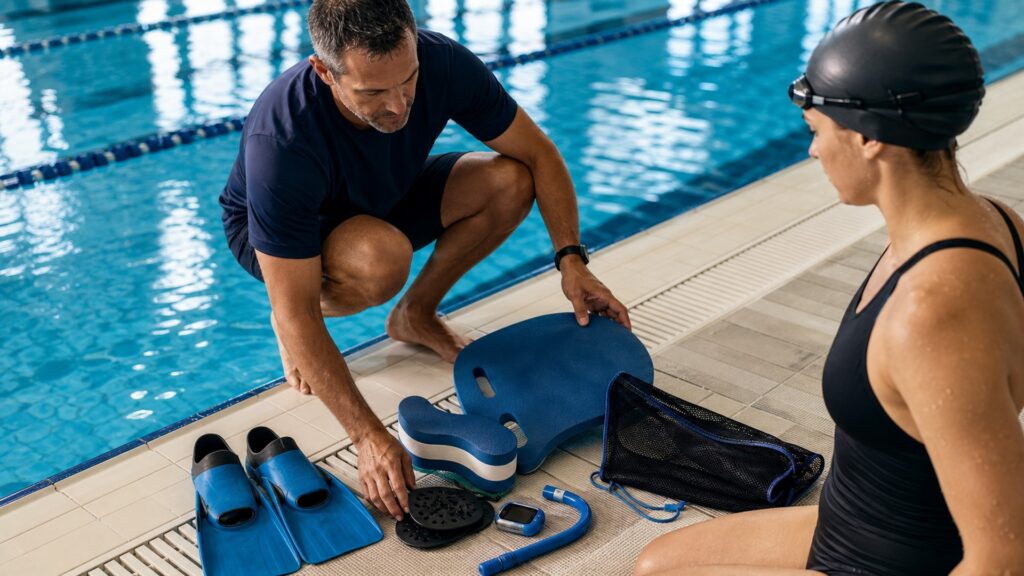
Swim training equipment matters when paddles, fins, buoys, boards, snorkels, and drag tools isolate a specific technique or conditioning problem.
Tip: For swim training equipment, decide which variable is actually changing before comparing products.
Hand paddles increase the surface area of the hand during the pull. The rest of these concepts explain where swim training equipment changes the swim or training task.
Hand paddles increase the surface area of the hand during the pull.
Fins increase foot surface area and alter kick propulsion.
A pull buoy lifts the legs while the arms do most of the work.
A kickboard supports the upper body during kick-focused drills.
A swim snorkel allows breathing with less head turn.
A drag tool adds resistance through socks, parachutes, or similar devices.
Tip: Fins increase foot surface area and alter kick propulsion.
Swimming combines many moving pieces; equipment can isolate one signal.
Training equipment matters when it clarifies a target.
Paddles and drag tools can raise physical demand.
Feedback and load must be separated.
Isolation is useful for learning but incomplete by design.
A drill tool is not the full stroke.
The strongest tool work ends with normal swimming that keeps the intended change.
Transfer is the quality check.
The practical question is what the swimmer needs to feel better.
Swim training equipment matters when it solves a named problem.
Swim Training Equipment is useful when its mechanism is matched to a specific swim or training task rather than a generic improvement promise.
It explains what swim training equipment changes during real use.
It gives swim training equipment a practical decision frame based on mechanism, setup, and limits.
Swim Training Equipment cannot guarantee performance, safety, recovery, injury prevention, or technique improvement.
Swim Training Equipment decisions still need coaching or medical context when pain, symptoms, open-water risk, heavy impact, or individualized programming is involved.
Common shortcuts and misunderstandings can make the topic seem simpler than it is.
Swim Training Equipment changes with setting, skill, fatigue, conditions, and the specific drill.
Extra features help only when they solve the actual technique, setup, or movement problem.
Gear and drills can support training, but they cannot promise safety, performance, recovery, or adaptation.
Pressure, speed, resistance, or visibility can feel obvious without proving the training target is correct.
Construction, fit, rebound, buoyancy, drag, and use conditions often matter more than the category name.
Tip: For swim training equipment, treat the tool label as a starting point and inspect the mechanism, setting, and limits.
Concise answers to common questions readers may have after the main explanation.
Start with the exact mechanism swim training equipment changes, then decide whether that mechanism fits the swim, drill, lift, or conditioning task.
No. Swim Training Equipment can support better decisions, but outcomes depend on technique, progression, recovery, setting, and individual response.
Compare the fit, construction, movement demand, setup, and evidence limits before comparing swim training equipment by brand language.
Use controlled training sessions to test swim training equipment before relying on it during races, open water, hard throws, or demanding workouts.
Expert help is useful when swim training equipment involves pain, symptoms, open-water safety, complex technique, or individualized programming.
Swim Training Equipment matters when it changes a named swim, strength, power, or movement-training task.
The useful decision about swim training equipment follows mechanism, fit, setup, transfer, and evidence boundaries.
Use these related explainers to continue the Review Streets fitness decision path around swim training equipment.
Use it to place this swimming topic inside the full gear system.
Read it when the gear decision is really about changing stroke mechanics.
Use it before adding fins, paddles, buoys, boards, or snorkels to training.
Choose a retailer
Prices checked regularly. We may earn a commission at no cost to you.