
Pull buoy
A pull buoy is foam placed between the legs to support lower-body position while the arms pull.
- It reduces kicking demand.
- It can highlight upper-body mechanics.
- It can also hide body-position problems.
Swim training tools matter because they can isolate one part of a stroke that is hard to feel during whole swimming. A buoy, board, fin, paddle, snorkel, or drag tool changes buoyancy, propulsion, breathing, resistance, or body position so the swimmer receives clearer feedback.
The risk is using tools as shortcuts. Paddles can overload shoulders, buoys can hide poor kick or body position, boards can encourage head lift, and fins can make speed feel better without fixing stroke timing.
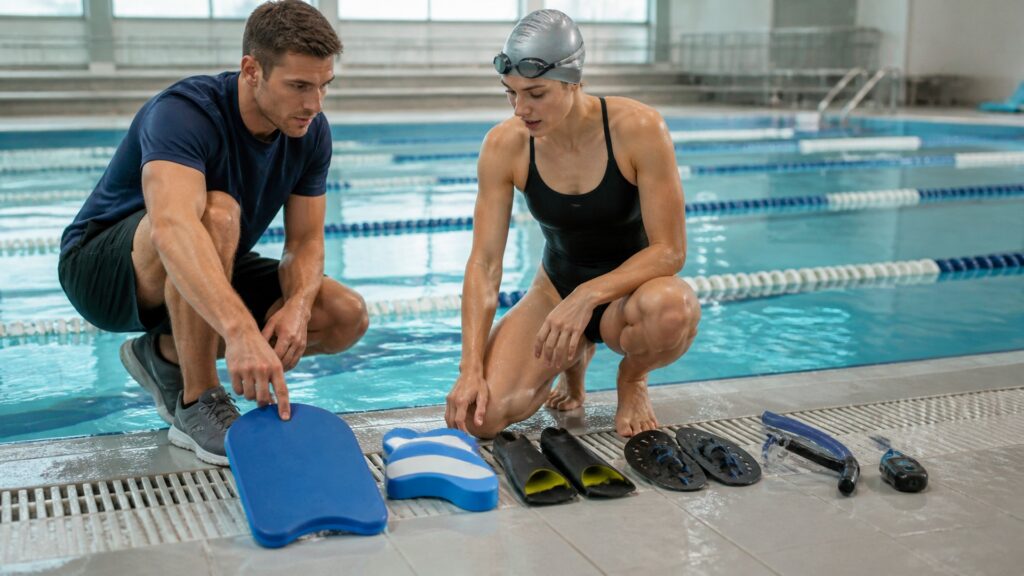
Swim training tools matter when buoyancy, propulsion, breathing control, resistance, and feedback are matched to a specific stroke skill.
Tip: Judge the equipment by the training job it changes, then compare features.
A pull buoy is foam placed between the legs to support lower-body position while the arms pull. The remaining concepts define the variables that change actual use.
A pull buoy is foam placed between the legs to support lower-body position while the arms pull.
A kickboard supports the upper body while the legs do focused kicking work.
Fins increase foot surface area and change propulsion from the kick.
Hand paddles increase the hand surface area during the pull.
A swim snorkel lets the swimmer breathe without turning the head.
A drag tool adds resistance through socks, parachutes, belts, or clothing.
Tip: A kickboard supports the upper body while the legs do focused kicking work.
Swimming is complex because breathing, balance, kick, catch, and rotation happen together. Tools isolate one element so the swimmer can feel it.
Training tools matter when they clarify one lesson.
Pull buoys and boards add flotation, which changes the body line and what muscles do the work.
Buoyancy changes the drill.
Fins and paddles make the feet or hands move more water. That gives feedback but also changes load.
More surface area changes both feedback and stress.
A swim snorkel lets the swimmer keep the head steadier while practicing catch, alignment, or body position.
Breathing isolation can make other mechanics visible.
A training tool is successful only if the swimmer can transfer the lesson back to regular stroke mechanics.
Swim tools matter when they teach, not when they replace swimming.
The useful answer follows the actual mechanism, setup, and training condition rather than a generic upgrade claim.
It explains what swim training tools changes in real training.
It gives readers practical comparison criteria without overstating outcomes.
It cannot guarantee performance, recovery, injury prevention, safety, or health outcomes.
Shoulder pain, stroke faults, and individualized swim programming need coaching or clinical context rather than more training tools.
Common shortcuts and misunderstandings can make the topic seem simpler than it is.
The useful choice depends on body size, skill, setup, environment, goal, and tolerance.
Extra features help only when they solve a specific movement, setup, or feedback problem.
Gear can support training decisions, but it cannot control technique, fatigue, progression, recovery, or risk.
A tool can feel good while still being poorly matched to the goal.
Complex lifts, stroke changes, pain, and symptoms need more context than a product page can provide.
Tip: For swim training tools, follow the mechanism before accepting broad gear claims.
Concise answers to common questions readers may have after the main explanation.
Start with the physical job: load support, resistance path, grip, stability, vision, buoyancy, propulsion, or stroke feedback.
No. It can support better training decisions, but it cannot guarantee performance, safety, recovery, or injury prevention.
Compare the mechanism, fit, setup, adjustment range, durability, and training context before brand claims.
Test the setup during ordinary training before using it for heavy attempts, races, long sessions, or technical work.
Qualified coaching or medical guidance matters for complex technique, pain, symptoms, injury concerns, or individualized programming.
Swim Training Tools matters when it changes a specific movement, setup, feedback, or progression problem.
The best decision matches mechanism, fit, training context, and evidence limits instead of treating equipment as a shortcut.
Use these related explainers to continue the Review Streets fitness decision path around swim training tools.
Start here for the category-wide swimming-equipment mechanics.
Use it when gear is being chosen to support better water mechanics.
Read it before treating paddles, fins, buoys, or boards as generic improvement tools.
Choose a retailer
Prices checked regularly. We may earn a commission at no cost to you.