
Rear Clearance
Open space behind the treadmill deck.
- It matters if the user steps or falls back.
- It is not storage space.
- It should be checked in the room.
Treadmill safety factors start with one fact: a powered belt keeps moving until the machine is told to slow or stop. That makes stop controls, belt edges, deck clearance, and the space behind the machine practical design issues.
The inspection path is simple: confirm the stop clip, look at belt tracking, check side rails and rear clearance, route the cord away from foot traffic, and respect the manufacturer's limits.
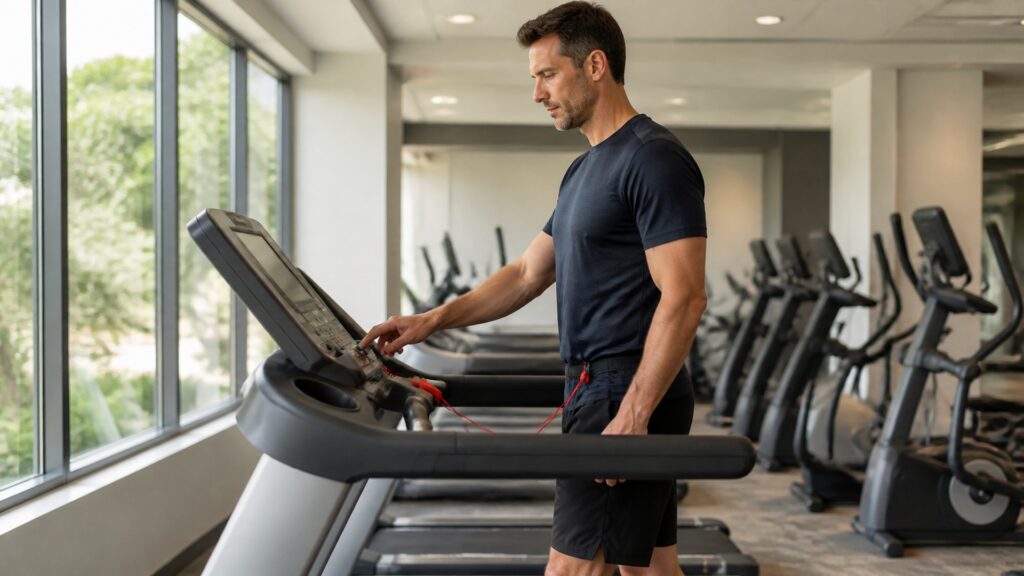
Safety factors here are observable treadmill checks: belt motion, stop behavior, clearance, and setup.
Tip: Trace a worst-case exit path before a normal workout path; the moving belt makes that sequence matter.
These definitions connect the main idea to the variables, limits, and practical signals readers need to compare options.
Open space behind the treadmill deck.
How centered the belt stays during motion.
The removable key or clip used to stop many treadmills.
The fixed rail beside the belt.
The front cover near the belt and motor.
The path from outlet to treadmill.
Tip: Each term should point to a visible control, surface, clearance, or manual limit.
The safety discussion starts with how the treadmill stops: emergency key, stop button, speed reduction, and the user's ability to step off.
Stopping behavior is the treadmill-specific safety center.
The belt should stay centered and move smoothly. Drift, slipping, rubbing, or edge confusion changes how predictable the surface feels.
The belt is the safety-relevant moving part.
A treadmill needs more than its footprint. Rear clearance, side access, cord routing, and folded-state locks affect everyday setup.
Room setup is part of the product safety check.
Incline motors and speed commands change the task while the belt is moving. Controls should make those transitions understandable.
The machine's changes should not surprise the user.
A safe-looking treadmill cannot decide whether walking or running is right for someone with pain, balance concerns, medication effects, or medical restrictions.
The article stays with observable equipment factors.
Product safety analysis is helpful when it names treadmill-specific checks before and during use.
It turns broad safety language into stop-clip, rail, belt, deck, cord, and clearance questions.
It explains why a powered belt needs different checks than stationary equipment.
It cannot clear someone medically for treadmill use.
It cannot replace the owner's manual or qualified advice for pain or balance concerns.
Common shortcuts and misunderstandings can make the topic seem simpler than it is.
It is only one control in a larger setup.
The moving belt makes the space behind the deck important.
Rails can help position, but they do not decide personal suitability.
Noise alone does not verify tracking, tension, or setup.
Tip: Treat strong claims as starting points for comparison, not final answers.
Concise answers to common questions readers may have after the main explanation.
Know the stop control and confirm clear space around the deck.
A drifting belt can make the surface less predictable.
No. It is mainly a boundary and support feature.
Yes. Incline changes deck angle and may change clearance or dismount feel.
No. It covers product-level factors only.
Treadmill safety factors matter because a powered belt, deck edges, stop controls, and room clearance all shape ordinary use.
The useful check is concrete and product-level, not a claim about individual medical suitability.
Use these Review Streets paths to connect the explainer to related categories, comparisons, and next decisions.
Use this for the treadmill mechanism behind this topic.
Browse treadmill options after clarifying the title-specific issue.
Use this for the bicycle-side mechanical baseline.
Choose a retailer
Prices checked regularly. We may earn a commission at no cost to you.