
Wheel Offset
The signed distance from the rim centerline to the hub-mounting face of the wheel.
- Positive offset moves the face outward
- It shifts the rim inward relative to the hub
- Width must be known to predict edges
Wheel offset is the distance between a wheel's mounting pad and its rim centerline. That dimension decides where the tire sits relative to the strut, control arms, brake hardware, fender, hub bearings, and steering axis. Changing wheel width without following offset can move both inner and outer edges farther than intuition suggests.
Fitment is not proved by a wheel that bolts on while parked. The assembly must clear at full steering lock and through suspension compression and droop, with the tire bulging under load and the brake hot. Offset also changes leverage at the hub and the scrub radius through which road forces steer the wheel. The correct value is therefore a vehicle-geometry decision, not a styling preference for flushness.
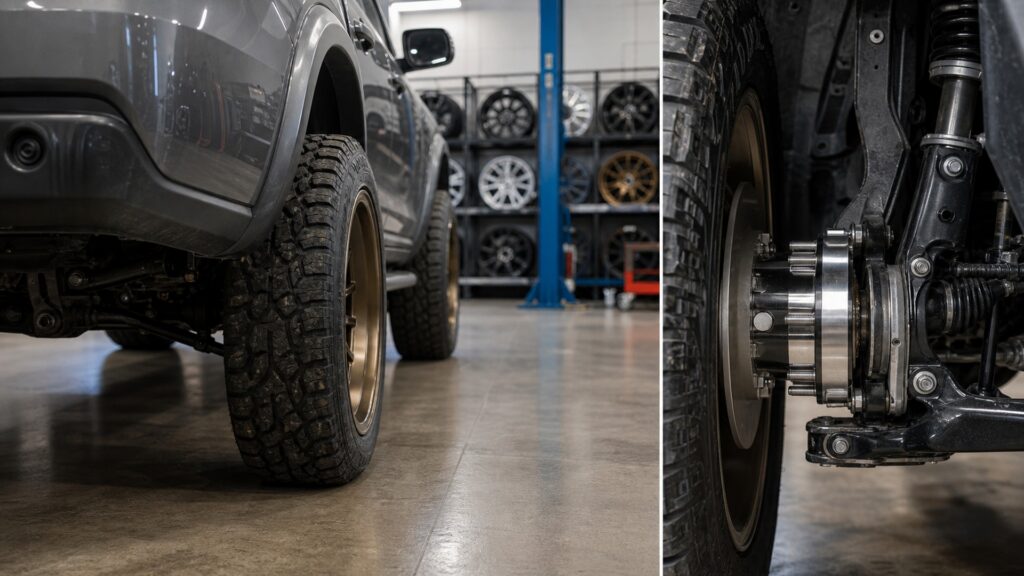
Offset becomes understandable when the mounting face, rim centerline, inner barrel, tire section, hub, steering axis, and body edge appear in one scaled picture.
Tip: Compare old and new width and offset together. A wider wheel with the same offset adds width on both sides; changing offset then shifts that entire package inward or outward.
These terms describe position, clearance, and steering leverage rather than cosmetic stance.
The signed distance from the rim centerline to the hub-mounting face of the wheel.
The machined wheel surface clamped against the vehicle hub or brake rotor hat.
The distance from the mounting surface to the wheel's inboard rim edge under a stated measurement convention.
The road-surface distance between the steering-axis intersection and the center of the tire contact area.
The bending leverage created when tire forces act at a distance from the hub-bearing support.
Space remaining around the rotating tire and wheel throughout steering, suspension travel, flex, heat, and load.
Tip: Every offset claim should identify wheel width, tire section, hub geometry, and the moving component or body surface that sets the clearance limit.
With positive offset, the mounting pad lies toward the street side of the rim centerline, placing more wheel inboard. Lowering that positive value generally moves the assembly outward. The exact edge change also includes half the difference in wheel width.
Offset alone cannot locate a wheel until width is in the equation.
More inboard position can approach springs, dampers, knuckles, control arms, steering links, or chassis. Barrel shape and spoke contour determine brake clearance independently of advertised diameter. Adhesive weights and flex need room too.
A few millimeters of static air is not a dynamic-clearance plan.
Moving outward may clear the strut but brings the loaded tire toward fender lips, liners, bumper tabs, and bodywork during compression and steering. It can also throw debris beyond required coverage and increase the bearing moment.
Flush at ride height can mean contact at the first diagonal driveway.
Offset moves the contact patch relative to the steering axis. The resulting scrub radius affects how braking differences, potholes, torque, and road crown feed the steering. Steering effort and return may change even when alignment angles remain numerically correct.
An alignment rack cannot move the wheel mounting face back to its designed relationship.
A spacer effectively reduces positive offset by its thickness. It also changes pilot engagement, fastener engagement, clamp interfaces, and potential runout. Hub-centric design, hardware strength, torque procedure, inspection, and legal acceptance must all be resolved.
A spacer solves one clearance dimension by creating several new engineering questions.
The wheel must fit the static hub, clear every moving component, and preserve acceptable steering and bearing leverage under road force.
Calculated inner and outer positions agree with measured templates, the exact tire clears through lock and travel, and brakes, weights, hub pilot, fasteners, and load rating all fit.
Any intentional scrub-radius or bearing-leverage change is understood and acceptable for the suspension, steering, braking, body coverage, and duty rather than discovered after installation.
Lug engagement and a stationary gap do not prove barrel-to-caliper clearance, tire flex room, full-compression body clearance, acceptable bearing load, or stable split-friction braking.
A more flush appearance cannot justify rubbing, altered steering behavior, insufficient hub centering, stacked spacers, wrong fastener seats, reduced load capability, or unverified legal coverage.
Offset myths reduce a three-dimensional moving fitment to one number or one parking-lot photograph.
Diameter does not establish width, barrel contour, spoke clearance, tire section, or hub position. Two wheels with identical diameter and offset can still differ at the brakes, suspension, body, fastener seat, and load rating.
Moving the assembly outward changes fender and liner clearance, bearing leverage, scrub radius, steering feedback, spray coverage, and sometimes fastener geometry. Appearance is merely the most visible outcome of a mechanical position change.
Alignment adjusts specified suspension angles, not the mounting face or steering-axis intersection with the road. Toe correction may hide some symptoms while the changed scrub radius, bearing moment, and physical clearances remain.
Tightness alone does not prove pilot engagement, fastener length, clamp load, material strength, flatness, runout, fatigue, or legal acceptance. Spacer systems require exact application engineering and disciplined installation, not generic reassurance.
Tip: Keep width, exact tire, brake shape, travel, steering axis, hub attachment, and vehicle load in the calculation until the assembly has passed dynamically.
These answers cover measurement, width changes, brake templates, rubbing diagnosis, spacers, and the limits of fitment calculators.
Find the wheel's true centerline from its measured overall width, then compare it with the mounting-pad position using a consistent sign convention. Marked ET values are preferable, but damage, machining, or uncertain provenance may require professional measurement.
Half the added width moves toward each side when offset stays constant. A simultaneous offset change shifts the whole rim, so calculate new inner and outer positions separately, then add the exact tire's mounted section width and bulge.
Calipers occupy a three-dimensional envelope. The barrel may clear its outer radius while a spoke contacts the caliper face, bridge, or corner. Use the brake maker's profile template and include wheel weights and manufacturing tolerances.
Possibly, but only after identifying the contact point and preserving load, speed, rim-width, diameter, TPMS, and vehicle requirements. A smaller section cannot correct wrong brake contour, hub attachment, steering leverage, or wheel load rating.
They are useful for nominal inner and outer position changes, but cannot know actual tire section, body tolerances, suspension travel, brake shape, steering geometry, wheel contour, fastener seating, or loaded flex. Physical validation remains necessary.
Wheel offset matters because it locates the tire and rim relative to moving suspension, brakes, bodywork, hub bearings, and the steering axis that converts road force into feedback.
Calculate width and offset together, validate the exact assembly through lock and travel, and preserve hub, fastener, load, brake, bearing, and steering requirements instead of approving a fitment because it bolts on.
The related explainers connect mounting-face position to wheel manufacture, tire load, and suspension response so fitment remains a complete mechanical decision.
Compare manufacturing routes only after the candidate wheel also proves offset, width, brake contour, load, fastener seat, and hub fit.
See how steering leverage, unsprung mass, spring and damper behavior, and contact-patch control interact after a fitment change.
Keep tire, wheel, axle, and vehicle load limits intact when size and position change.
Choose a retailer
Prices checked regularly. We may earn a commission at no cost to you.