
Master Cylinder
A pedal-actuated hydraulic device that converts mechanical input into pressure in separate service-brake circuits.
- Reservoir compartments supply fluid
- Piston seals contain pressure
- Circuit splits preserve partial function
A light-vehicle brake system turns pedal input into force at each wheel. Power assist reduces driver effort, the master cylinder creates hydraulic pressure in split circuits, hoses carry that pressure through suspension movement, and caliper pistons clamp pads against rotating discs.
Friction converts vehicle motion into heat that rotors, pads, calipers, tires, and airflow must manage. ABS can reduce and restore pressure when sensors indicate excessive wheel slip; regenerative braking may share deceleration in electrified vehicles. A mechanically retained parking brake handles stationary holding. Stopping performance therefore depends on the complete command, pressure, friction, heat, modulation, tire, and road chain.
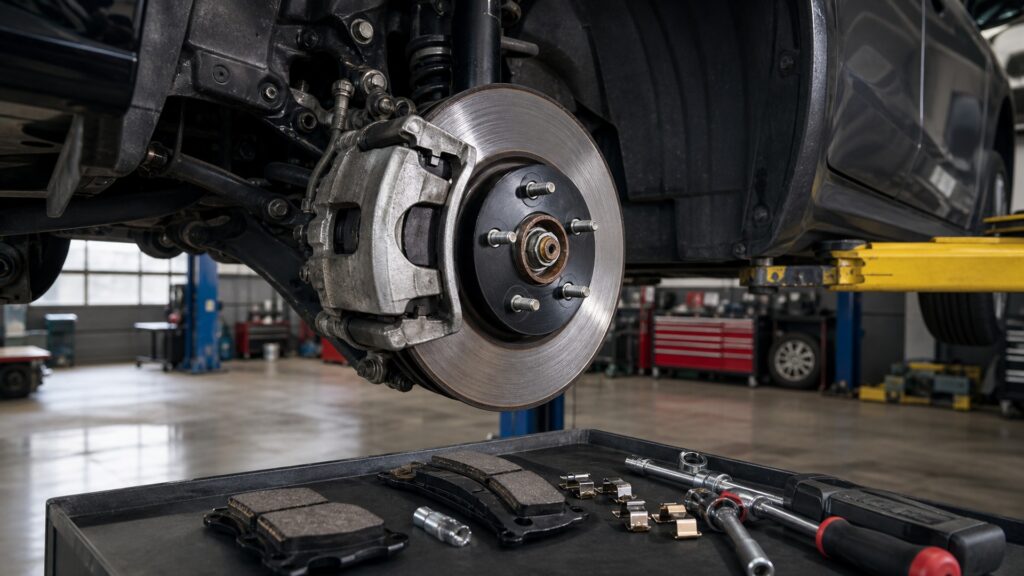
A brake component is understandable only by its place in the command path, hydraulic redundancy, friction pair, thermal cycle, wheel-slip control, and tire contact patch.
Tip: A firm pedal does not prove adequate friction, and new pads do not prove sound hydraulics. Diagnose the complete path and measure against vehicle-specific service limits before returning a safety-critical system to use.
These terms define the command, pressure, friction, heat, and control stages of a modern service brake.
A pedal-actuated hydraulic device that converts mechanical input into pressure in separate service-brake circuits.
Vacuum, hydraulic, or electric assistance that reduces the pedal force needed to command braking.
A wheel-end assembly whose pistons push disc pads against both sides of a rotating rotor.
The pad-and-rotor or shoe-and-drum surfaces that create braking torque through controlled friction.
Valves and a pump that adjust circuit pressure when the controller detects excessive wheel slip.
A mechanically retained friction system intended to hold a stationary vehicle independently of ordinary service-brake control.
Tip: Brake work requires exact service information, clean compatible fluid and friction surfaces, correct torque, and final functional verification by qualified procedures.
The pedal lever magnifies foot force; assist adds energy; master-cylinder pistons pressurize fluid. Free play, pushrod geometry, seals, assist supply, reservoir level, and warning circuits affect command feel and available reserve.
Pedal feel is diagnostic evidence, not a substitute for stopping tests.
Steel lines carry pressure along the body while each brake hose flexes with steering and suspension. The split hydraulic circuit allows partial braking after some failures; leaks, swelling, internal restriction, corrosion, or trapped gas change force and release.
Hydraulic force arrives only when the closed fluid path remains sound.
Pressure acting over piston area creates force; caliper geometry clamps the friction pair; friction at an effective radius creates brake torque. Rotor thickness, pad area, material, runout, slides, and bracket alignment shape the result.
A visually similar part can change leverage, clearance, or thermal capacity.
Brakes absorb kinetic energy rapidly. Rotors or drums store and reject heat; pads must retain friction; fluid must resist boiling. Excess temperature can cause fade, distortion, glazing, vapor, seal damage, and accelerated wear.
A brake sized for one stop may not survive repeated energy without cooling.
Wheel-speed sensors inform ABS when braking demand exceeds available tire friction. The modulator cycles pressure to preserve control. Separately, mechanical parking retention must hold without depending on hydraulic pressure or regeneration.
Electronic control depends on healthy base brakes and usable tire-road friction.
The system works when command, assistance, split pressure, friction, thermal capacity, slip control, tires, and parking retention each perform their distinct job.
Predictable pedal response creates balanced wheel-end force, friction components remain within limits, heat recovers between demands, ABS controls slip, and warning functions reveal specified failures.
Correct fitment, clean fluid and friction surfaces, free caliper movement, sound hoses and lines, suitable tires, and verified parking retention keep redundancy and control available.
Fluid loss, sinking or suddenly hard pedal, pulling, grinding, smoke, repeated fade, overheated wheels, warning lamps, damaged hoses, missing friction material, or inadequate parking hold can signal unsafe braking.
No premium pad, drilled rotor, fluid flush, ABS reset, or regenerative setting compensates for a leak, wrong fitment, seized mechanism, contaminated friction pair, unsuitable tire, or incorrect service procedure.
Brake myths isolate a visible wear part and ignore pressure integrity, thermal energy, tire friction, or electronic modulation.
Pads create friction against rotors, but pedal leverage, assist, master-cylinder pressure, lines, hoses, calipers, rotor condition, ABS, tires, load, temperature, and road surface all determine the final delivered stopping response.
ABS regulates wheel slip to preserve steering control and stability under many conditions. Distance still depends on tires, surface, speed, load, base brakes, and terrain; loose gravel or deep snow can behave differently.
Pedal firmness can coexist with thin pads, cracked friction material, poor tires, seized caliper slides, heat fade, contaminated rotors, weak rear contribution, or disabled ABS. Complete inspection and performance verification remain necessary.
Regeneration recovers some kinetic energy through the traction motor, but friction brakes supply stopping under low battery acceptance, low speed, emergency demand, ABS events, faults, and parking requirements. Blending needs correct calibration.
Tip: Trace the symptom through the operating stage that can physically create it before choosing parts or authorizing continued driving.
These answers cover hydraulic pressure, pad and rotor replacement, bleeding, ABS behavior, heat fade, and safety after service.
A split service system is designed so certain failures in one subsystem do not disable every service brake. Remaining performance is reduced, so any warning, leak, or changed pedal requires immediate safe stopping and repair.
Follow measured thickness, runout, surface condition, heat damage, manufacturer limits, friction compatibility, and warranty procedure. A reusable rotor must still provide adequate material and finish; visual appearance alone is insufficient.
Possible causes include air, fluid leakage, hose expansion, master-cylinder bypass, incorrect bleeding, excessive mechanical clearance, or power-unit behavior. Because several are dangerous, stop use and diagnose by the exact service procedure.
Repeated energy input can overheat friction material, rotors, drums, fluid, seals, and nearby components. Reduced friction or vapor lowers response. Use approved gearing and loading practices, then inspect any overheating event.
Confirm correct parts, clean mating surfaces, hardware, lubrication points, hose routing, fluid level, leak-free pressure, pedal reserve, wheel torque, parking function, warning lamps, sensor operation, bedding procedure, and controlled stopping performance.
Brake components work as a chain: pedal and assist create a command, split hydraulics transmit pressure, wheel ends convert it into friction torque, thermal mass absorbs energy, ABS controls slip, and tires create road force.
Safety depends on every stage plus correct fitment, fluid, fastening, calibration, and verification. Treat new friction parts as one repair step, not proof that hydraulic redundancy, heat capacity, electronic control, and parking retention are sound.
Related explainers connect the brake mechanism to replacement-part workflow, fitment precision, and the broader reason safety-critical brake hardware deserves system-level inspection.
See how rotor geometry, caliper mounting, pad shape, hoses, sensors, and option codes preserve the mechanism described here.
Understand why brake condition, redundancy, heat, and tire interaction matter beyond one replacement event.
Return to diagnosis, application lookup, installation, and functional verification for replacement parts.
Choose a retailer
Prices checked regularly. We may earn a commission at no cost to you.