
Hydraulic Pressure
Fluid pressure carrying pedal or actuator force through the brake circuit.
- The master cylinder creates pressure
- Lines and hoses transmit it
- Air adds compressibility and travel
Brake components matter because stopping is an energy-conversion and force-control event, not simply a pad pressing a disc. Pedal input becomes hydraulic or electromechanical command, clamps friction surfaces, turns vehicle kinetic energy into heat, and asks the tires to transmit opposing force at the road. Every handoff must remain predictable.
A high-friction pad cannot compensate for air in the hydraulic circuit, a seized caliper, contaminated surfaces, unsuitable tires, or overheated fluid. Likewise, a large rotor does not shorten every stop if tire grip or ABS control is the limit. Good brake work matches components by axle and duty, preserves clean interfaces, follows torque and bleeding procedures, then verifies balance, pedal feel, bedding, warning systems, and repeated-stop behavior.
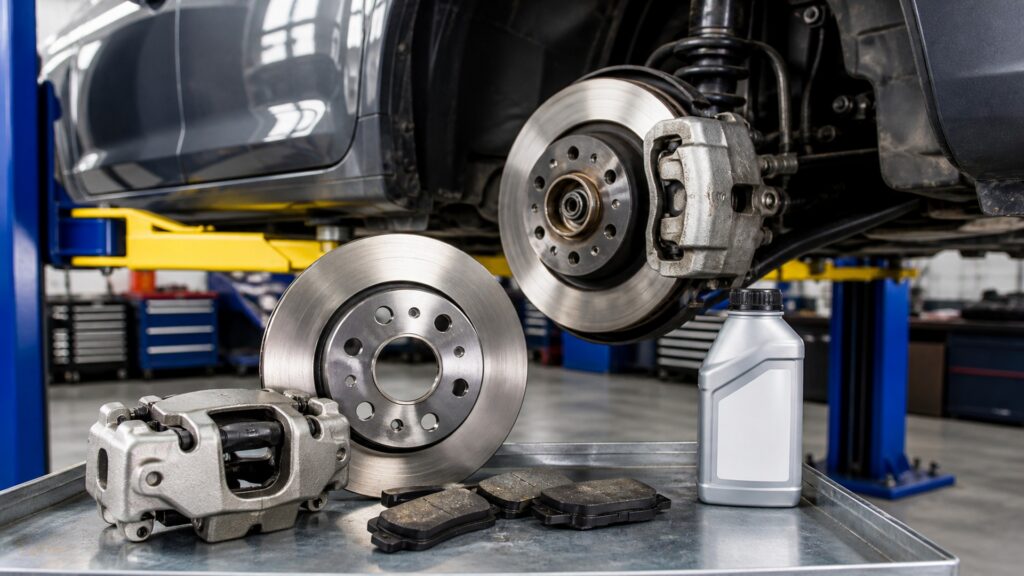
Braking quality comes from pressure generation, controlled clamping, stable friction, thermal capacity, electronic modulation, and tire grip working as one chain.
Tip: Diagnose a brake complaint by separating pedal hydraulics, wheel-end friction, temperature, control intervention, and tire grip; replacing pads addresses only one link.
These concepts describe the physical and control handoffs behind a stable stop.
Fluid pressure carrying pedal or actuator force through the brake circuit.
The pad-and-rotor or shoe-and-drum surfaces producing braking torque.
A component's capacity to absorb heat for a given temperature rise.
Reduced braking response as temperature changes friction, fluid, or component behavior.
Rapid pressure adjustment intended to manage excessive wheel slip during braking.
Distribution of braking effort among axles or wheels.
Tip: Keep braking torque and road force separate: the wheel hardware can generate torque, while the tire must transmit it without exceeding available grip.
Pedal leverage and booster assistance act on the master cylinder, creating pressure that travels through clean fluid, lines, hoses, valves, and caliper or wheel-cylinder pistons. Leaks, expansion, trapped air, and seized parts change the relationship.
A firm, proportionate pressure path is the foundation for every friction choice downstream.
Braking torque depends on clamp force, effective radius, and friction behavior. Surface condition, material transfer, runout, thickness variation, glazing, contamination, and bedding can create noise, pulsation, imbalance, or weak response.
The mating surfaces form the working component; neither should be judged alone.
Vehicle speed and mass create kinetic energy that the brake system must convert and reject. Descents, towing, track use, and repeated high-speed stops add heat faster than ordinary commuting, making material stability, rotor mass, airflow, and fluid condition important.
A brake that completes one cold stop may still be unsuitable for the repeated thermal load.
Wheel-speed sensors and hydraulic modulators can reduce pressure when a tire approaches excessive slip. Stability control may brake individual wheels to influence yaw. These systems manage force distribution but cannot create friction beyond the tire-road interface.
Electronic modulation protects controllability within the physical grip available.
After assembly, the system needs correct pedal feel, leak-free pressure, free wheel rotation, proper fluid level, restored warnings, controlled bedding, and a safe road test that checks straight stops and repeated response without overheating.
Brake service ends with balanced function under relevant conditions, not when the wheels are reinstalled.
Brake hardware can create substantial wheel torque, but hydraulics, temperature, controls, tires, and installation decide whether it remains usable.
Matched friction materials, sound hydraulics, adequate heat capacity, and accurate control signals produce repeatable, balanced deceleration with predictable pedal response.
Duty-appropriate components can resist fade and reduce service disruption when towing, descending, or repeated stops create higher thermal demand.
No rotor or pad can overcome unsuitable tires, excessive speed, overloaded conditions, failed hydraulics, contaminated interfaces, or incorrect installation.
ABS can modulate pressure near the grip limit, but it cannot shorten every stop or restore friction that the road and tires do not provide.
Brake myths often assign the entire stop to one visible component or one performance label.
More friction can change pedal effort or temperature behavior, but a single stop may already be tire- or ABS-limited. Pad choice can also change noise, dust, rotor wear, cold response, and balance.
Surface features can serve specific gas, debris, cooling, or pad-conditioning goals, yet geometry, material, mass, cracking resistance, pad compatibility, and duty matter. Styling alone does not establish greater stopping capacity.
ABS attempts to manage excessive wheel slip through pressure modulation, but faults, surfaces, tires, speed, and driver inputs affect outcomes. A pulsing pedal can be normal activation rather than mechanical failure.
Fluid can absorb moisture, experience heat, and accumulate contamination. Condition and replacement guidance are vehicle-specific; boiling resistance, corrosion protection, and compatible specification matter more than fluid appearance alone in service.
Tip: Trace the command, friction, heat, control, and contact-patch chain before deciding what actually limits the vehicle.
These answers address axle replacement, rotor machining, pedal pulsation, regenerative braking, and the signs that require immediate professional inspection.
Usually yes, because left-right friction and wear should remain balanced. Inspect calipers, slides, hoses, rotors, and hardware to find why wear differed; follow the vehicle service procedure for exact replacement scope.
Only when its material, thickness, runout, surface condition, and manufacturer guidance allow machining while remaining above the service limit. Heat damage, cracks, severe corrosion, or insufficient post-machining thickness require another solution.
Rotor thickness variation, runout, hub contamination, uneven wheel torque, bearing play, friction deposits, or ABS activation can create pulsation. Measurement should identify the frequency and source before a rotor is automatically condemned.
Electrified vehicles may use the traction motor for part of deceleration, reducing friction use. Friction brakes still provide high demand, low speed, stability action, backup, and stops when battery or traction conditions limit regeneration.
A sinking or very soft pedal, fluid leak, grinding, smoke, severe pull, overheating wheel, reduced response, or brake warning needs prompt assessment. Limit driving and follow the vehicle maker's safety guidance.
Brake components matter because they must translate a command into balanced pressure, stable friction, manageable heat, electronic control, and tire force repeatedly.
Match the complete friction and hydraulic system to vehicle duty, install it cleanly to specification, and prove pedal, balance, temperature, and warning behavior before relying on the repair.
Use the complete parts workflow, whole-vehicle force model, and reliability framework to understand fitment, tire limits, and the consequences of repeat brake faults.
Apply diagnosis, exact application, procedure, torque, bleeding, calibration, and verification to safety-critical brake parts.
Trace how braking torque becomes opposing force through the tire contact patches and chassis controls.
Evaluate how brake failures, warning signs, parts access, and repeat repairs affect practical ownership reliability.
Choose a retailer
Prices checked regularly. We may earn a commission at no cost to you.